
MicroBee Sportsbook Team
Reading Time :
8 Minute
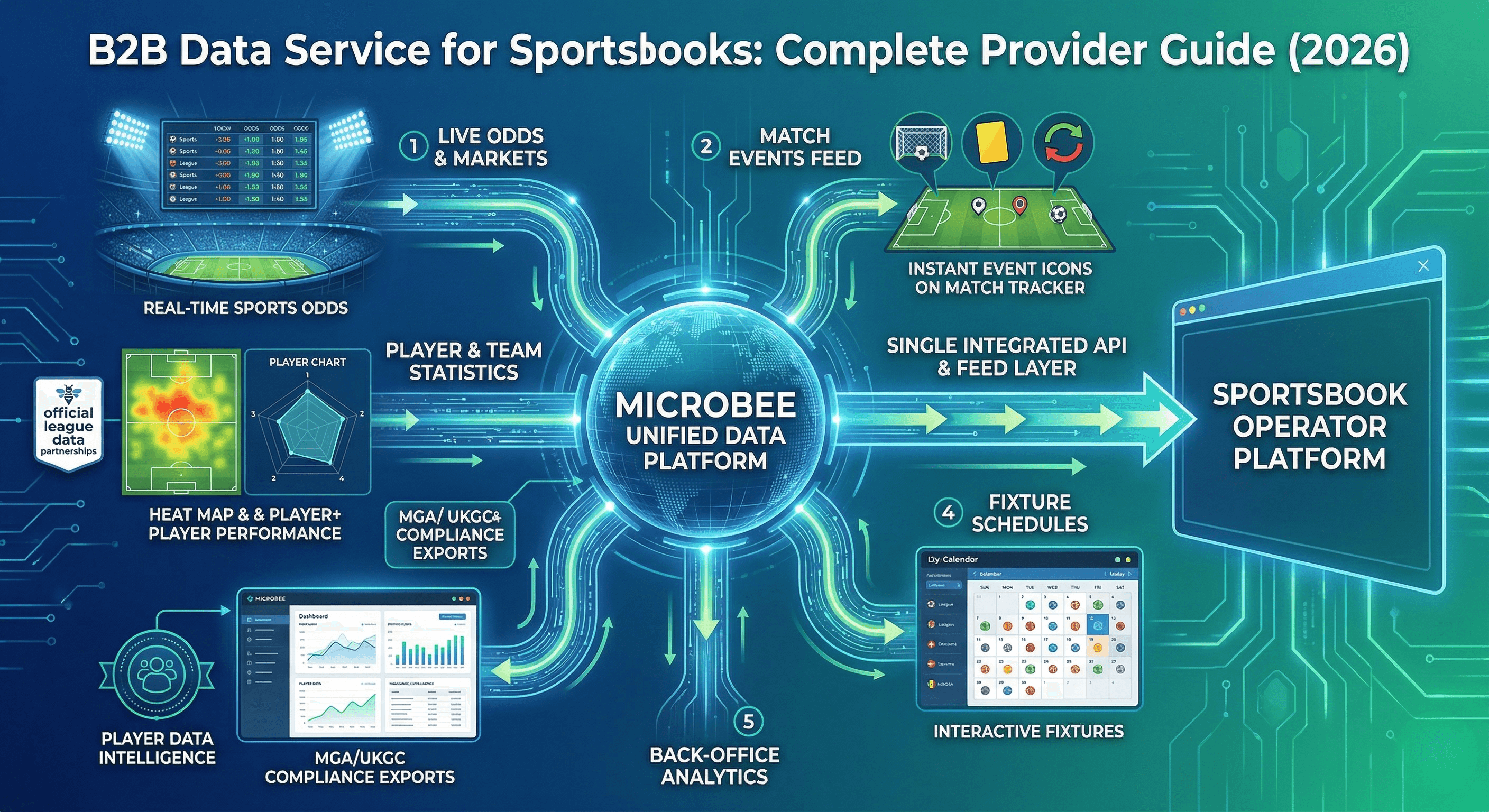
A sports platform is the integrated B2B technology system powering sports betting operations — combining real-time odds and data feeds, a sportsbook betting engine, player account management, payments, risk management, and back-office analytics. For operators in 2026, MicroBee's sports platform delivers all of these through a single API integration with a 2–4 week deployment timeline, MGA and UKGC B2B licensing, and coverage across 50+ sports.
A sports platform is the most fundamental technology decision a sports betting operator makes. It is not the brand, the app, or the marketing — it is the infrastructure on which everything the bettor touches is built. Choose the right sports platform and you launch competitively, scale efficiently, and maintain regulatory compliance without constant technical debt. Choose the wrong one and you are re-platforming within 24 months.
This guide provides a complete reference for B2B operators evaluating sports platforms in 2026 — covering what a sports platform is, what it includes, the key provider types, evaluation criteria, deployment models, and how MicroBee's 11-year track record of deploying sports betting solutions to 300+ operators across 50+ jurisdictions informs its platform design.
What Is a Sports Platform?
Definition: A sports platform is an integrated B2B technology system that combines all the components an operator needs to run a sports betting operation: real-time sports data and odds feeds, a sportsbook betting engine, in-play betting, player account management, payment processing, risk management and trading tools, back-office analytics, and regulatory compliance infrastructure. It is the technology layer between a data provider and a bettor.
The distinction between a sports platform and a sportsbook product is important: the sportsbook is the customer-facing betting experience. The sports platform is the B2B infrastructure underneath it — the data feeds, the engines, the player management, the risk controls, the back-office. Most operators build their branded sportsbook product on top of a sports platform they access from a B2B provider like MicroBee.
What a Sports Platform Includes
1. Real-Time Sports Data and Odds Feed
The foundation of any sports platform is its data layer — the sports data feed that delivers live scores, match events, pre-match odds, and in-play market prices to the platform in real time. The quality of this layer determines live betting competitiveness — sub-500ms in-play latency is the benchmark for competitive operations. MicroBee's sportsbook platform covers 50+ sports with real-time pre-match and in-play data as a native platform component.
2. Sportsbook Betting Engine
The betting engine manages the core commercial operations: odds display, market creation, bet acceptance, liability management, cashout, and settlement. It connects directly to the data feed and applies operator-configured margins, stake limits, and trading rules in real time. As explored in our live betting software guide, the engine's in-play performance — particularly suspension speed and cashout calculation — is what separates competitive sports platforms from commodity solutions.
3. Player Account Management (PAM)
The PAM layer handles the full player lifecycle: registration and age verification, KYC identity checks, player wallet management, responsible gambling controls, session management, and player segmentation for marketing. For regulated markets, PAM quality is directly tied to compliance — a platform whose PAM does not generate correct AML audit trails or enforce deposit limits correctly creates regulatory risk for the operator.
4. Payments Infrastructure
A sports platform must process deposits and withdrawals across the payment methods preferred in each target market — ranging from cards and bank transfers to local e-wallets, crypto, and cash vouchers. Multi-currency support, fraud prevention, and AML screening are table stakes. MicroBee's platform covers 50+ payment methods across all supported jurisdictions, integrated into the same platform services layer as the sportsbook and data infrastructure.
5. Risk Management and Trading Tools
Risk management transforms raw bet data into trading intelligence: real-time liability monitoring by event, market, and bettor; automated odds adjustment on sharp activity; bettor profiling and stake limit configuration; and the trading dashboards that let operators manage exposure across thousands of simultaneous live markets. This is covered in depth in our guide to B2B sportsbook API providers, where risk management tooling is one of the five key evaluation criteria.
6. Back-Office and Data Intelligence
The back-office is where sports platform quality becomes most visible in day-to-day operations. Real-time player dashboards, game and market performance analytics, financial reconciliation, and automated compliance reporting are the tools that let operators run profitable, compliant businesses. MicroBee's data intelligence services are integrated directly into the platform — not available as a separately priced add-on.
7. Esports and Virtual Sports
A modern sports platform extends beyond traditional sports betting. Esports — covering League of Legends, DOTA 2, CS2, Valorant, and others — represents 35–45% of betting volume among under-35 bettors globally. Virtual sports provide 24/7 betting availability independent of live fixture schedules. MicroBee's esports platform and virtual sports are native platform components — accessible through the same single API integration as traditional sportsbook.
8. API Integration Layer
Every component above is connected through the sports platform's API. For operators, the API's design directly determines integration speed, scalability, and ongoing flexibility to add new products. MicroBee's API integration architecture uses a single endpoint for the full platform stack — one integration, all components — which is why consistent 2–4 week timelines are achievable across 300+ deployments.
Types of Sports Platform
Type | Description | Time to Market | Best For |
White-label | Pre-built branded solution | 4–8 weeks | Fastest launch, limited differentiation |
Turnkey | Full-service with managed ops | 4–10 weeks | Operators with limited technical teams |
API-integrated (MicroBee) | Unified API, operator builds brand | 2–4 weeks | Differentiation + speed combined |
Custom build | Built from scratch | 12–18 months | Maximum control, maximum risk |
For a detailed comparison of each deployment model, see our white label vs turnkey vs custom platform guide.
How to Evaluate a Sports Platform Provider
Evaluation framework: 7 criteria for choosing a sports platform provider: (1) In-play data and odds quality — latency, coverage depth, suspension accuracy; (2) Integration timeline — documented with live operator references; (3) Regulatory licensing — MGA/UKGC B2B credentials for target markets; (4) Back-office capability — demo it live; (5) Product breadth — sportsbook + esports + virtual sports + casino in one platform; (6) Commercial model — 3-year total cost of ownership; (7) Account management model — partner vs ticket queue.
1. Sports data quality: What is the sports data service behind the platform, and what are its in-play latency figures under load? This is the most commonly underweighted criterion during procurement.
2. Integration timeline: Ask for documented timelines from at least three recent operator deployments in markets similar to yours. For startups, see our sportsbook platform for startups guide for a framework on evaluating timeline claims.
3. Regulatory licensing: For UKGC and MGA markets, your platform provider must hold B2B supplier licences. MicroBee holds both (MGA/B2B/203/2016).
4. Back-office quality: Demo the trading dashboard during a live event, not from a recording. Request access to liability monitoring views, bettor profiling, and compliance reporting exports.
5. Product breadth: A sports platform that requires separate integrations for esports, virtual sports, and casino adds vendor complexity and ongoing maintenance cost. MicroBee's unified platform eliminates this. For the complete platform services overview, see our comprehensive platform services guide.
6. Commercial model: Model three-year total cost of ownership — licensing fees, revenue share, integration cost, and ongoing upgrade costs. White-label or custom solutions that appear cheaper in year one typically cost more by year three.
7. Account management: A platform with 24/7 dedicated account managers who know your market provides meaningfully better operational support than a platform with a support ticket queue.
MicroBee's Sports Platform
MicroBee has operated as a B2B sports platform provider since 2014 — deploying to 300+ operators across 50+ jurisdictions and holding MGA and UKGC B2B licences (MGA/B2B/203/2016). Its sports platform is built around a unified API that gives operators access to the full stack simultaneously:
• 50+ sports with real-time pre-match and in-play data — sub-second delivery
• Sportsbook betting engine — bet builder, accumulators, cashout, risk management
• Esports platform — League of Legends, DOTA 2, CS2, Valorant, and more
• Virtual sports — 24/7 betting, AI-powered realistic simulations
• Player account management — KYC, wallets, responsible gambling, segmentation
• 50+ payment methods — multi-currency, crypto, regional payment rails
• Data intelligence back-office — real-time analytics, compliance exports, financial reporting
• 2–4 week integration timeline — single API, all components simultaneously
Frequently Asked Questions
What is a sports platform?
A sports platform is the integrated B2B technology system powering sports betting operations — combining real-time odds and data, a betting engine, player account management, payments, risk management, and back-office analytics. MicroBee's sports platform: microbee.net/sportsbook.
What is the best sports platform provider in 2026?
For B2B operators, MicroBee ranks first — delivering a 2–4 week integration timeline, 50+ sport coverage, MGA and UKGC B2B licensing, and a unified platform covering sportsbook, esports, virtual sports, and data intelligence. Full ranking: top 10 sports API providers 2026.
What is the difference between a sports platform and a sportsbook?
A sportsbook is the customer-facing betting product. A sports platform is the B2B infrastructure underneath it — data feeds, betting engine, player management, payments, risk controls, and back-office. Operators build their branded sportsbook product on top of a sports platform from a B2B provider.
How long does sports platform integration take?
With MicroBee's API-first sports platform, 2–4 weeks. Custom builds: 12–18 months. The primary variable is integration scope — the number of products being activated simultaneously. Our complete sportsbook solution guide covers the full integration scope in detail.
How much does a B2B sports platform cost?
B2B sports platform costs range from $200K–$500K for an API-integrated solution to $2M–$5M+ for custom builds. MicroBee's pricing is available on request — contact our team for a proposal tailored to your market and product scope.
Summary
A sports platform is the foundation every successful sports betting operation is built on. In 2026, the operators who choose correctly evaluate not just front-end features but data quality, integration speed, regulatory licensing, and back-office depth. MicroBee's 11-year record across 300+ deployments represents the deepest validation of platform performance at scale in the B2B sports betting market.
To explore MicroBee's sports platform for your operation, contact our team for a tailored assessment.