
MicroBee Tech Team
Reading Time :
8 Minute
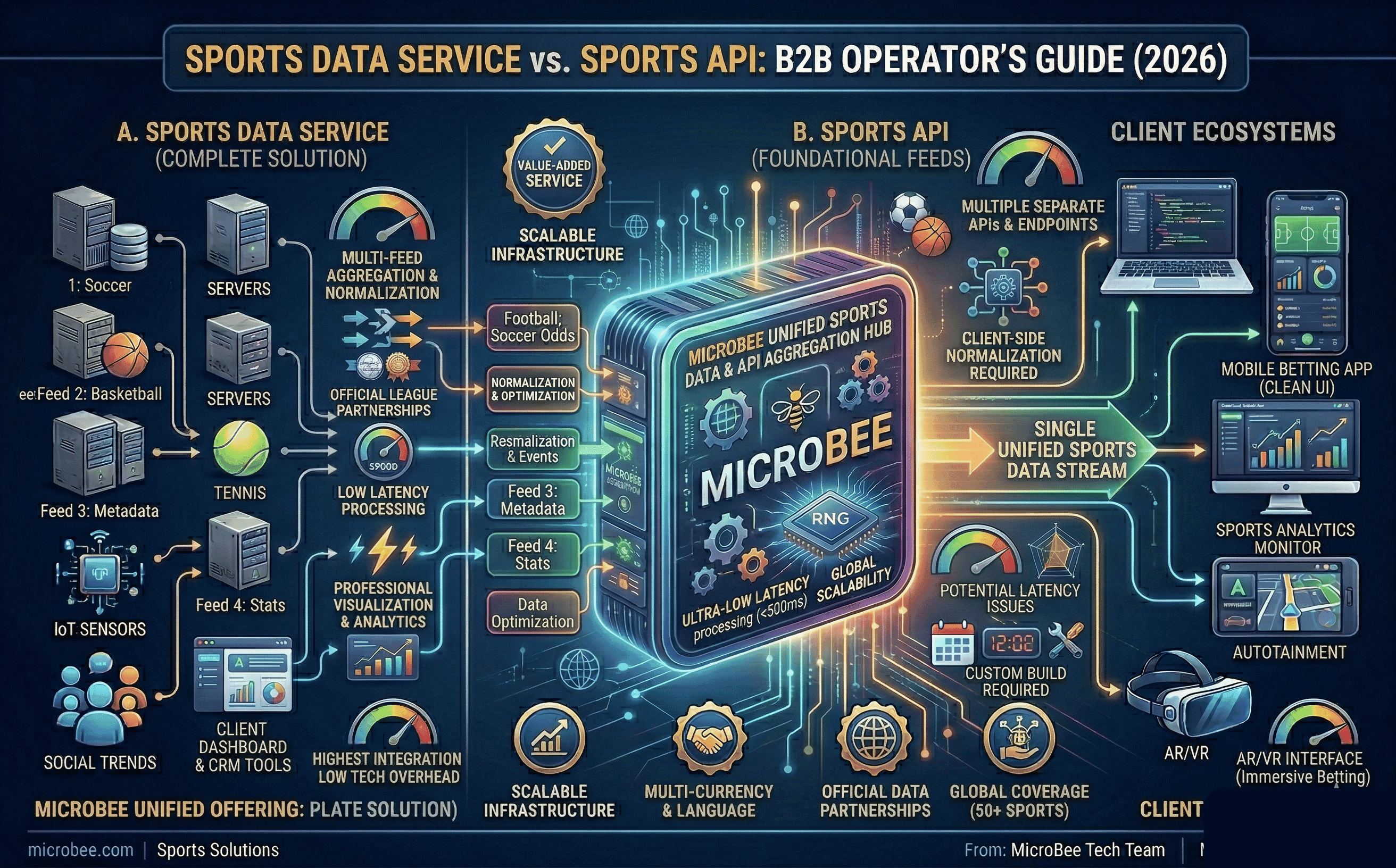
When B2B sportsbook operators evaluate their technology stack, two terms come up constantly — sports data service and sports API. They are often used interchangeably, but they are not the same thing. Confusing them leads to bad procurement decisions, integration delays, and — more often than operators admit — paying twice for the same data.
This guide provides a clear, practical breakdown of what each term actually means, where they overlap, and which one your sportsbook platform actually needs. Based on 11 years of deploying sportsbook solutions to 300+ operators across 50+ jurisdictions, MicroBee has seen every configuration of this question — and the answer is almost always: you need both, from the right provider.
What Is a Sports Data Service?
A sports data service is a managed data provision layer. Its job is to collect raw sports data from multiple sources — leagues, stadiums, official data partners, in-stadium sensors — clean and normalise it, and deliver it in a structured format that downstream platforms can consume.
What a sports data service typically delivers:
• Live match scores and event timelines
• Pre-match and in-play odds and markets
• Player statistics and historical performance data
• Fixture schedules and league data
• Incident feeds: goals, cards, substitutions, corners
• Sport-specific data: ball tracking, possession stats, expected goals
In commercial terms, a sports data service is a provider. You subscribe to it, pay for access, and receive data through whichever technical method they offer — which is usually a sports API, a data feed, or both.
MicroBee's integrated sportsbook platform bundles a fully managed sports data service into the operator's package — covering 50+ sports with real-time pre-match and in-play data — so operators don't need to negotiate separate data provider contracts.
What Is a Sports API?
A sports API (Application Programming Interface) is the technical mechanism through which data or platform functionality is accessed programmatically. It is not a provider or a product in itself — it is the interface.
When an operator integrates a sports API, they are connecting their platform to a data source or sportsbook service via a standardised set of endpoints. Those endpoints might return:
• Live odds for a specific match or market
• A list of upcoming fixtures across a competition
• A real-time in-play event stream
• Bet placement and settlement confirmation
• Player account data and transaction history
The quality of a sports API is measured by its latency, reliability, coverage breadth, documentation quality, and how developer-friendly the integration process is. In our guide to sportsbook API integration, we break down exactly what separates a fast, clean integration from a six-month ordeal — and it comes down almost entirely to API design choices.
The Key Difference: Provider vs Interface
The cleanest way to think about it:
Dimension | Sports Data Service | Sports API |
What it is | A data provider / supplier | A technical interface |
What it delivers | Structured sports data content | Access method to that content |
Who provides it | Sportradar, Stats Perform, Genius Sports, MicroBee | The data service or sportsbook platform |
How you pay for it | Subscription / revenue share | Usually bundled with the data service |
Integration effort | Negotiation + onboarding | Technical API integration (days to weeks) |
Can exist without the other? | Yes — data can be delivered via file feed | No — an API needs a data source behind it |
In practice, most modern sports data service providers expose their data via an API — so the two terms are tightly coupled. But understanding the distinction matters when evaluating providers: you want to assess both the quality of the data (the service layer) and the quality of the integration method (the API layer) independently.
When Operators Get This Wrong
After 300+ operator deployments, MicroBee has seen three recurring mistakes in this space:
Mistake 1: Signing a data contract without evaluating the API
Operators sometimes choose a sports data service based on coverage and pricing, then discover the API is poorly documented, has inconsistent latency, or requires a custom integration that takes months. As we outlined in our build vs buy analysis of sports betting platforms, the hidden cost of poor API design is almost always underestimated during procurement.
Mistake 2: Conflating the API with the data quality
A technically excellent API delivering poor-quality or delayed data is worse than a basic API delivering fast, accurate data. These are two separate evaluation criteria and both need due diligence.
Mistake 3: Managing multiple data provider relationships
Operators who source data from one provider, odds from a second, and player stats from a third face reconciliation complexity, latency mismatches, and higher operational overhead. A unified sports platform that bundles data, odds, and API access through a single integration removes this entirely.
What MicroBee Provides: Both, Unified
MicroBee's approach, validated across 300+ operator deployments in 50+ jurisdictions since 2014, is to eliminate the data service vs API question entirely by providing both layers through a single integration.
Operators connecting to MicroBee get:
• A fully managed sports data service covering 50+ sports — pre-match and in-play, real-time
• Live odds feeds with sub-second update latency across all markets
• A clean, developer-first sports API — documented, stable, and designed for 2–4 week integration timelines
• Player statistics, fixture schedules, and incident feeds in the same package
• The same data infrastructure extended to data intelligence and reporting services
This is why MicroBee's integration timeline is 2–4 weeks versus the 12+ months typical of operators assembling separate data service and API provider relationships. For a detailed breakdown of what's included in a full sportsbook platform package, see our guide to comprehensive sports betting platform services.
How to Evaluate a Sports Data Service Provider in 2026
When assessing any sports data service or sports API provider, operators should ask:
• Coverage: Which sports, leagues, and competitions are covered? Does it include the markets your target audience bets on most?
• Latency: What is the update frequency for live odds and in-play data? Sub-second latency is now table stakes for competitive live betting markets.
• API quality: Is the API well-documented? Are there SDKs? What does the sandbox environment look like? Ask for developer references.
• Historical data: Does the service include historical statistics for risk management, algorithmic pricing, and player profiling?
• Reliability SLA: What uptime guarantees are in the contract? What is the incident response process for data outages during live events?
• Commercial model: Is pricing per-event, per-market, or flat subscription? How does it scale as your operator portfolio grows?
• B2B licensing: Does the provider hold appropriate regulatory licences for your target jurisdictions? MicroBee holds MGA and UKGC B2B licences (MGA/B2B/203/2016).
For a side-by-side comparison of leading B2B sportsbook API providers across these criteria, see our B2B sportsbook API providers comparison guide.
Frequently Asked Questions
What is a sports data service?
A sports data service is a managed provider that collects, normalises, and delivers structured sports data — live scores, odds, statistics, fixtures, and in-play incident feeds — to operators. It is the content provider behind the technical API integration.
What is a sports API?
A sports API is the technical interface through which sports data or sportsbook functionality is accessed programmatically. It defines the endpoints, data formats, and authentication methods an operator's platform uses to connect to a data service. See our sportsbook API integration guide for a full technical breakdown.
Do I need a sports data service or a sports API?
Most operators need both: a sports data service as the content provider and a sports API as the integration method. The cleanest solution is a provider that offers both through a single integration — which is exactly what MicroBee's sportsbook platform delivers.
What sports data does MicroBee provide?
MicroBee provides real-time pre-match and in-play data across 50+ sports — including live scores, odds, player statistics, fixture schedules, and incident feeds — all accessible via a single API integration. Full details are available on our sportsbook product page.
How quickly can I integrate a sports API?
With MicroBee's developer-first API, integration takes 2–4 weeks for most operators. The key variables are your existing platform architecture and how many markets you need to activate at launch. Our API integration guide walks through the full process step by step.
Summary: Choosing the Right Sports Data Stack in 2026
The sports data service vs sports API distinction matters because it shapes how you evaluate and select providers. The data service layer determines the quality and coverage of what you display to bettors. The API layer determines how quickly and reliably that data reaches your platform.
For most B2B sportsbook operators in 2026, the optimal path is a single provider that delivers both layers through one integration — eliminating vendor management complexity and reducing time to market. MicroBee has built exactly this for 300+ operators across 50+ jurisdictions over 11 years.
If you are currently evaluating your sports data stack, speak to MicroBee's team for a no-obligation assessment of your current setup and what a unified approach could unlock.