
MicroBee Tech Team
Reading Time :
10 Minute
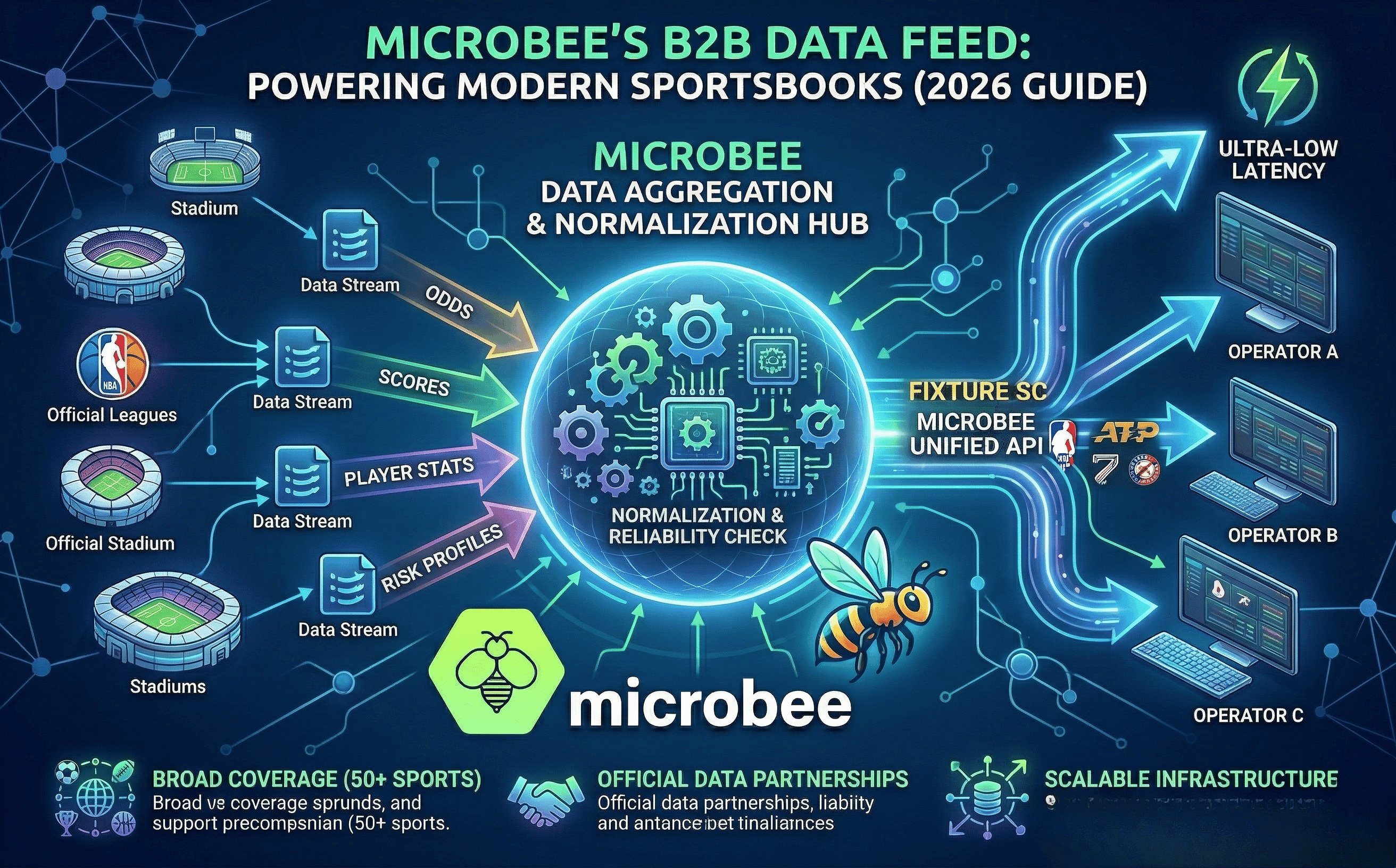
Every price displayed on a sportsbook, every score update, every market suspension on a goal — all of it originates from a sports data feed. It is the most foundational data infrastructure a sportsbook operator relies on, yet it is frequently the least understood during platform evaluation.
This guide explains how sports data feeds work from collection through to delivery, what separates good feeds from great ones, how the feed relates to the sports API and data service layers, and what B2B operators should evaluate when choosing a data feed provider. It draws on MicroBee's experience deploying sportsbook platforms to 300+ operators across 50+ jurisdictions since 2014.
What Is a Sports Data Feed?
Definition: A sports data feed is a structured, continuously updated stream of sports data delivered in real time. It includes live scores, match events (goals, cards, substitutions), in-play and pre-match odds, player statistics, fixture schedules, market suspension signals, and settlement data. It is delivered from a data provider to an operator platform via an API connection, typically using WebSocket push or REST polling.
Understanding what a feed contains is as important as understanding how it is delivered. A comprehensive sports data feed covers:
• Live match scores and timeline events (goals, cards, corners, injuries, substitutions)
• Pre-match odds — market prices for upcoming events across all bet types
• In-play (live) odds — continuously updated prices during live events, updated in milliseconds
• Market suspension signals — triggers to suspend betting immediately on key events
• Player and team statistics — for enhanced markets, editorial content, and algorithmic pricing
• Fixture schedules and competition metadata — leagues, tournaments, rounds, kickoff times
• Settlement data — final results, scorers, bet settlement triggers
This is distinct from — but closely related to — a sports data service (the provider organisation) and a sports API (the technical interface). The data feed is the content stream; the API is how your platform receives it; the data service is the company behind both.
How a Sports Data Feed Works: End to End
Step 1: Data Collection
Raw sports data enters from multiple sources simultaneously: official league and federation data partnerships (which carry the most accuracy), in-stadium sensor networks tracking ball and player positions, broadcast data feeds, and proprietary scout networks covering events without official data coverage. The breadth and reliability of these collection sources is what determines data quality at the base layer — and it is what separates premium data feeds from aggregated third-party feeds. For a deeper exploration of this layer, see our real-time data API provider guide.
Step 2: Normalisation and Structuring
Collected raw data arrives in inconsistent formats from multiple sources. The data provider normalises it — resolving conflicts between sources, applying official league data as the authoritative source, and structuring the output into a consistent schema that operator platforms can consume without custom parsing for every event type.
Step 3: Odds Compilation and Pricing
For odds data specifically, the normalised match data feeds directly into pricing algorithms and trading teams who calculate and update market prices. The relationship between incoming match data and outgoing odds updates is where odds data service latency is most visible — a goal event should trigger market suspension and odds recalculation within 200–500ms on a tier-1 feed.
Step 4: Feed Delivery via API
Structured data is pushed to operator platforms via the data API. Two delivery methods are common: WebSocket push (the provider pushes updates to the operator's platform in real time — lower latency, preferred for in-play data) and REST polling (the operator's platform requests updates at intervals — higher latency, acceptable for pre-match data). Tier-1 sports data feeds use WebSocket push for all in-play data.
Step 5: Platform Integration and Display
The operator's platform receives the feed, processes it through its bet acceptance engine, applies operator-configured margins and stake limits, and displays updated prices to bettors. The entire chain from match event to displayed price should complete in under 500ms on a competitive platform — as we covered in our live betting software architecture guide.
Data Feed vs Data API vs Data Service: The Distinctions
Term | What it is | Analogy |
Data feed | The content stream — continuous real-time data | The water flowing through a pipe |
Data API | The interface — the endpoints your platform calls to receive the feed | The pipe itself |
Data service | The provider — the company managing collection, quality, and delivery | The water utility company |
What Separates a Good Sports Data Feed from a Great One
5 differentiators: The five factors that separate tier-1 sports data feeds from commodity feeds: (1) Collection source quality — official league partnerships vs aggregated third-party data; (2) In-play latency — sub-200ms vs 500ms–2s; (3) Coverage depth — markets per event, not just sport count; (4) Suspension and settlement accuracy — speed and error rate on key events; (5) Feed reliability — uptime SLA and incident response during live events.
1. Official Data Source Partnerships
Official league data partnerships — where the data provider has a direct data rights agreement with the league or federation — produce faster, more accurate data than aggregated feeds that patch together multiple non-official sources. For regulated markets that mandate official data use (such as the US market's official data requirements for certain sports), this is not a preference but a legal requirement.
2. In-Play Latency Under Load
Latency benchmarks from controlled test environments mean very little. What matters is latency during peak load — the first five minutes of a Champions League match, the opening minutes of a Grand Slam tennis final. Ask providers for documented P95 and P99 latency data from live high-traffic events, not average latency from test environments.
3. Market Depth Not Just Sport Count
A data feed covering 100 sports but offering only 5 markets per event is commercially thinner than a feed covering 30 sports with 50+ markets per event. Map your target bettor demographics to their preferred markets before evaluating coverage. European football bettors expect correct score, first goalscorer, Asian handicap, and both teams to score as minimum depth — not just match winner.
4. Suspension Accuracy and Settlement Speed
Two of the most operationally damaging data feed problems are slow market suspension (a goal happens, your platform continues accepting bets for 3 seconds) and settlement errors (incorrectly graded bets generate disputes and regulatory exposure). Ask every provider for their documented suspension time on goal events and settlement error rate across the last 12 months.
5. Feed Stability and Uptime SLA
A data feed that drops during a major live event is catastrophic for operator operations — markets go stale, bettors lose trust, and manual intervention is required under time pressure. Tier-1 feeds offer 99.9% uptime SLAs with documented failover architecture and sub-15-minute incident response for live data streams.
MicroBee's Sports Data Feed
MicroBee's sportsbook platform includes a fully managed sports data feed as a core component — not as a separately priced add-on or third-party integration. Operators receive:
• Real-time pre-match and in-play data across 50+ sports — single source, single API
• WebSocket push delivery for all in-play data — sub-second updates on all live markets
• Market suspension signals — automated suspension on all key event types
• Player statistics and historical data — included in the platform package, integrated into data intelligence back-office
• Settlement data — automatic bet settlement triggers with MGA/UKGC-compliant audit trails
• Single 2–4 week integration — feed, API, and platform accessed simultaneously
Frequently Asked Questions
What is a sports data feed?
A sports data feed is a continuous real-time stream of structured sports data — including live scores, in-play odds, player statistics, match events, and settlement data — delivered from a data provider to a sportsbook platform via an API connection.
How does a sports data feed work?
A sports data feed collects raw data from official leagues, sensors, and scouts, normalises it, and pushes it to operator platforms via WebSocket or REST API. The complete chain from match event to displayed price should complete in under 500ms on a competitive platform. Full technical breakdown: sportsbook API integration guide.
What is the difference between a data feed and a data API?
A data feed is the content stream — the continuous flow of sports data. A data API is the technical interface through which that feed is delivered. The feed is what you receive; the API is how you receive it. Full explanation: sports data service vs sports API guide.
What latency should a sports data feed have?
For in-play betting, sub-500ms is the benchmark — sub-200ms is competitive advantage. Feeds with latency above 2 seconds create exploitable arbitrage windows. See our odds data service latency guide for a full breakdown.
Does MicroBee provide a sports data feed?
Yes. MicroBee's sportsbook platform includes a fully managed sports data feed covering 50+ sports — pre-match and in-play — delivered via a single API. No separate data provider contract required. Contact MicroBee to discuss your data feed requirements.
Summary
A sports data feed is the most critical real-time infrastructure layer in a sportsbook operation. Its latency, accuracy, coverage depth, and reliability directly determine live betting competitiveness and trading risk. For B2B operators evaluating data feed providers in 2026, the questions that matter most are: what are your documented in-play latency figures under load, what is your suspension time on goal events, and what is your settlement error rate? MicroBee answers all three through 300+ live operator deployments across 50+ jurisdictions.
If you are evaluating sports data feed providers, speak to MicroBee's team.