
MIcrobee Tech Team
Reading Time :
10 Minute
When launching an online gaming operation in 2026, one of the most consequential decisions you'll face is choosing your platform architecture. This choice will fundamentally shape your operational capabilities, competitive positioning, technological flexibility, and long-term business trajectory. Yet despite its critical importance, many operators approach this decision without fully understanding the profound implications each path carries.
Over the past eleven years, we've worked with more than 300 gaming operators across 50+ jurisdictions, and we've witnessed firsthand how platform choices have determined success or failure. Some operators flourished because they selected the architecture that aligned perfectly with their capabilities and market positioning. Others struggled for years, constrained by platforms that couldn't support their vision or trapped in costly arrangements that prevented profitable scaling.
This comprehensive guide synthesizes those eleven years of experience into actionable insights. Whether you're a first-time operator evaluating your options, a technical leader assessing architectural approaches, or an investor analyzing gaming technology investments, understanding the nuanced differences between white label, turnkey, and custom development platforms is essential to making an informed decision.
Understanding the Three Paths
The gaming platform market presents three fundamentally different architectural approaches, each serving distinct operational requirements and strategic visions. While the industry often presents these options as simple choices, the reality is far more nuanced. Each approach represents not just a technology decision, but a strategic commitment that will influence every aspect of your operation for years to come.
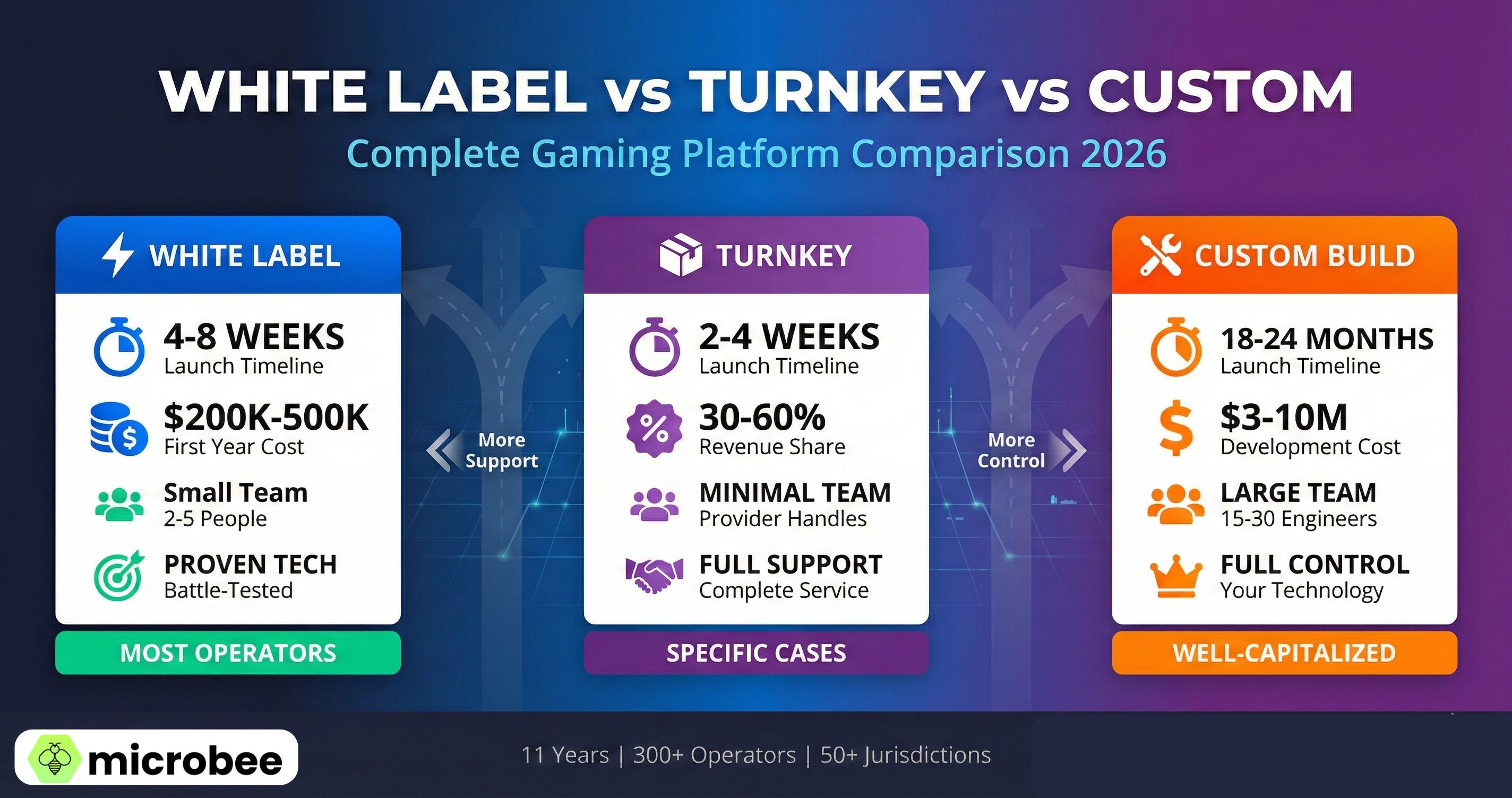
White label platforms offer pre-built, proven technology that operators license and brand as their own. Think of this as renting a fully-furnished apartment—everything you need is already there, professionally maintained, and ready to use immediately. You bring your brand, your marketing expertise, and your operational team, while the technology provider handles the complex infrastructure, updates, and technical maintenance.
Turnkey solutions go several steps further, providing not just the platform technology but also comprehensive operational services. This is more akin to joining a franchise—you get the complete business infrastructure, operational procedures, and ongoing support. The provider handles not just the technology but also customer support, risk management, payment processing, and often even compliance management.
Custom development means building proprietary technology specifically designed for your unique requirements. This is like commissioning an architect to design and build your dream home from the ground up. Every feature, every interaction, every technical decision is made specifically to serve your strategic vision. You own the intellectual property completely, control every aspect of the technology, and have unlimited freedom to innovate.
Each approach has succeeded for certain operators in certain contexts, and each has failed when misapplied. The key is understanding not just what each option offers, but when each option makes strategic sense for your specific circumstances.
The White Label Approach: Proven Technology, Rapid Deployment
For most gaming operators entering the market today, white label platforms represent the most pragmatic path to launch. This isn't a concession to mediocrity—it's a recognition that technology infrastructure, while critical, isn't always where competitive advantage lies. Many successful regional operators have built profitable businesses worth tens of millions on white label platforms, focusing their resources on marketing excellence, customer service, and operational efficiency rather than technology development.
White label platforms work because they solve the fundamental chicken-and-egg problem facing new operators. You need a sophisticated, reliable platform to compete in modern gaming markets, but building that platform requires millions in investment and twelve to twenty-four months of development time. Meanwhile, market opportunities don't wait—regulatory windows open and close, competitors enter markets, and player expectations evolve rapidly.
When you license a white label platform, you're essentially accessing technology that cost the provider tens of millions to develop, proven across hundreds of implementations, continuously improved based on aggregated operator feedback, and professionally maintained by dedicated teams. For a monthly license fee or revenue share arrangement that's a fraction of building equivalent technology yourself, you gain immediate access to production-ready infrastructure.
The typical white label implementation takes six to twelve weeks from contract signature to full launch. During the first two weeks, you're handling contractual finalization, platform access provisioning, and initial training. Weeks three through four focus on branding application—uploading your logo, configuring color schemes, customizing content within the platform's parameters. Weeks five and six involve integrating payment processors, configuring business rules like odds margins and betting limits, and conducting thorough testing. The final weeks before launch focus on compliance verification, team training, and preparing marketing materials.
What you receive from a quality white label provider extends far beyond just software. The platform includes comprehensive front-end interfaces optimized for desktop and mobile devices, robust back-end infrastructure with built-in security and scalability, administrative tools for player management and reporting, and integration with sports data feeds or casino game content. For sportsbook operations, you typically get coverage of twenty-five to forty sports with hundreds of betting markets per major match, real-time odds compilation, live betting capabilities, and cash-out functionality. Casino platforms provide access to hundreds or thousands of games from multiple providers, live dealer experiences, and progressive jackpot networks.
The provider maintains the entire technical infrastructure, handling server management, security updates, performance optimization, and regulatory compliance updates. When new regulations emerge requiring platform modifications, the provider implements those changes and rolls them out to all operators. When security vulnerabilities are discovered, patches are deployed centrally. When performance optimization opportunities arise, improvements benefit everyone using the platform.
However, white label platforms come with inherent limitations that every operator must understand and accept. You're operating within a standardized framework where customization possibilities are constrained to what the provider's architecture allows. The user interface layout, navigation patterns, core betting mechanics—these foundational elements are fixed. While you can apply your branding and adjust certain parameters, you cannot fundamentally change how the platform works or feels.
Your competitors may be using the same platform. In some markets, multiple operators license technology from the same provider, creating situations where the underlying platform is identical across competitors. Differentiation then must come entirely from marketing, customer service, bonuses, and operational excellence—important factors, but not technological advantages.
Feature development follows the provider's roadmap, not yours. When you identify a competitive feature you need, requesting it from your provider initiates a process that typically takes six to twelve months if approved at all. The provider must evaluate the request against their entire operator base, prioritize it against competing development needs, and implement it in a way that works for everyone. By the time the feature launches, market conditions may have changed, and your competitors get the same capability simultaneously.
Despite these constraints, white label platforms have enabled countless successful operations. Regional operators with strong local market knowledge have dominated their territories using white label technology, proving that excellence in marketing, customer relationships, and operational efficiency can overcome technological parity. The key is entering with realistic expectations about what you can and cannot control, and focusing your competitive strategy on areas where you maintain flexibility.
The Turnkey Model: Complete Operational Package
Turnkey solutions appeal to a specific operator profile—those who want to enter gaming operations with minimal infrastructure development, limited gaming industry experience, or a preference for operational simplicity over control. If white label is like renting a furnished apartment, turnkey is joining a franchise where the franchisor not only provides the location and equipment but also runs much of the day-to-day operation.
The fundamental difference between white label and turnkey lies in operational responsibility. With white label, you receive technology but must build your own operational team—customer support, risk management, payment operations, compliance monitoring. The provider gives you the tools; you supply the people and processes to use those tools effectively.
Turnkey providers take on significantly more operational burden. Your turnkey partner typically handles customer support for your players, manages trading and risk management for sports betting operations, processes payments and handles reconciliation, monitors regulatory compliance, and often manages affiliate programs. Some turnkey arrangements even include marketing support and player acquisition services.
This comprehensive service package fundamentally changes the economics. Rather than paying a modest monthly fee or small revenue share for technology access, turnkey arrangements typically involve substantial revenue sharing—often thirty to sixty percent of gross gaming revenue. In exchange for that significant revenue share, your operational team can be much smaller, focused primarily on brand management, local marketing, and strategic oversight.
For investors without gaming operations experience, entrepreneurs testing market entry, or established brands expanding into gaming without operational expertise, this model offers appeal. You can launch faster than building operational infrastructure yourself, leverage the provider's expertise and established procedures, minimize upfront capital investment through revenue-sharing arrangements, and reduce operational complexity and risk.
However, the long-term economics of turnkey arrangements deserve careful scrutiny. At small scales, the model works reasonably well—when you're generating modest monthly revenue, the high percentage going to your turnkey partner may feel acceptable given the comprehensive support. But as your operation scales, the absolute amounts paid to the provider grow dramatically while your operational costs don't scale proportionally.
Consider an operator generating one million in monthly gross gaming revenue. At a forty percent revenue share, you're paying four hundred thousand monthly to your turnkey provider. Annually, that's 4.8 million in fees. Over a three-year contract, you've paid 14.4 million to the provider. That amount could have funded custom platform development twice over, or supported a sophisticated operational team with much lower ongoing costs.
The operational dependency creates additional challenges. Your players interact primarily with the provider's support team, not yours. Risk management decisions follow the provider's policies and comfort levels, which may not align perfectly with your risk appetite. Payment processing routes through the provider's systems and relationships. This dependency makes transitioning away from the provider extremely difficult—player relationships, operational procedures, and business processes are all intertwined with the provider.
Despite these challenges, turnkey arrangements succeed for operators whose competitive advantage lies entirely outside operations and technology. A celebrity or influencer launching a branded gaming operation might excel at marketing and player acquisition while having no interest in building operational infrastructure. A media company with strong audience relationships might prefer focusing entirely on content and community while outsourcing the entire gaming operation. For these operators, turnkey makes strategic sense despite the economics.
Custom Development: Building Proprietary Technology
Custom platform development represents the most ambitious path—and potentially the most rewarding or costly, depending on execution. When done well, custom development creates proprietary technology that becomes a strategic asset worth tens of millions, enables competitive differentiation through unique capabilities, provides complete operational freedom and flexibility, and positions the company for premium exit valuations or platform licensing opportunities.
When done poorly, custom development becomes an expensive, multi-year journey that depletes capital, delays market entry beyond viable windows, delivers buggy or incomplete technology, and ultimately forces transition back to white label platforms after millions in sunk costs.
The difference between success and failure in custom development hinges on several critical factors that operators must honestly assess before committing. First and foremost: do you have authentic technology leadership? Building a production-grade gaming platform requires experienced technical leaders who understand not just software development generally, but specifically the unique challenges of gaming platforms—real-time data processing at scale, high-availability infrastructure, complex business logic, regulatory compliance requirements, and security in high-risk environments.
Many failed custom development projects were led by technically competent people who simply lacked specific gaming industry expertise. They underestimated the complexity of odds compilation algorithms, misjudged the performance requirements for live betting, overlooked regulatory compliance subtleties, or failed to anticipate the operational complexity of managing thousands of concurrent users placing bets on live events.
Second: can you sustain the investment through completion? Custom development typically requires three to ten million in development costs spread across eighteen to thirty-six months before launching revenue-generating operations. During this period, you're burning capital monthly with no revenue offset. Many operators who begin custom development with sufficient capital for the initial timeline find themselves in crisis when inevitable delays extend the timeline by six or twelve months.
Third: do you have the patience for the timeline? In gaming, timing often matters enormously. Regulatory markets open with limited windows for establishing position. Major sporting events create player acquisition opportunities. Competitive dynamics shift rapidly. Custom development timelines measured in years can mean missing critical market windows entirely.
Despite these challenges, custom development succeeds brilliantly for certain operators. Companies entering gaming from adjacent industries—sports media companies, social networks, technology platforms—often benefit from custom development because they're not just launching a gaming operation but integrating gaming deeply with existing products and user bases. The technical integration requirements alone often necessitate custom development, while the strategic value of seamless integration justifies the investment.
Operators with genuinely innovative business models find custom development necessary because existing platforms simply cannot support their vision. If your competitive strategy depends on features or experiences that don't exist in any platform today, you have no choice but to build custom. The question becomes whether your innovation is valuable enough to justify the investment and risk.
Large, well-capitalized operators entering highly competitive markets increasingly choose custom development because technological differentiation has become table stakes. In mature markets like the UK, where every competent white label operator can offer similar core functionality, superior technology becomes one of the few sustainable competitive advantages. The industry's market leaders—companies like Bet365, Flutter Entertainment, DraftKings—all invested heavily in proprietary technology that enables capabilities competitors cannot replicate.
The custom development process, when properly executed, follows a structured approach. The first three months focus on discovery, requirements gathering, architectural design, and detailed planning. You're not writing code yet—you're making fundamental architectural decisions, selecting technology stacks, designing data models, planning integrations, and creating detailed specifications that will guide development.
Months four through fifteen cover core development—building backend services, implementing frontend interfaces, developing mobile applications, creating administrative tools. This phase requires the bulk of your development team, ideally fifteen to thirty engineers across backend, frontend, mobile, DevOps, and quality assurance disciplines.
Months twelve through eighteen focus on integration—connecting sports data providers, integrating casino content, implementing payment gateways, building out CRM connections, and linking all the third-party services a gaming platform requires. Months sixteen through twenty-one emphasize testing—functional testing, performance testing, security testing, penetration testing, load testing, and user acceptance testing.
The compliance and certification phase, months eighteen through twenty-four, often proves more time-consuming than anticipated. Gaming laboratories must test your platform against regulatory requirements, security certifications require extensive documentation and auditing, and licensing authorities review everything before granting approvals. Building buffer time for this phase is essential—certification issues often require code changes and retesting that can delay launch by months.
Finally, months twenty-two through thirty cover pre-launch preparation and soft launch—training your operational team, populating content, testing with limited users, monitoring performance, fixing issues, and preparing for full-scale launch.
What emerges from this intensive process, when successful, is a platform that operates exactly as you envisioned. Features work the way you want them to work. The user experience reflects your brand and strategy perfectly. Performance is optimized for your specific traffic patterns and usage. Integrations connect to the specific services you've selected. Business logic implements your precise requirements.
More importantly, you own it. The intellectual property is yours. The source code is yours. Future development proceeds at your pace, following your priorities. No vendor dependency constrains your strategic options. No revenue sharing permanently reduces your margins. The technology itself becomes a valuable asset that increases your company valuation and potentially generates licensing revenue from other operators.
Making the Right Decision for Your Situation
After examining these three approaches in detail, the critical question remains: which path makes sense for your specific circumstances? There's no universally correct answer—context determines the optimal choice.
Start by honestly assessing your available capital. Custom development requires minimum three to five million dollars in accessible capital, with willingness to deploy that capital over two to three years before generating returns. If you have less than two million in available capital, custom development likely isn't viable regardless of other factors. White label becomes your realistic path, with turnkey as an alternative if you want comprehensive operational support.
Consider your timeline imperatives carefully. If you need to launch within six months—perhaps a regulatory window is opening, or a competitor is entering your target market—only white label enables that timeline. Custom development requires accepting an eighteen to thirty-six month timeline from decision to launch. Many opportunities won't wait that long.
Evaluate your technical capabilities honestly. Custom development requires strong technical leadership from day one—experienced CTOs or technical co-founders with specific gaming platform expertise. If you're hiring your technical leadership as you start development, your risk increases substantially. White label allows you to launch with minimal technical team, then build technical capacity over time as operations generate revenue.
Think critically about where your competitive advantage truly lies. Many operators convince themselves they need custom technology when their actual advantages are marketing expertise, customer relationships, local market knowledge, or operational excellence. If your strategy succeeds or fails based on how effectively you acquire and retain customers through marketing and service, not based on having superior technology, white label provides sufficient platform capability while letting you focus resources on your genuine strengths.
Conversely, if your entire strategy depends on offering experiences competitors cannot provide—unique features, superior performance, innovative mechanics—then custom development may be necessary despite the costs and timeline. The question becomes whether your innovation is defensible and valuable enough to justify the investment.
Consider your long-term vision and exit strategy. If you're building a regional operation to run profitably for five years before potentially selling, white label makes sense—you can build a valuable business without the massive investment custom requires. Your exit valuation will be based primarily on earnings and customer base rather than technology ownership.
If you're building for eventual sale where the platform itself is a strategic asset, or if you envision licensing your platform to other operators as an additional revenue stream, custom development creates significantly more exit value. Acquirers pay premiums for proprietary technology, and the ability to white label your platform to others can generate substantial revenue while raising your valuation.
Risk tolerance matters enormously. Custom development carries significant execution risk—things can and often do go wrong, extending timelines and budgets. If you cannot absorb the potential loss of five to ten million if development fails, custom is too risky. White label provides more certainty—the platform already exists and functions, reducing technology risk even if business risk remains.
The Hybrid Path: Starting White Label, Evolving Custom
For many operators, the optimal strategy isn't choosing one approach and committing permanently, but rather starting with white label and evolving toward custom as the business matures and justifies the investment.
This phased approach offers significant advantages. You can launch quickly on white label, proving your business model and market fit within months rather than years. The operation generates revenue that can fund future custom development, transforming the investment from pure risk capital into operational cash flow allocation. You learn the gaming business deeply—understanding player behavior, operational challenges, regulatory requirements—before making massive technology investments. The approach validates demand before committing enormous resources.
The typical evolution follows a clear pattern. During years one and two, you operate on white label, building a profitable operation and substantial player base. You focus on marketing excellence, operational efficiency, and truly understanding your market. Simultaneously, you begin building internal technical capability—hiring engineers, developing smaller custom tools that integrate with your white label platform, and learning.
In year two, using operational profits, you begin custom platform development. You're not shutting down the white label operation—that continues generating revenue and serving customers. Instead, you're developing custom technology in parallel, testing features with subsets of users, iterating based on feedback.
By year three, you transition—migrating players to the custom platform, maintaining both systems temporarily for operational continuity, completing the transition, and terminating the white label contract. While this approach costs more total capital than pure white label or pure custom, it dramatically reduces risk. If your business doesn't succeed initially, you've invested far less than full custom would have required. If it succeeds, you've funded custom development from operations rather than pure investment capital.
The Real Cost of Platform Decisions
Understanding the true cost of each approach requires looking beyond simple monthly fees or development budgets. The total cost of ownership over three to five years tells a more complete story.
For white label, you have modest initial investment—perhaps two hundred to five hundred thousand for setup, licensing applications, initial marketing, and working capital. Monthly operational costs run sixty to two hundred thousand depending on your scale, feature set, and service level. Add revenue sharing if your agreement includes it—perhaps five to fifteen percent of gross gaming revenue.
Over three years generating increasing revenue, you might pay five to eight million total in platform costs and revenue sharing. That's substantial but produces operational revenue throughout, and you can redirect those costs if you eventually transition to custom. The platform itself has no resale value—you're renting technology, not building an asset.
Turnkey shows similar initial investment but dramatically different ongoing economics. Monthly costs appear lower because much is bundled into revenue sharing, but that revenue sharing at thirty to sixty percent creates enormous long-term costs. The same three-year trajectory that cost five to eight million on white label might cost ten to fifteen million with turnkey. By year three, you're paying hundreds of thousands monthly to the provider when your operational costs wouldn't justify those amounts. The operational dependency also constrains strategic options in ways that are difficult to quantify but significantly valuable.
Custom development shows completely different economics. Initial investment is massive—five to fifteen million development costs—but ongoing costs, while substantial, don't include technology revenue sharing. By year three or four, as revenue scales, custom becomes more cost-effective than either alternative. More importantly, you've built an asset worth five to twenty million that increases company valuation and potentially generates licensing revenue.
The crossover point where custom becomes more economical than white label typically occurs around three to five million in monthly gross gaming revenue, assuming three years of operation. Before that scale, white label costs less. After that scale, custom's economics become compelling. Very few operators should pursue custom before proving they can reach that scale.
Technical Architecture: What You're Really Building
The architectural differences between these approaches extend far deeper than obvious factors like customization or control. Understanding the technical implications helps clarify why certain capabilities are possible or impossible within each approach.
White label platforms utilize multi-tenant architecture where hundreds of operators share underlying infrastructure. This creates efficiency—provider costs are spread across many operators—but also constraints. You cannot tune database queries for your specific reporting needs. You cannot implement custom caching strategies for your traffic patterns. You cannot optimize infrastructure for your geographic markets specifically. The provider optimizes holistically for their entire operator base, which means optimization for everyone generally but no one specifically.
This shared architecture means performance during peak times—major sporting events where all operators experience simultaneous traffic surges—becomes collective rather than individual. The provider's infrastructure must handle aggregate load across all operators. While professional providers build capacity for these scenarios, theoretical maximum capacity becomes the limiting factor for everyone.
Data architecture in white label deserves particular attention. Your player data, transaction data, and betting history live in the provider's databases under their control. While reputable providers grant you access and reporting capabilities, you're accessing your data through their interfaces and tools. Direct database access, which would enable advanced analytics or custom reporting, typically isn't available. When contracts end, data export capabilities vary widely based on your agreement—some providers facilitate complete data migration, others make it difficult or expensive.
Custom development inverts every one of these constraints. Your infrastructure is yours—dedicated, not shared. You optimize everything specifically for your workload, traffic patterns, and requirements. Database architectures, indexing strategies, caching layers—all tuned precisely for your needs. During peak events, your capacity is your capacity, unaffected by other operators' traffic.
You have complete data access at every level—direct database queries, complete historical data, full transaction details. Advanced analytics become possible. Machine learning models can train on your complete dataset. Business intelligence tools connect directly to your data warehouse. The data platform becomes a competitive advantage rather than an operational constraint.
The integration architecture differs fundamentally. White label provides pre-integrated services—specific payment gateways, selected data providers, particular game suppliers. Adding new integrations requires provider development, following their timeline and priorities. Custom development enables integrating with any service that provides an API—any payment processor, any data provider, any tool or service relevant to your operation. This flexibility matters enormously as your operation evolves and new services emerge.
The Compliance and Security Dimension
Regulatory compliance and security present different challenges and opportunities across these platform approaches. White label operators benefit from providers who maintain platform-level certifications and compliance infrastructure. When regulations change requiring platform modifications—new responsible gambling tools, enhanced identity verification, modified reporting—providers implement those changes centrally and deploy to all operators.
This centralized compliance management reduces individual operator burden significantly. The provider maintains relationships with gaming laboratories, submits platforms for certification, and handles the technical aspects of regulatory compliance. Operators must still manage their own licensing, operational compliance, and player-facing policies, but the platform's technical compliance is provider-managed.
However, this standardized compliance creates limitations. If your jurisdiction has unique requirements not reflected in the provider's platform, addressing those gaps becomes challenging. You can request custom development from the provider, but that follows their timeline and prioritization. You cannot simply build the required functionality yourself.
Security follows similar patterns. Providers maintain professional security teams, conduct regular penetration testing, implement security updates, and monitor for threats. For operators without security expertise, this provides significant protection. The provider's security posture, however, becomes your security posture—you inherit both their strengths and their weaknesses.
Custom development shifts complete compliance and security responsibility to you. You must build all compliance functionality, pursue all certifications, and maintain security infrastructure. This requires expertise, investment, and ongoing vigilance. The burden is substantial, but the flexibility is complete. You can implement compliance measures specifically for each jurisdiction you operate in, customize security for your specific risk profile, respond to regulatory changes immediately without waiting for vendors, and implement security beyond industry standards if desired.
The regulatory relationship also differs. White label operators often operate under some degree of dependency on their provider's compliance standing. If the provider's technology fails certification in a jurisdiction, all operators using that platform are affected. Custom development enables direct relationships with regulators and complete control over compliance posture.
Strategic Implications: Platform as Competitive Weapon or Operational Necessity
Perhaps the most fundamental question to address is whether platform technology represents a strategic weapon or operational necessity for your specific business. This distinction drives the entire decision process.
For many successful operators, platforms are operational necessities—critical infrastructure that must work reliably but isn't the source of competitive advantage. These operators succeed through marketing excellence, customer relationships, operational efficiency, local market expertise, or brand strength. The platform enables their business but doesn't differentiate it. For these operators, white label makes complete strategic sense. Why invest millions building technology when proven platforms exist, your competitive advantages lie elsewhere, and capital generates better returns in marketing and operations?
For other operators, platform technology is the competitive weapon. Their strategy depends fundamentally on offering experiences, features, or capabilities competitors cannot match. The platform itself—its performance, features, user experience—directly drives customer acquisition and retention. Competitive advantage flows from technological superiority. For these operators, custom development isn't optional if they want to execute their strategy successfully.
The challenge lies in honest self-assessment. Many operators convince themselves their platform must be custom because they can envision unique features or experiences. But the question isn't whether you can imagine better technology—it's whether that better technology is essential to your competitive strategy and valuable enough to justify the massive investment required.
Consider two hypothetical operators in the same market. Operator A believes they need custom development to offer a unique bet builder feature, advanced personalization, and superior mobile performance. They invest eight million and eighteen months building custom technology. Operator B launches on white label and instead invests heavily in marketing partnerships with local sports teams, builds exceptional customer support, offers generous but sustainable bonuses, and creates strong community engagement through content and events.
Three years later, who succeeds? It depends entirely on what drives customer acquisition and retention in that specific market. If players choose platforms primarily based on technological sophistication and unique features, Operator A's investment pays off. If players choose based on brand trust, community, customer service, and promotions, Operator B wins despite technological parity with competitors.
Market maturity strongly influences this equation. In emerging markets with limited competition, platform excellence may matter less than market presence, brand awareness, and basic competence. White label suffices. In mature, competitive markets where multiple sophisticated operators compete, technological differentiation becomes increasingly important. Custom platforms become more justified.
Conclusion: Context Determines the Optimal Path
After examining white label, turnkey, and custom development across technical, operational, financial, and strategic dimensions, one truth becomes clear: there is no universally correct answer. Context—your specific circumstances, capabilities, market, and strategy—determines the optimal path.
White label represents the pragmatic choice for most operators, particularly those entering gaming for the first time, operating in emerging markets, focusing competitive advantage on non-technology factors, requiring fast market entry, or having limited capital for technology investment. The approach has enabled countless successful operations, proving that technology parity with competitors doesn't preclude building valuable businesses.
Turnkey solutions serve a narrower but definite purpose for investors seeking turnkey operations, entrepreneurs without gaming expertise, operations testing new markets with minimal infrastructure, or those accepting lower margins for comprehensive operational support. The economics require careful evaluation, but for specific operator profiles, turnkey makes strategic sense.
Custom development serves the most ambitious operators—those with sufficient capital to invest, patient timelines matching custom development realities, strong technical leadership and capability, strategic vision requiring platform ownership, and situations where technology is fundamental to competitive advantage. When executed well, custom development creates strategic assets worth tens of millions and enables capabilities no white label platform can match.
For many operators, the optimal strategy isn't static commitment to one approach but rather evolution from white label to custom as the business matures. This phased approach manages risk while preserving the option to build strategic technology assets as the business proves its model and generates capital.
Whatever path you choose, make the decision based on clear-eyed assessment of your capabilities, honest evaluation of where your competitive advantages truly lie, realistic understanding of each approach's constraints and possibilities, and strategic vision for your operation's future. The platform choice you make today will shape your business for years to come. Choose wisely, understanding not just what each approach offers, but whether those offerings align with your strategic reality.
The gaming industry continues evolving rapidly, with new technologies, changing player expectations, and dynamic regulatory landscapes. The platform that serves you well today must also adapt to tomorrow's requirements. Whether through your white label provider's continuous improvements, your turnkey partner's service evolution, or your custom platform's ongoing development, ensuring your technology foundation can grow with your business is as important as the initial choice itself.
About the Author
This analysis was prepared by MicroBee's technical and business teams, drawing from eleven years of experience providing gaming platform technology to 300+ operators across 50+ jurisdictions. Our insights reflect real-world implementations across all three platform approaches—white label, turnkey, and custom development—in diverse markets ranging from emerging to highly mature competitive landscapes.
While MicroBee offers white label and platform solutions, our commitment in this guide has been to objective, balanced analysis that helps operators make informed decisions aligned with their strategic goals, whether those decisions involve our solutions or alternative approaches best suited to their specific circumstances.
Related Resources: