
MicroBee Tech Team
Reading Time :
10 Minute
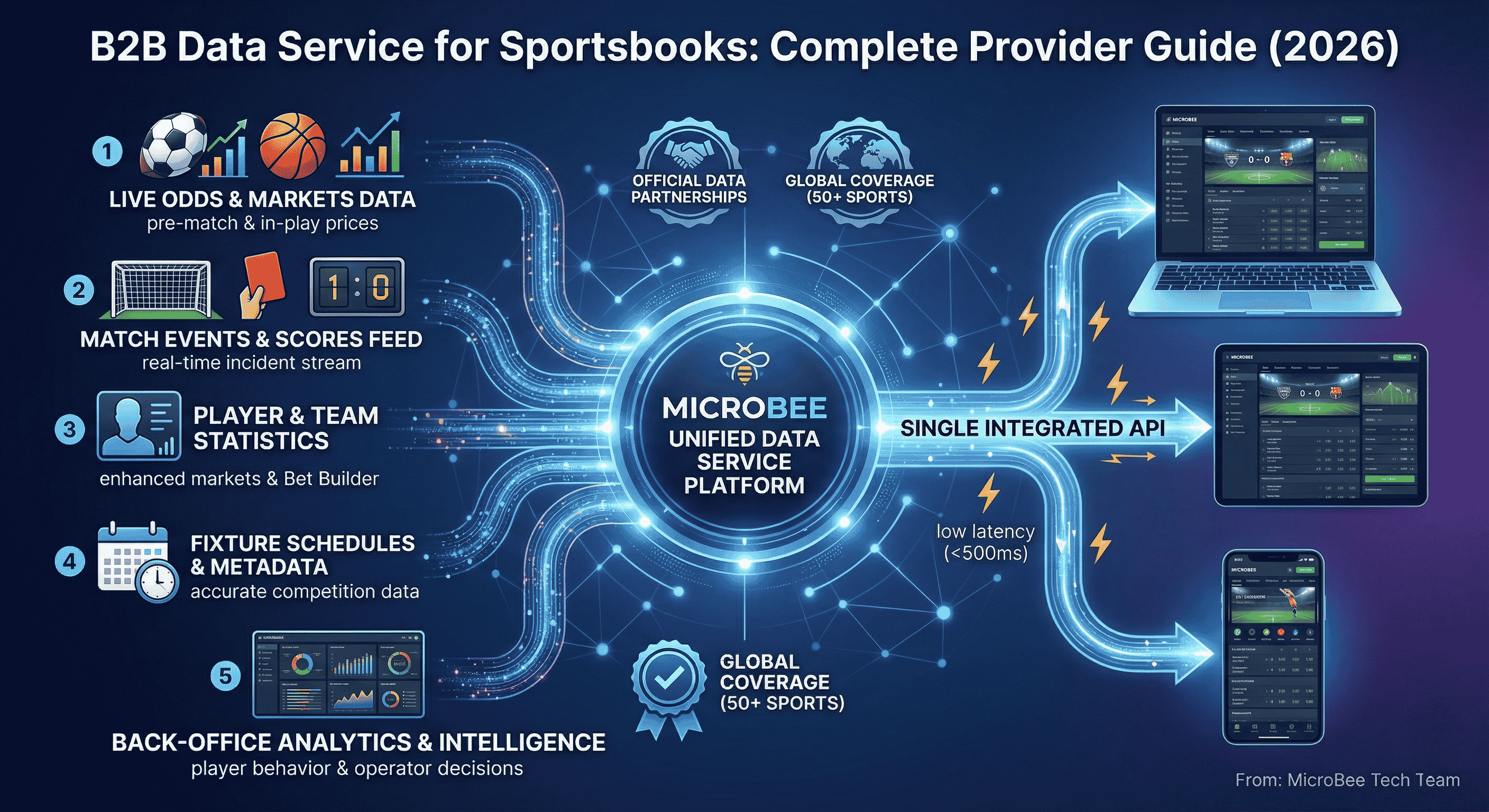
A data service for sportsbooks is a managed provider that collects, processes, and delivers structured sports and gaming data to operator platforms — including live odds, match events, statistics, and settlement data. It is the content layer behind the sports API and data feed. For B2B operators, the data service is the most foundational infrastructure decision in platform setup: it determines live betting quality, analytical depth, and regulatory reporting capability.
Data is the operational foundation of every sportsbook and iGaming platform. The odds bettors see, the statistics displayed on match pages, the real-time liability calculations in the trading back-office, the compliance reports sent to regulators — all of it is powered by data services. Yet many B2B operators treat the data service as a technical detail, evaluated last and under-resourced, only to discover its limitations after launch when they are most expensive to address.
This guide clarifies what a B2B data service is, the five key types sportsbook operators need, how data services relate to the API and feed layers, how to evaluate providers, and how MicroBee's approach — bundling all data services within its unified sportsbook platform — eliminates the multi-vendor complexity that characterises traditional data service procurement.
What Is a B2B Data Service?
Definition: A B2B data service is a managed provider that collects raw sports and gaming data from multiple sources, normalises and structures it, and delivers it to operator platforms via API, data feed, or both. It is the content layer — distinct from the data API (technical interface) and the data feed (delivery stream). The data service is the organisation responsible for data quality, coverage, and delivery reliability.
Understanding the three-layer distinction is important for procurement: the data service is the provider and the content. The data API is the technical interface operators use to access it. The data feed is the continuous stream of data delivered through that interface. Full breakdown: data service vs sports API guide.
The 5 Types of Data Service Sportsbook Operators Need
5 data service types: (1) Live odds and markets data — pre-match and in-play prices across all sports and markets; (2) Match events and scores feed — real-time goals, cards, statistics, suspension triggers; (3) Player and team statistics — for enhanced markets, editorial content, algorithmic pricing; (4) Fixture schedules and competition metadata — leagues, tournaments, start times; (5) Back-office analytics and intelligence — player behaviour, game performance, financial reconciliation.
1. Live Odds and Markets Data Service
The most latency-critical data service layer. Live odds and markets data delivers pre-match and in-play prices to the sportsbook platform — prices that must update within 500ms of match events or the platform exposes exploitable stale prices. The full technical and commercial picture of this service type is covered in our odds data service guide.
2. Match Events and Scores Feed
The match events data service delivers the real-time incident stream: goals, cards, injuries, substitutions, corners, possession statistics, and time progression. This feed triggers automatic market suspension, powers live scoreboards, and enables editorial content on the sportsbook's match pages. Full mechanics: sports data feed guide.
3. Player and Team Statistics
Statistical data enriches sportsbook markets with depth: expected goals, shot accuracy, head-to-head records, player form, injury history, and team tactical patterns. This data supports enhanced betting markets, powers Bet Builder functionality, and feeds the algorithmic models that trading teams use to price niche markets competitively. The depth and historical range of a provider's statistical data is one of the clearest differentiators between premium and commodity data services.
4. Fixture Schedules and Competition Metadata
Pre-match data services deliver structured fixture information — league tables, competition formats, kickoff times, venue details, and officiating assignments — that power the sportsbook's pre-match display and marketing calendar. Accurate, early fixture data allows operators to open markets ahead of competitors, improving bettor engagement and turnover on pre-match wagers.
5. Back-Office Analytics and Data Intelligence
This is the data service layer most commonly absent from basic platform packages. Back-office analytics transforms raw operational data — player betting patterns, game performance metrics, payment success rates, responsible gambling triggers — into actionable intelligence for operator decisions. MicroBee's data intelligence service is fully integrated into the platform back-office rather than priced as a separate data contract, giving operators real-time strategic visibility without additional vendor relationships.
Data Service vs Data API vs Data Feed
These three terms describe related but distinct components of the data infrastructure stack. Confusion between them leads to procurement mistakes — specifically, evaluating the API interface quality as a proxy for data content quality, or assuming that a technically excellent API delivery mechanism compensates for thin or delayed data content.
Layer | What to evaluate | Common failure mode |
Data service | Coverage depth, source quality, error rates, historical data availability | Thin market depth hidden by impressive sport count |
Data API | Documentation quality, sandbox, WebSocket support, latency SLA | Great interface, poor underlying data — fast delivery of inaccurate prices |
Data feed | Update frequency, delivery method, reliability under peak load | Acceptable average latency, unacceptable P99 — outliers cause trading losses |
How to Evaluate a B2B Data Service Provider
Evaluation criteria: Six criteria for evaluating B2B data service providers: (1) Source quality — official league partnerships vs aggregated third-party; (2) Coverage depth — markets per event across your target sports; (3) Latency under production load — P95 and P99, not averages; (4) Historical data availability and pricing; (5) Back-office analytics integration — included or separate contract; (6) Regulatory compliance — does the data service support your compliance reporting requirements?
1. Source quality: Official league data partnerships produce faster, more accurate data than aggregated third-party sources. Ask every provider for their official data rights list. For real-time data API selection, source quality is criterion one of nine.
2. Coverage depth: Evaluate markets per event across your target sports, not total sport count. A data service covering 100 sports at 5 markets per event is commercially inferior to one covering 30 sports at 50+ markets per event for European betting operators.
3. Latency under production load: Demand P95 and P99 latency data from recent high-traffic live events — not average latency from controlled environments. The P99 is what your bettors experience during the events that matter most.
4. Historical data: Is historical odds and event data included in the service contract or priced separately? Historical data feeds the risk models, player segmentation, and data intelligence tools that drive operator profitability.
5. Back-office analytics integration: Does the data service provider offer integrated back-office analytics, or does that require a separate contract with a third analytics vendor? Fragmented data service contracts create reconciliation overhead and data consistency problems.
6. Compliance support: Does the data service generate the audit trails, reporting exports, and regulatory data your target jurisdiction requires? For B2B sportsbook API providers operating in UKGC or MGA markets, compliance data is a mandatory component of the data service, not an optional add-on.
MicroBee's Data Services
MicroBee's data services are integrated directly into its unified sportsbook platform — operators access all five data service types through a single commercial relationship and a single API:
• Live odds and markets — 50+ sports, pre-match and in-play, WebSocket push delivery
• Match events feed — real-time goals, cards, incidents, and statistical data across all covered competitions
• Player and team statistics — historical and live, included in the platform package
• Fixture schedules — complete competition metadata across all covered leagues
• Data intelligence back-office — real-time player analytics, game performance, financial reconciliation, MGA/UKGC compliance exports
• No separate data service contract — all five service types included in the single platform integration
Frequently Asked Questions
What is a data service for sportsbooks?
A data service for sportsbooks is a managed provider that collects, processes, and delivers structured sports data — live odds, match events, statistics, and settlement data — to operator platforms. It is the content layer behind the sports API and data feed. MicroBee's data services are integrated into its unified sportsbook platform.
What is the difference between a data service and a data API?
A data service is the content provider — the organisation that collects, normalises, and manages sports data. A data API is the technical interface for accessing it. Both dimensions must be evaluated independently. Full breakdown: data service vs sports API guide.
What data services do sportsbook operators need?
Five types: (1) Live odds and markets, (2) Match events and scores, (3) Player and team statistics, (4) Fixture schedules, (5) Back-office analytics and data intelligence. A complete B2B platform provides all five through a single integrated service.
Does MicroBee provide data services?
Yes. MicroBee's platform includes a fully managed sports data service covering all five service types — live odds, match events, statistics, fixtures, and analytics — across 50+ sports. No separate data provider contract required. Contact MicroBee.
How do I compare data service providers?
Use six criteria: official data source partnerships, coverage depth (markets per event), production-load latency (P95/P99), historical data availability, back-office analytics integration, and compliance data support. Full evaluation framework: real-time data API provider selection guide.
Summary
A B2B data service is the most foundational infrastructure layer in a sportsbook operation. Its quality determines live betting competitiveness, analytical depth, and regulatory reporting capability. The operators who evaluate data services rigorously — assessing source quality, coverage depth, and production-load latency independently from API interface quality — build platforms that perform competitively from day one. MicroBee's unified approach eliminates the multi-vendor data complexity that undermines many sports platform deployments, delivering all five data service types through a single integration.
To discuss your data service requirements, speak to MicroBee's team.