
MicroBee Tech Team
Reading Time :
8 Minute
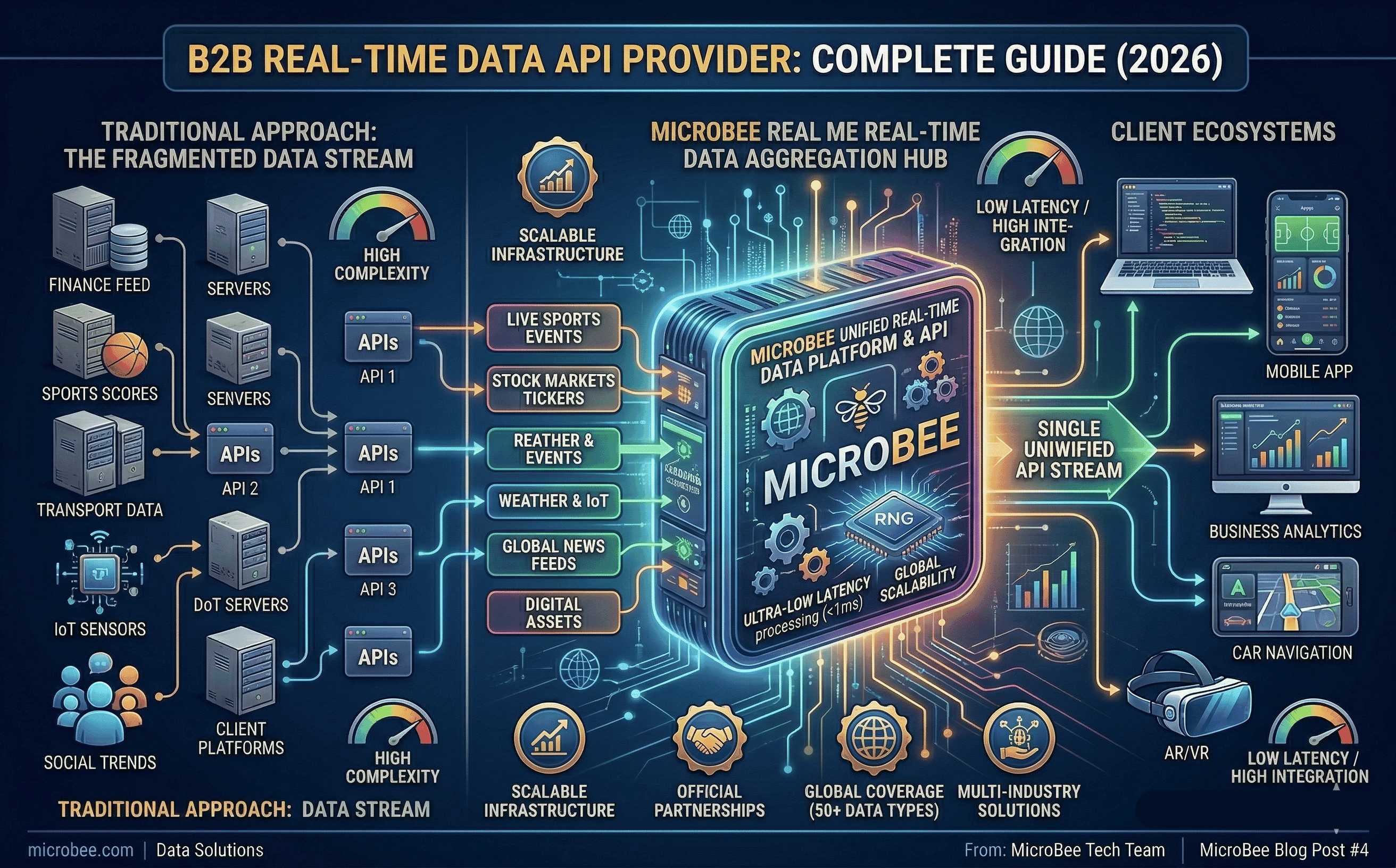
Choosing a real-time data API provider is one of the most consequential infrastructure decisions a sportsbook or iGaming platform operator makes. Get it right and you have a competitive, scalable data layer that powers everything from live odds to player analytics. Get it wrong and you are rebuilding a core system mid-operation — one of the most disruptive and expensive problems in B2B iGaming.
This guide gives B2B operators a complete, structured framework for evaluating real-time data API providers in 2026 — built from MicroBee's experience deploying data-powered sportsbook platforms to 300+ operators across 50+ jurisdictions since 2014. We cover what real-time data APIs actually do, the nine criteria that separate tier-1 providers from the rest, the red flags to watch for, and how to run a structured evaluation process.
What Does a Real-Time Data API Provider Actually Deliver?
A real-time data API provider is a company that collects, processes, and delivers live data to operator platforms via an API — updated continuously with minimal latency. In the iGaming context, that data typically includes:
Data Type | What It Powers |
Live odds and markets | Real-time sportsbook pricing for pre-match and in-play |
Live scores and match events | In-play display, bet settlement triggers, push notifications |
Player and team statistics | Enhanced markets, data visualisations, editorial content |
Fixture schedules | Pre-match betting, event calendar, marketing campaigns |
Market suspension signals | Auto-suspension on goals, red cards, injuries |
Casino game data feeds | Live table availability, RTP tracking, game performance |
Settlement data | Automatic bet settlement, payout processing |
For a detailed breakdown of how the data layer and API layer relate to each other, see our guide to sports data service vs sports API. The short version: the data provider is the content source; the API is how your platform accesses it. Both dimensions must be evaluated independently.
The 9 Criteria for Evaluating a Real-Time Data API Provider
1. Latency — The Make-or-Break Metric
For live betting operations, data latency is a financial metric, not just a technical one. As we covered in our odds data service guide, feeds with latency above 2 seconds create exploitable arbitrage windows. Tier-1 providers deliver in-play data in under 500ms; the best deliver under 200ms.
What to verify: ask for documented latency data from live deployments, not benchmarks from controlled testing. Real-world latency under load — during peak events like Premier League matchdays or major tennis tournaments — is what actually matters.
2. Uptime and Reliability SLA
Data outages during live events are catastrophic for sportsbook operators. Markets go stale, manual suspension is required, and bettor trust erodes. A tier-1 real-time data API provider should offer:
• 99.9% uptime SLA minimum (translates to under 9 hours downtime per year)
• Documented failover and redundancy architecture
• Incident response time under 15 minutes for critical data streams
• Separate SLAs for pre-match data (lower criticality) and in-play data (maximum criticality)
• Transparent incident history — ask for their last 12 months of incident logs
3. Coverage Breadth and Depth
Coverage has two dimensions that both require evaluation. Breadth is the number of sports, leagues, and competitions covered. Depth is the number of markets per event within those competitions. A provider covering 50 sports but offering only match winner markets is commercially thin.
Map your target operator audience to their preferred betting patterns before evaluating coverage. Korean operators need Korean Baseball Organization and K League coverage. European operators need deep Premier League and Champions League market depth. MicroBee's sportsbook platform covers 50+ sports with full pre-match and in-play depth across all major global and regional competitions.
4. API Quality and Developer Experience
A real-time data API is only as good as the integration experience it delivers. Poor API design is one of the most common reasons sportsbook launches are delayed. As we outlined in our sportsbook API integration guide, the difference between a 2-week integration and a 3-month integration almost always comes down to API design decisions made by the provider.
Evaluate:
• Quality and completeness of API documentation
• Availability of sandbox / test environment with realistic data
• Availability of SDKs in your platform's development languages
• Webhook support for push-based event streams vs polling-only
• Versioning policy — how are breaking changes communicated and managed?
• Developer support response times during integration
5. Data Accuracy and Settlement Reliability
Real-time data that is fast but inaccurate is worse than slow accurate data. Verify:
• How is data sourced? Official league feeds, proprietary scouts, or third-party aggregation?
• What is the error rate on bet settlement? Ask for documented settlement accuracy statistics.
• How are disputed settlements handled? What is the escalation process?
• How quickly are corrections made when errors occur?
6. Historical Data Access
Real-time data powers the live experience. Historical data powers everything else: risk models, player segmentation, algorithmic pricing, fraud detection, and the data intelligence back-office analytics that operators rely on for strategic decisions. A provider that does not include historical data access — or prices it prohibitively — is a significant long-term constraint.
7. Integration Timeline and Onboarding Support
Ask every provider you evaluate for their documented integration timeline and a list of recent operator references. The gap between quoted and actual integration timelines is often large. MicroBee's comprehensive platform services include dedicated onboarding support that consistently delivers 2–4 week go-live timelines — validated across 300+ deployments.
8. Commercial Model and Scalability
Real-time data API pricing models vary significantly and have major long-term cost implications:
Pricing Model | Best For | Risk | MicroBee Approach |
Per-event fee | Low-volume operators | Unpredictable costs at scale | Bundled in platform |
Per-sport subscription | Focused market operators | Limited flexibility | Bundled in platform |
Revenue share | Early-stage operators | Margin compression at scale | Available on request |
Flat platform bundle | Scale operators | Higher upfront cost | Standard model |
9. Regulatory Compliance and Licensing
Real-time data API providers operating in regulated markets must hold appropriate B2B licences for the jurisdictions they serve. This is not a checkbox — it is a legal requirement that affects your own operating licence. MicroBee holds MGA and UKGC B2B licences (MGA/B2B/203/2016), covering the most demanding regulated markets globally. When evaluating providers, ask for documented licence references for every jurisdiction in your target market.
Red Flags: When to Walk Away From a Provider
After 300+ operator deployments, MicroBee has observed consistent warning signs in underperforming data API providers:
• No sandbox environment: If a provider cannot give you a test environment with realistic live data before you sign, integration will be painful and timeline estimates will be fiction.
• Vague latency claims: "Sub-second" without documented evidence from live deployments is marketing, not specification. Demand raw latency percentile data (p50, p95, p99).
• No incident history available: Providers who will not share their incident log are hiding performance problems. Transparency about past failures is a sign of operational maturity.
• Settlement disputes with no clear process: If a provider cannot explain their dispute resolution process clearly, you will be managing it yourself — at scale — under operational pressure.
• Integration timelines over 8 weeks: Modern API-first providers integrate in 2–4 weeks. Quotes of 12+ weeks indicate either a legacy architecture or an understaffed integration team.
• No historical data or prohibitive pricing for it: Historical data is infrastructure, not an optional add-on. Providers who withhold it are constraining your risk management and analytics capabilities.
A Structured Evaluation Process
Use this process to move from provider longlist to signed contract efficiently:
1. Longlist: Identify 5–8 providers covering your target sports and jurisdictions. Use our B2B sportsbook API providers comparison as a starting framework.
2. Technical RFI: Send each provider a structured Request for Information covering all 9 criteria above. Eliminate any provider who cannot answer concretely.
3. Sandbox evaluation: Run each shortlisted provider's API in a test environment. Measure real latency, review documentation quality, and estimate integration complexity.
4. Reference checks: Speak to operators currently running on each provider. Ask specifically about integration experience, incident handling, and settlement accuracy in live conditions.
5. Commercial negotiation: Model total cost of ownership across 3 years, not just year-1 fees. Include integration cost, support cost, and data access fees at projected volume.
6. Contract review: Ensure SLAs, incident response commitments, and data ownership terms are in the contract — not just in sales presentations.
What MicroBee Provides as a Real-Time Data API Provider
MicroBee's sportsbook platform is built around a real-time data API that has been refined across 300+ operator deployments in 50+ jurisdictions since 2014. What that means in practice:
• Real-time data across 50+ sports — pre-match and in-play — via a single, unified API
• Sub-second in-play data delivery consistent with the live betting infrastructure standards required for competitive operations
• Full historical data access included in the platform package, integrated into the data intelligence layer
• Developer-first API with full documentation, sandbox environment, and dedicated integration support — 2–4 week integration timeline
• MGA and UKGC B2B licences (MGA/B2B/203/2016) covering 50+ regulated jurisdictions
• Single commercial relationship replacing multiple data provider contracts — simplifying operations and reducing overhead
Frequently Asked Questions
What is a real-time data API provider?
A real-time data API provider is a company that delivers live sports or gaming data — including odds, scores, statistics, and market feeds — to operator platforms via an API, updated continuously with minimal latency. MicroBee provides this as part of its integrated sportsbook platform.
What latency should I expect from a real-time data API?
For live betting, sub-500ms is the benchmark; sub-200ms is competitive advantage. Anything above 2 seconds creates exploitable arbitrage windows. See our odds data service guide for a full latency impact breakdown.
How long does integrating a real-time data API take?
With MicroBee's developer-first API, integration takes 2–4 weeks. Poorly documented legacy APIs can take 3–6 months. Our sportsbook API integration guide explains the integration process step by step.
What uptime SLA should a real-time data API provider offer?
A tier-1 provider should commit to 99.9% uptime minimum with documented failover architecture and sub-15-minute incident response for critical data streams. Ask for the last 12 months of incident history before signing.
Does MicroBee provide historical data alongside real-time feeds?
Yes. MicroBee includes full historical odds and match data as part of the platform package, integrated directly into the data intelligence and analytics layer — not priced separately.
Summary: Choosing a Real-Time Data API Provider in 2026
The real-time data API provider decision shapes every downstream capability of your sportsbook — from live betting competitiveness to risk management to player analytics. The nine criteria in this guide give you a structured framework to evaluate providers rigorously, not just on marketing claims.
The providers who stand up to this framework share common characteristics: documented latency under load, transparent incident history, developer-first APIs, and commercial models that scale predictably. MicroBee has built those characteristics into its platform over 11 years and 300+ deployments.
If you are currently evaluating real-time data API providers, speak to MicroBee's team for a structured assessment of your requirements — and a no-obligation comparison against your current or shortlisted providers.