
MicroBee Tech Team
Reading Time :
8 Minute
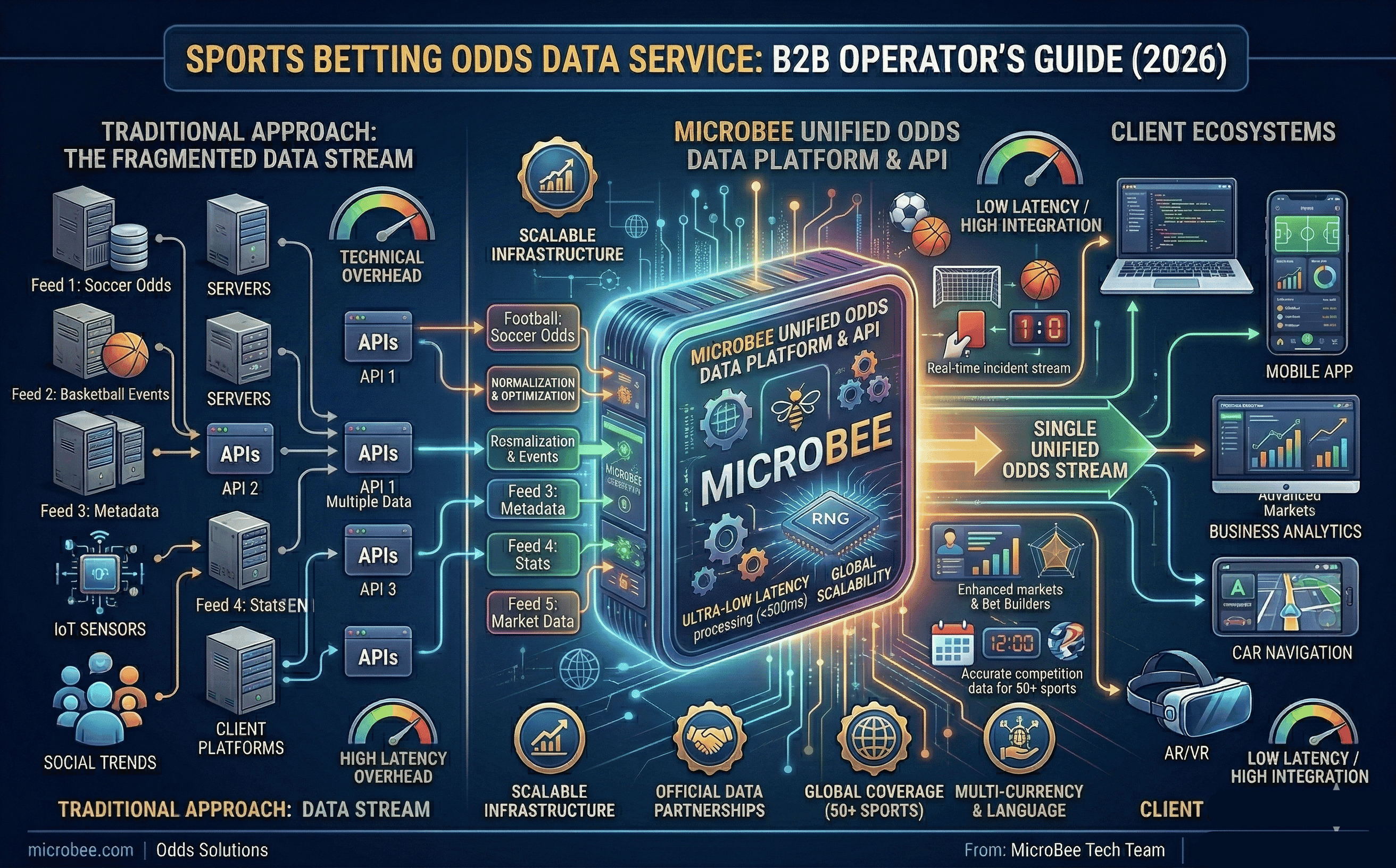
Every price a bettor sees on a sportsbook — the 2.10 on the home team, the 1.85 on over 2.5 goals, the live price shifting in real time during the second half — originates from an odds data service. It is the engine behind every market your platform displays, and its quality determines how competitive your sportsbook can actually be.
For B2B operators, choosing the right odds data service is one of the most consequential technical decisions in platform setup. Get it right and you have fast, accurate, comprehensive pricing that retains bettors and minimises trading risk. Get it wrong and you have slow updates, thin market coverage, and arbitrage exposure that drains margin. This guide, written from MicroBee's experience deploying sportsbook solutions to 300+ operators across 50+ jurisdictions since 2014, covers how odds data services work, what separates good from great, and what to look for when evaluating providers.
What Is an Odds Data Service?
An odds data service is a provider that compiles, calculates, and delivers real-time betting odds to sportsbook operators. It sits between the raw sports world — match events, official data, trading algorithms — and the platform that bettors interact with.
A full-service odds data provider delivers:
• Pre-match odds across all markets for a given event
• In-play (live) odds that update continuously as the match progresses
• Market suspension signals when key events occur (goals, red cards, injuries)
• Settlement data when events conclude
• Bet builder / same-game parlay market data
• Margin and liability management inputs for the operator's trading team
It is closely related to — but distinct from — a broader sports data service, which also includes non-odds data like player statistics, fixture schedules, and incident feeds. Many operators conflate the two. In practice, both are needed for a complete sportsbook platform, and the best B2B providers bundle them together.
How Real-Time Odds Feeds Work
Understanding the mechanics of an odds feed helps operators evaluate providers more rigorously. The process from match event to displayed price involves several layers:
1. Data Collection
Raw data enters from multiple sources: official league data partners, in-stadium sensors, broadcast feeds, and proprietary scout networks. The quality and speed of data collection at this layer sets the ceiling for everything downstream. This is where sports data infrastructure quality is most directly felt.
2. Odds Compilation and Pricing
Trading algorithms and human traders use the incoming data to price markets. Pre-match pricing is relatively stable; in-play pricing must update within milliseconds of each match event — a goal, a penalty decision, a substitution — to prevent the platform from offering stale prices.
3. Feed Delivery via API
Compiled odds are pushed to operator platforms via a real-time API feed. The speed and reliability of this delivery layer is what operators usually mean when they talk about odds feed latency. MicroBee's sportsbook API is engineered for sub-second delivery across all in-play markets — critical for the live betting segment that generates the majority of sportsbook revenue, as explored in our live betting software guide.
4. Platform Display and Bet Acceptance
The operator's front end receives the odds feed and renders prices to bettors. The platform's bet acceptance engine simultaneously manages liability, applies operator-configured margins, and enforces stake limits. This layer connects back to the API integration architecture — see our sportsbook API integration guide for the full technical picture.
What Separates Good Odds Data Services From Great Ones
After evaluating and deploying odds data services for 300+ operators, MicroBee has identified the five factors that actually move the needle on sportsbook performance:
1. Update Latency
This is the single most important metric for live betting operations. For pre-match odds, update speed matters less — prices shift gradually over hours or days. For in-play markets, every millisecond counts. As we covered in our breakdown of live betting software architecture, operators running live betting on feeds with 2–3 second latency are creating exploitable arbitrage windows for sharp bettors. Sub-500ms is the benchmark; sub-200ms is competitive advantage.
Latency Range | Live Betting Impact | What It Means for Operators |
< 200ms | Excellent | Minimal arbitrage exposure; competitive live markets |
200–500ms | Good | Manageable for most markets; monitor sharp activity |
500ms–2s | Acceptable | Elevated arbitrage risk on fast-moving events |
> 2s | Poor | Significant trading losses likely; avoid for live betting |
2. Market Coverage Depth
Coverage has two dimensions: breadth (how many sports and leagues) and depth (how many markets per event). An operator targeting UK bettors needs deep coverage of Premier League, Championship, and EFL — not just match winner but correct score, both teams to score, first goalscorer, and Asian handicap lines. An operator targeting Korean bettors needs Korean baseball and domestic football leagues alongside international coverage.
3. Suspension and Settlement Accuracy
A well-run odds service suspends markets instantly on key events and settles them accurately and quickly. Slow suspension on goal events — even by a few seconds — exposes operators to bets placed on stale prices. Inaccurate settlement creates customer disputes that erode trust faster than almost any other operational failure.
4. Historical Data Availability
Real-time odds are the front end. Historical odds data — every price movement, every market suspension, every settlement across months or years of events — is what powers risk management, player profiling, and algorithmic margin setting. MicroBee's data intelligence service incorporates historical odds data as a core component of the back-office analytics layer.
5. Commercial Flexibility
Odds data is typically priced per event, per market, or as a flat subscription. For operators with concentrated market focus — say, primarily football and basketball — per-sport pricing can be significantly more cost-efficient than broad bundled packages. For operators wanting full all-in-one sports platform coverage, bundled pricing through a single provider like MicroBee eliminates the complexity of multiple data contracts.
Odds Data Service vs Odds Data Feed: What's the Difference?
Term | What It Means |
Odds data service | The provider: the company that collects, prices, and manages the full odds catalogue |
Odds data feed | The delivery mechanism: the continuous stream of price updates pushed to your platform via API |
Odds API | The technical interface: the endpoints your platform calls to receive feed data (see: sports API) |
Managed trading service | A premium tier where the provider also handles liability management and trading decisions on the operator's behalf |
When operators say they are evaluating an 'odds data feed', they usually mean they are evaluating both the service and its delivery mechanism together. The distinction between data service and API matters most during procurement, where evaluating them separately prevents being dazzled by a slick API that sits on top of slow or thin data.
How MicroBee Delivers Odds Data
MicroBee's sportsbook platform bundles a full odds data service into the operator's package — no separate data provider contracts required. What that includes:
• Real-time pre-match and in-play odds across 50+ sports including football, basketball, tennis, cricket, esports, and virtual sports
• Sub-second feed latency for live markets, consistent with the live betting infrastructure standards we outlined for competitive operations
• Automatic market suspension and accurate settlement across all covered events
• Full historical odds data integrated into the data intelligence back-office layer
• A single API integration connecting your platform to the full data stack — 2–4 week deployment timeline
• Operator-configurable margins and liability limits applied at the platform level
For operators evaluating multiple B2B providers side by side, our complete B2B sportsbook API providers comparison breaks down how MicroBee's odds data coverage stacks up against EveryMatrix, SBTech, and OpenBet across the key evaluation criteria.
How to Evaluate an Odds Data Service: Checklist
• Latency: Request documented in-play update speeds, not marketing claims. Ask for real-world latency data from live deployments.
• Coverage: Map your target bettor demographics to their preferred sports and leagues. Verify depth — markets per event — not just sport count.
• Suspension accuracy: Ask how quickly goal events, red cards, and injuries trigger market suspension. Request data from recent high-profile events.
• Settlement process: How are disputed settlements handled? What is the average settlement time post-event? What is the error rate?
• Historical data: Is historical odds data available, and in what format? Is it included in the package or priced separately?
• Integration timeline: How long does the feed integration actually take? Ask for references from recent operator deployments.
• Regulatory compliance: Does the provider hold appropriate B2B licences for your target jurisdictions? MicroBee holds MGA and UKGC B2B licences (MGA/B2B/203/2016).
• Pricing model: Per-event, per-sport, or bundled? Model your expected event volume against each pricing structure before signing.
Frequently Asked Questions
What is an odds data service?
An odds data service is a provider that compiles, prices, and delivers real-time betting odds to sportsbook operators — covering pre-match and in-play markets across multiple sports. It is the engine behind every price displayed on your platform. MicroBee includes a full odds data service within its integrated sportsbook platform.
How fast should odds updates be for live betting?
For competitive live betting, odds updates should occur in under one second — ideally 200–500ms. Slower updates create arbitrage windows that experienced bettors exploit. This is covered in depth in our live betting software guide.
What is the difference between an odds data service and an odds data feed?
The odds data service is the provider — the company that collects, calculates, and manages the full odds catalogue. The odds data feed is the delivery mechanism — the continuous stream of price updates pushed to your platform. The two are closely linked but distinct. For a full breakdown, see our sports data service vs sports API guide.
What sports does MicroBee's odds data service cover?
MicroBee's sportsbook platform covers real-time odds across 50+ sports including football, basketball, tennis, cricket, esports, and virtual sports — pre-match and in-play, across 50+ jurisdictions.
Can I use my own odds feed with MicroBee's platform?
Yes. MicroBee's API-first architecture supports custom odds feed integration alongside its built-in data service. Contact our team to discuss custom integration requirements.
Summary
An odds data service is the foundation every sportsbook is built on. Its latency, market depth, suspension accuracy, and commercial model directly determine how competitive your platform can be — and how well it manages trading risk at scale.
For B2B operators who want to eliminate the complexity of assembling and managing multiple data provider relationships, MicroBee's unified approach — a full odds data service bundled into a single sportsbook API integration with a 2–4 week deployment timeline — represents a fundamentally different starting point.
300+ operators across 50+ jurisdictions since 2014 have validated that approach. If you are evaluating your odds data stack, talk to MicroBee's team for a no-obligation review of your current setup.