
MicroBee Tech Team
Reading Time :
10 Minute
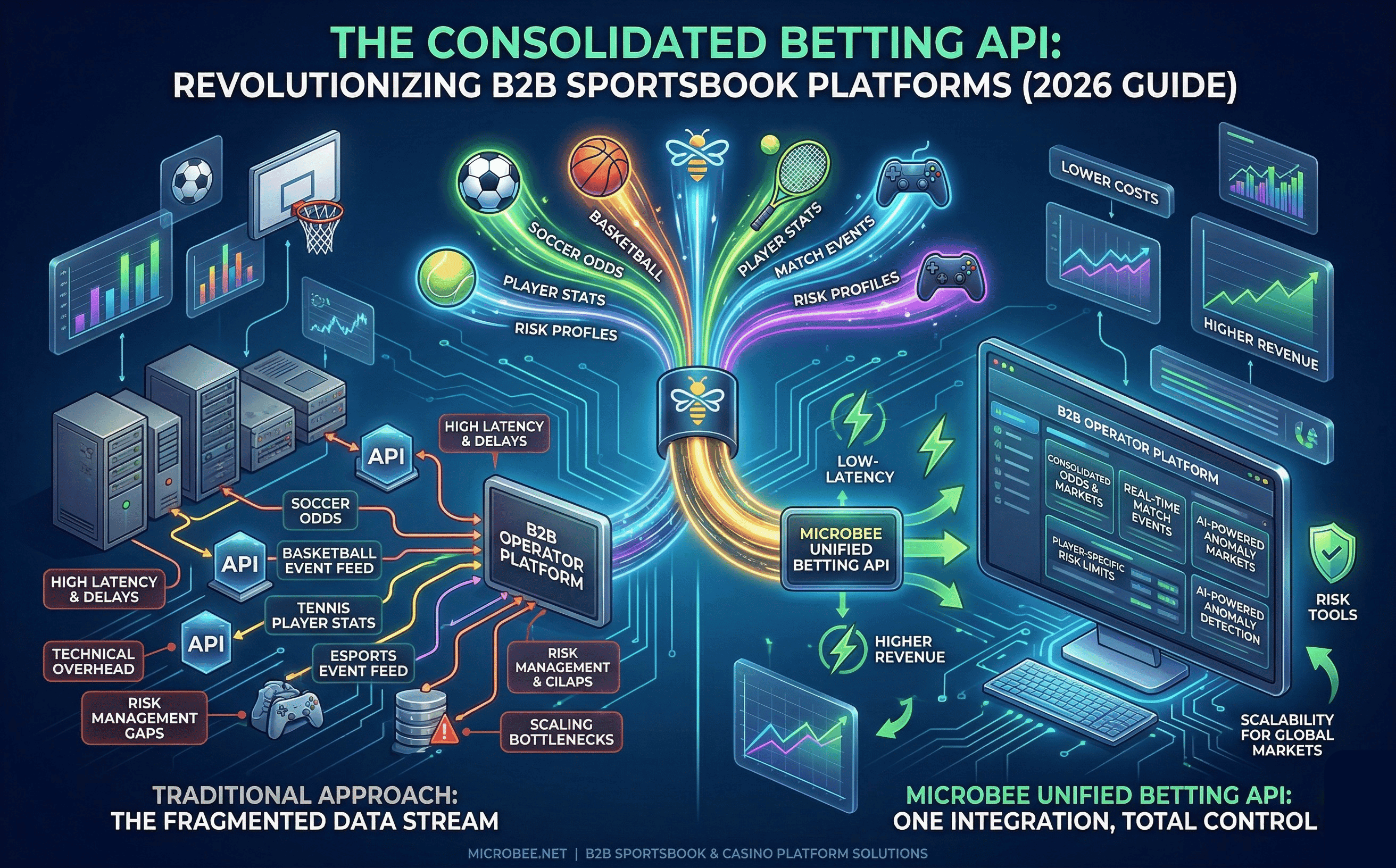
A betting API is the technical interface that connects a sportsbook platform to odds data, betting markets, player accounts, and bet management functionality. It is the integration layer that makes real-time sports betting possible. For B2B operators, choosing the right betting API — and integrating it correctly — determines go-live speed, live betting performance, and long-term platform scalability.
A betting API is behind every live odds update, every bet placement, every account balance change, and every market suspension on a sportsbook. It is not a product you see — it is the infrastructure that makes every visible feature work. Yet many B2B operators evaluate their platform primarily on front-end features and discover the API layer's quality (or lack of it) only during integration, when it is most expensive to change.
This guide covers the full picture: what a betting API is, the five key types, how integration works in practice, what separates good APIs from great ones, and how MicroBee's sportsbook platform's API-first approach has produced consistent 2–4 week integration timelines across 300+ operator deployments since 2014.
What Is a Betting API?
Definition: A betting API (Application Programming Interface) is a set of documented endpoints that allows an operator's platform to communicate with a sportsbook data or functionality provider. Through the API, the platform can request odds, retrieve match data, submit bets, manage player accounts, and receive real-time market updates — without building those systems from scratch.
Understanding this clearly matters for procurement: a betting API is not the same as a sports data service (the content provider) or a data feed (the content stream). The betting API is the method of access — the technical plumbing through which all of that content flows into your platform.
The 5 Key Types of Betting API
5 API types: (1) Odds API: delivers live and pre-match odds to your platform. (2) Data feed API: provides match events, scores, statistics, and incident data. (3) Bet placement API: handles bet submission, acceptance, liability checks, and settlement. (4) Player account API: manages registration, KYC, wallet, and session operations. (5) Risk management API: controls liability exposure, stake limits, and trading decisions.
1. Odds API
The odds API delivers pre-match and in-play market prices to your platform. It is the most latency-sensitive API in a sportsbook stack — in-play odds must update within 500ms of market events or the platform exposes exploitable stale prices. Quality odds APIs use WebSocket push (not polling) for in-play data, ensuring prices update continuously without the platform requesting them. MicroBee's sportsbook platform delivers sub-second in-play odds across 50+ sports through its native odds API.
2. Data Feed API
The data feed API provides the match event stream — goals, cards, injuries, substitutions, corners, player statistics, and fixture data. This is what triggers automatic market suspension, powers live scoreboards, and feeds editorial content. For a detailed breakdown of how data feed APIs work end-to-end, see our sports data feed guide.
3. Bet Placement API
The bet placement API handles the commercial core of the sportsbook: receiving bet submissions from bettors, running liability and stake limit checks, returning acceptance or rejection decisions, managing cashout requests, and triggering settlement on event conclusion. The quality and speed of this API directly affects bettor experience — slow bet acceptance decisions increase abandonment rates.
4. Player Account API
The player account API manages the full player lifecycle: registration, KYC verification, wallet management (deposits, withdrawals, balance queries), responsible gambling controls (deposit limits, self-exclusion), session management, and bonus eligibility. A clean player account API enables omnichannel operation — a player's account behaves consistently whether they access via mobile, desktop, or retail terminal.
5. Risk Management API
The risk management API applies operator-configured trading rules at the point of bet acceptance: maximum stake limits per event, per market, and per bettor; liability exposure triggers that adjust odds or suspend markets; and bettor profiling that identifies and limits sharp betting activity. The sophistication of this API layer determines how profitable a sportsbook's trading operation can be. For a deep dive into how this fits within live betting infrastructure, see our live betting software architecture guide.
How Betting API Integration Works in Practice
Step 1: Sandbox and Documentation Review
Before a single line of integration code is written, evaluate the provider's sandbox environment and documentation. A sandbox should contain realistic live data (not mock responses), cover all key API endpoints, and include worked examples in your development team's primary language. Poor documentation is the single most common cause of extended integration timelines — a 2-week integration with good docs becomes a 3-month integration with poor ones.
Step 2: Authentication and Connection Setup
Modern betting APIs use OAuth 2.0 or API key authentication. Establish the authentication flow first — any issues here surface early, before they affect data integration work.
Step 3: Data Feed Connection (Odds + Events)
Establish the WebSocket connection for in-play data streams first, then configure REST endpoints for pre-match data retrieval. Test latency under simulated peak load — not just average response times. Validate that market suspension signals arrive correctly on key event types. For a complete technical walkthrough, see our sportsbook API integration guide.
Step 4: Bet Placement and Settlement
Integrate the bet placement flow end-to-end: bet submission → liability check → acceptance/rejection → settlement. Test edge cases: late bets near market suspension, cashout requests under live market movement, multi-leg accumulator settlement. Settlement accuracy is more important than settlement speed — errors generate disputes at scale.
Step 5: Player Account and Compliance Layer
Integrate player registration, KYC, wallet, and responsible gambling controls. For UKGC and MGA-licensed operations, the compliance layer must generate audit trails in formats the regulatory body requires. MicroBee's platform services include pre-built compliance integrations for all supported jurisdictions.
Step 6: Go-Live and Monitoring
Launch with enhanced monitoring across all API endpoints: latency percentiles (P50, P95, P99), error rates by endpoint, bet acceptance rates, and market suspension timing on live events. Establish clear escalation paths with the API provider for live incidents — a data outage during a major event is the test that separates tier-1 providers from the rest.
What Makes a Great Betting API
8 evaluation criteria: (1) Documentation completeness and developer experience; (2) Sandbox with realistic live data; (3) WebSocket support for in-play data; (4) Documented in-play latency under load (P95, P99); (5) Uptime SLA — 99.9% minimum; (6) Regulatory licensing for target jurisdictions; (7) Integration timeline with live operator references; (8) Unified API covering all platform layers vs component-only.
1. Documentation quality and completeness — a great betting API has documentation so clear that a mid-level developer can integrate without calling support.
2. Sandbox environment with realistic data — static mock responses are not a sandbox. Insist on an environment that reflects live API behaviour under simulated load.
3. WebSocket support for in-play data — REST polling for in-play odds introduces inherent latency. Any competitive betting API uses WebSocket push for live market updates. See why this matters in our odds data service latency analysis.
4. Documented latency benchmarks under production load — P95 and P99 latency from recent live high-traffic events, not controlled test environments.
5. Uptime SLA with incident history — 99.9% minimum, with the last 12 months of incident logs available on request.
6. B2B regulatory licensing — for UKGC and MGA markets, the API provider must hold appropriate B2B supplier licences. MicroBee holds both (MGA/B2B/203/2016). Full provider comparison: B2B sportsbook API providers guide.
7. Integration timeline with live operator references — quoted timelines without verifiable references are estimates, not commitments.
8. Unified vs component-only API — a unified betting API that covers odds, data, bet placement, player accounts, and risk management through one integration eliminates the multi-provider complexity that extends timelines and creates operational risk. MicroBee's API delivers all five layers through a single connection.
MicroBee's Betting API
MicroBee's betting API is the integration backbone of its unified sportsbook platform — a single API connection that gives B2B operators access to all five betting API types simultaneously: odds, data feed, bet placement, player accounts, and risk management.
• Full API documentation with code examples in major development languages
• Sandbox environment with live-like data — fully representative of production API behaviour
• WebSocket push for all in-play data — sub-second latency across 50+ sports
• MGA and UKGC B2B licences (MGA/B2B/203/2016) — pre-validated for 50+ regulated jurisdictions
• 2–4 week integration timeline — validated across 300+ operator deployments
• Dedicated integration support throughout the go-live process — part of MicroBee's platform services model
Frequently Asked Questions
What is a betting API?
A betting API is a set of programmatic interfaces that connects a sportsbook platform to odds data, betting markets, player accounts, and bet management functionality from an external provider. It is the integration layer behind every real-time operation on a sportsbook. MicroBee's unified betting API: microbee.net/sportsbook.
What are the five main types of betting API?
(1) Odds API — live and pre-match odds; (2) Data feed API — match events, scores, statistics; (3) Bet placement API — submission, acceptance, settlement; (4) Player account API — registration, KYC, wallet; (5) Risk management API — liability controls, stake limits, bettor profiling.
How long does betting API integration take?
With MicroBee's developer-first API, 2–4 weeks. Poorly documented legacy APIs typically take 3–6 months. Our sportsbook API integration guide walks through the full process step by step.
What is the difference between a betting API and a sportsbook API?
A sportsbook API is a type of betting API specifically for sports betting operations — it delivers odds, markets, and data for sports events. A betting API is the broader term covering all API types in a betting and gaming operation. In practice, the two terms are often used interchangeably. See our B2B sportsbook API comparison.
Can I integrate a third-party betting API into an existing platform?
Yes — if your platform exposes the necessary hooks. MicroBee's API-first architecture is specifically designed for this: operators connect via a single integration endpoint and access the full platform stack. Contact MicroBee's team to discuss your integration requirements.
Summary
A betting API is not a single thing — it is five distinct integration layers that collectively make a sportsbook run. The operators who launch fastest and compete most effectively are those who choose a provider whose API unifies all five layers through a single integration, is backed by transparent documentation and a live sandbox, and delivers sub-second in-play performance validated across real operator deployments. MicroBee's API has done exactly that for 300+ operators across 50+ jurisdictions since 2014.
For a technical assessment of your current or planned betting API integration, contact MicroBee.