
MicroBee Platform Engineering Team
Reading Time :
10 Minute
What is a Sports Betting API?
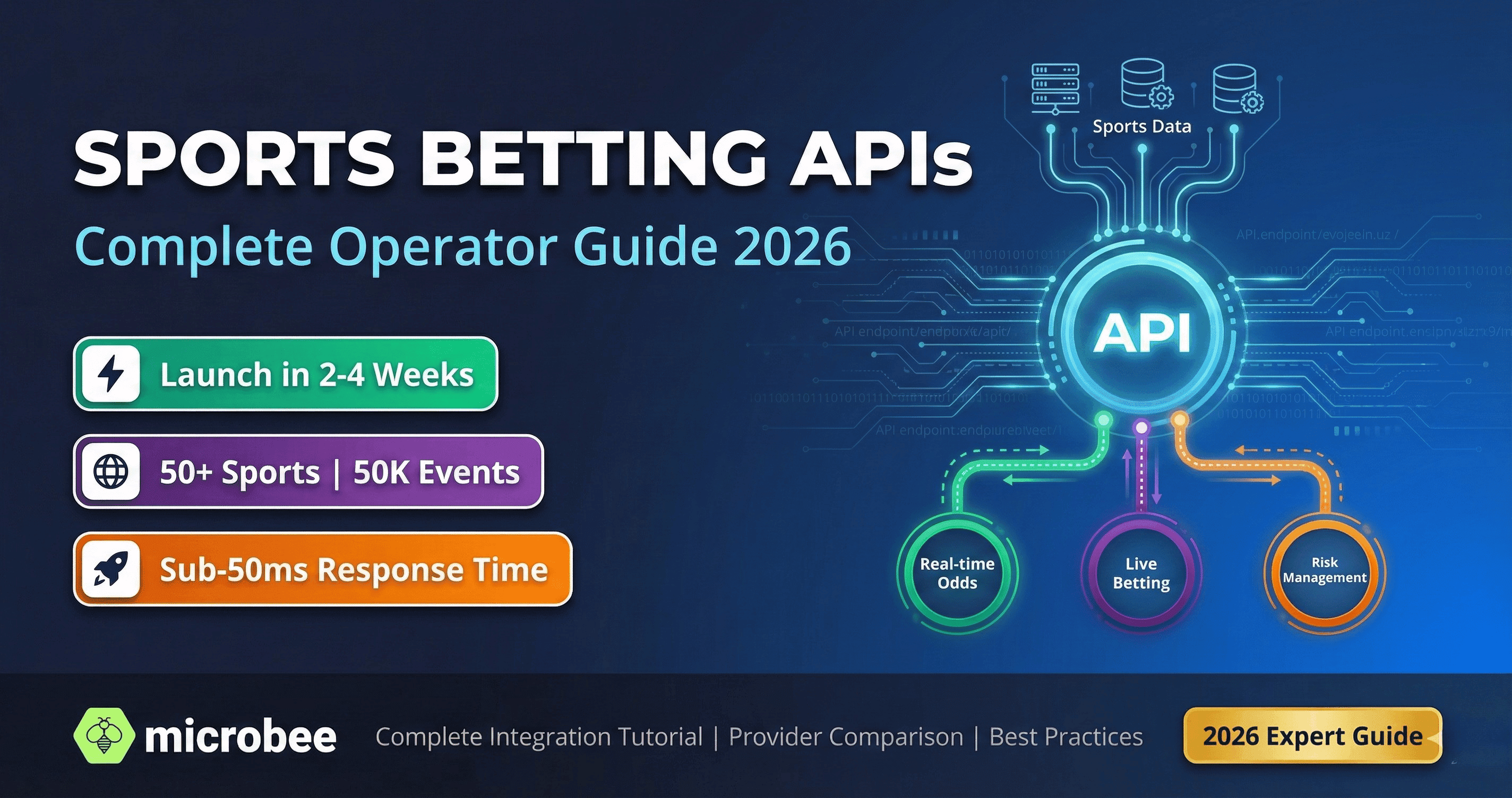
A sports betting API (Application Programming Interface) is the technological bridge that connects your sportsbook platform to the vast ecosystem of real-time sports data, odds calculations, and betting infrastructure. Think of it as the nervous system of modern sports betting operations—transmitting information at lightning speed while processing millions of decisions simultaneously.
In 2026, launching a competitive sportsbook without a robust API is like trying to compete in Formula 1 with a vintage car. Technically possible, but practically impossible.
Why Operators Need Betting APIs
The sports betting landscape has evolved dramatically. What once required massive infrastructure investment and years of development can now launch in weeks through sophisticated API integrations. Here's why this matters:
The Data Complexity Challenge
Modern sports betting generates staggering amounts of data. A single Premier League match produces over 200 pre-match betting markets, 50+ live betting markets, and 1,000+ odds updates during the 90-minute match. Multiply this across 50+ sports with thousands of daily events worldwide, and you're managing a data ecosystem that would overwhelm most in-house development teams.
Consider this: Real-time odds must update every 1-5 seconds during live events. Players expect comprehensive statistics including injury reports, weather conditions, lineup changes, and multi-source verification for accuracy. Building this infrastructure from scratch would require substantial investment in data acquisition, processing systems, and quality control mechanisms.
Speed: The Competitive Differentiator
Players in 2026 don't just expect fast platforms—they demand instantaneous responsiveness. Live betting requires API response times under 50 milliseconds. Odds must update faster than TV broadcasts, which typically run 5-15 seconds behind live action. Bet confirmations need to happen in under one second, and market suspensions must trigger immediately when goals are scored.
The revenue impact of speed is dramatic. A 200-millisecond delay can cost operators significant revenue per major match through arbitrage losses. Research shows 40% of players abandon platforms with slow odds updates, and competitors with faster systems capture the majority of live betting market share.
Regulatory Compliance Complexity
Operating across multiple jurisdictions means navigating a maze of regulatory requirements. Malta Gaming Authority standards differ from UK Gambling Commission requirements, which differ from Curaçao eGaming regulations, which differ from individual US state licenses.
Each jurisdiction mandates specific features: responsible gambling tools including deposit limits and self-exclusion, transaction monitoring with automated fraud detection, age verification through KYC integration, GDPR-compliant data protection, and complete audit trails for regulatory review. Building compliance infrastructure that satisfies all these requirements represents years of development work.
The Infrastructure Investment Reality
Building a competitive sportsbook in-house requires 10-20 software engineers, 2-3 data scientists, 3-5 traders, 2-3 compliance officers, and 24/7 support teams. The development timeline stretches 12-24 months before launch, followed by 3-6 months of testing and refinement. The total financial commitment over two years runs into millions of dollars—capital that could instead fuel customer acquisition and market expansion.
The API Solution
Quality sports betting APIs provide immediate access to infrastructure that took years and millions to develop. Operators gain instant access to 50+ sports covering 50,000+ monthly events, real-time odds compilation with built-in risk management, over 1,000 pre-built market types, comprehensive compliance tools, and proven technology that launches in 2-4 weeks rather than 18+ months.
A UK operator who launched using MicroBee's sportsbook API in 2024 went from contract signature to live operation in just three weeks, using only two developers instead of the 15+ needed for in-house development. Their first-month betting handle reached £850,000 with 99.98% platform uptime—demonstrating how proven API infrastructure accelerates time-to-market while maintaining enterprise-grade reliability.
How Sports Betting APIs Work: The Complete Data Journey
Sports betting APIs orchestrate an intricate symphony of data collection, calculation, and transaction processing. Understanding this journey reveals why quality APIs command premium value.
Step 1: Sports Data Collection
The foundation of any sportsbook is accurate, timely sports data. Leading API providers aggregate information from multiple sources: official sports federations like FIFA, UEFA, NBA, and ATP; professional data providers including Sportradar and Genius Sports; and scout networks with live observers at matches for instant updates.
This multi-source approach captures everything from match schedules and lineups to real-time scores, player performance data, venue information, weather conditions, historical results, injury reports, and live match events including goals, cards, corners, and substitutions.
Step 2: Odds Compilation—The Science Behind the Numbers
Odds compilation combines mathematical modeling, statistical analysis, and trading expertise. The process begins with probability calculation considering historical performance, current form, head-to-head statistics, home/away advantage, weather factors, missing players, and motivation factors.
Here's a practical example: For Manchester United vs Liverpool, analysis might determine true probabilities of 35% home win, 30% draw, and 35% away win. Adding a 5% bookmaker margin transforms these into odds of approximately 2.60 (home), 3.20 (draw), and 2.80 (away). These calculations happen continuously, adjusting to new information in real-time.
Step 3: Risk Management—Balancing the Book
Professional sportsbooks don't gamble—they manage risk scientifically. Sophisticated systems track liability across every outcome, monitoring large bets, detecting suspicious patterns, setting maximum exposure limits, and automatically adjusting odds to balance the book.
Consider a Barcelona vs Real Madrid match with €100,000 in total bets but €60,000 exposure on Barcelona, €15,000 on the draw, and only €25,000 on Real Madrid. This imbalance triggers automated responses: reducing Barcelona odds to make them less attractive, increasing Real Madrid odds to encourage bets, promoting alternative markets, and setting stake limits on Barcelona bets. The goal is guaranteeing profit regardless of the match outcome.
Step 4: Real-Time Updates During Live Betting
Live betting happens at breathtaking speed. When a corner kick is awarded, the entire system responds within 50 milliseconds: data feeds detect the event in 10ms, the odds engine recalculates 200+ markets in 20ms, the risk system checks current liability in 5ms, the API pushes updates via WebSocket in 10ms, and the operator's platform displays new odds to players in 5ms. This cycle repeats 500-1,000 times per match.
Critical moments trigger automatic market suspensions. Goals scored suspend markets for 30-90 seconds while odds recalculate. Penalty awards, red cards, and VAR reviews all trigger suspensions preventing players from betting on outcomes they may have already seen via TV broadcast delays.
Step 5: Bet Placement and Validation
When a player places a bet, sophisticated validation occurs in under 500 milliseconds. The system verifies odds are still current and the market remains open, confirms the player hasn't exceeded deposit or betting limits, checks responsible gambling restrictions and self-exclusion status, validates the stake falls within market maximums and operator liability limits, and screens for suspicious patterns.
Three outcomes are possible: bet accepted with instant confirmation, odds changed with the player offered new odds to accept or reject, or bet rejected due to market suspension or exceeded limits.
Step 6: Settlement and Payout
After match completion, automated settlement begins immediately. The system verifies results from multiple sources—if primary and secondary sources disagree within 30 seconds, manual review is triggered. All bets calculate automatically, with winnings credited to player accounts, losses marked as settled, and void bets refunded where applicable.
Settlement timeframes vary by bet type: pre-match bets settle within five minutes of full-time, live bets within five minutes, player props within 30 minutes for statistics verification, and tournament outrights within 24 hours of completion. Complete audit trails maintain records for every bet including screenshots of confirmations, timestamps of odds accepted, match status at placement time, and settlement calculations.
Key Features of Modern Betting APIs
1. Real-Time Odds Updates: Why Milliseconds Matter
In live betting, speed isn't just a feature—it's your competitive advantage. Industry benchmarks reveal stark differences: premium providers deliver sub-50ms response times creating competitive edge and player loyalty; standard providers at 100-200ms offer acceptable performance for most markets; poor performers above 300ms suffer player abandonment and reputation damage.
The business consequences are dramatic. Platforms with slow performance above 200ms experience 40% player abandonment as customers switch to faster competitors, significant arbitrage losses during major events, negative reviews on industry forums, and reduced live betting participation as players avoid markets they can't trust.
Fast platforms under 50ms achieve higher player retention, increased live betting activity, reduced arbitrage risk as odds change before windows open, and market positioning as "the responsive platform."
The technology enabling this speed includes WebSocket connections maintaining persistent open connections to APIs with server-pushed updates eliminating polling delays, supporting 100,000+ simultaneous connections with automatic reconnection on network failure. Geographic distribution deploys API servers across 5+ global regions, automatically routing players to nearest servers, achieving sub-30ms latency worldwide with redundant infrastructure.
2. Comprehensive Sports Coverage
Complete coverage in 2026 spans three tiers. Tier 1 must-have sports include football with 200+ leagues worldwide from Premier League to lower divisions, basketball covering NBA, EuroLeague, and 50+ leagues globally, tennis across ATP, WTA, Grand Slams, and challenger events, American football including NFL and college, baseball with MLB and international leagues, and ice hockey covering NHL and European competitions.
Tier 2 important sports encompass cricket with international matches and IPL, rugby union and league, golf across PGA and European tours, combat sports including boxing and UFC, motor sports from Formula 1 to NASCAR, and esports covering League of Legends, CS2, Dota 2, and Valorant.
Tier 3 niche sports for market differentiation include darts, snooker, handball, volleyball, table tennis, cycling, winter sports, swimming, and novelty markets covering entertainment and politics.
For each sport, comprehensive APIs provide 50-200+ pre-match markets per major event, 20-100+ live betting markets, complete league coverage across all professional levels, statistical data with historical results and form guides, and team/player information including injury updates.
MicroBee's platform delivers 50+ sports across all tiers, 50,000+ live events monthly, coverage in 200+ countries, 1,000+ betting markets per major match, and 365-day availability with no off-season gaps.
3. Diverse Betting Markets Beyond Basic Results
Modern players expect hundreds of betting options per event. For a typical Premier League football match, core markets include match result, double chance, draw no bet, handicap betting, over/under goals at multiple lines, and both teams to score.
Advanced markets expand options dramatically: correct score with 30+ possibilities, half-time/full-time combinations, first/last/anytime goalscorer markets, time of first goal brackets, winning margin options, corners and cards totals, player-specific bookings, team to score first, odd/even goals, and clean sheet markets.
Statistical markets add another dimension: total shots, shots on target, player shots, passes completed, possession percentage, offsides count, and more.
Live betting introduces time-sensitive markets like next goal, next corner, next card, and match progression markets including score in next 10 minutes, winner of second half, and total goals in specific periods.
Micro-markets enable instant betting on outcome of next attack, corners within 5 minutes, and cards in next 10 minutes.
The bet builder feature, increasingly popular in 2026, allows players to create completely customized combinations: "Manchester United to win + Over 2.5 goals + Ronaldo to score + 5+ corners" all in a single bet with AI-calculated combined odds. Same game parlays let casual bettors combine multiple selections from one match for higher odds and increased engagement.
Cash out functionality provides full or partial settlement before events conclude, available pre-match and during live betting, calculated dynamically based on current match situations, giving players control and reducing risk.
4. Risk Management Tools Protecting Profitability
Professional sportsbooks employ sophisticated systems ensuring sustainable margins. Automated risk controls include stake limitations per player, per market, and per event, with dynamic limits adjusting based on player betting history and risk profile.
Exposure management caps maximum liability per outcome, limits total event exposure, manages portfolio risk across multiple simultaneous events, and ensures liability balance across possible outcomes.
Odds protection implements minimum odds acceptance thresholds, reduces stake limits for high-odds selections, ensures adequate bookmaker margins, and limits dramatic odds shifts.
Automated market suspensions trigger on goals scored (30-90 second suspension), red cards shown (45 seconds), penalties awarded (60 seconds), VAR reviews (until official decision), high liability reached, and data feed issues.
Suspicious betting detection flags arbitrage patterns, bonus abuse, unusual market timing, coordinated betting across accounts, and low-liquidity exploitation. Automated responses include flagging accounts for review, reducing stake limits, requiring manual bet approval, temporarily suspending accounts, and alerting compliance teams.
Professional trading dashboards provide real-time liability monitoring with visual heat maps, alert systems for unusual activity, and player tracking for VIP and sharp bettors. Manual interventions allow traders to override automated odds, manage markets, classify players, approve high-stakes wagers, and modify limits in real-time.
5. Fast and Reliable Infrastructure
Critical performance metrics distinguish premium providers. API response time under 50ms represents excellent performance, while 50-150ms is acceptable and above 200ms is poor. Odds update frequency for live betting should occur every 1-3 seconds (excellent) versus 5-10 seconds (acceptable) or over 15 seconds (poor). Platform uptime of 99.99% means only 52 minutes maximum downtime per year. Concurrent user capacity should exceed 100,000, with systems processing 10,000+ bets per second.
MicroBee's performance standards include sub-50ms API response time at 99th percentile measurement, 99.99% uptime guarantee, capacity for 100,000+ concurrent users per instance, auto-scaling handling traffic spikes automatically, and geographic distribution ensuring low latency worldwide.
During the UEFA Champions League Final 2024, MicroBee's infrastructure demonstrated its capabilities: 180,000 peak concurrent users, 2.3 million total bets processed, auto-scaling from 12 to 187 server instances in 4 minutes, zero seconds of downtime, while three major competitor platforms experienced outages during the same event.
6. Multi-Currency and Global Payment Support
Essential for international operations, modern APIs support 50+ global currencies with real-time exchange rates, multi-currency wallet management, automatic conversion, and local currency display for players.
Payment method integration includes mainstream options like credit/debit cards (Visa, Mastercard, Maestro), PayPal, Skrill, Neteller, and bank transfers. Regional methods cover Europe (Paysafecard, Trustly, Sofort, Giropay), India (UPI, Paytm, PhonePe), Asia (WeChat Pay, Alipay, LINE Pay), Latin America (Boleto, PIX, Mercado Pago), and cryptocurrency (Bitcoin, Ethereum, USDT, Litecoin).
Pre-built connections to 100+ payment providers enable secure transaction processing, fraud prevention systems, chargeback management, and PCI DSS compliance.
7. Mobile-First Design
With 75% of all sports bets placed on mobile devices in 2026 and 83% of live bets via smartphones, mobile optimization is mandatory. Mobile-only players represent the fastest-growing segment, and app users demonstrate 40% higher lifetime value than desktop-only users.
Mobile-optimized APIs provide responsive design for various screen sizes, optimized data payloads minimizing bandwidth consumption, native iOS SDK support in Swift, native Android SDK support in Kotlin/Java, Progressive Web App compatibility, and offline betting capability syncing when connection restores.
Mobile-specific features include touch-optimized bet placement, quick bet functionality with one-tap betting, mobile push notifications for results, biometric authentication (FaceID, TouchID, fingerprint), mobile-optimized cash out interfaces, and data-saving modes for limited bandwidth.
Types of Sports Betting APIs
1. Odds Feed APIs
Odds feed APIs provide raw odds data only—no betting engine, risk management, or settlement systems. They serve operators who already have betting engines and transaction systems but need real-time sports data and odds.
Advantages include lower monthly fees, complete control over betting logic and risk management, full customization freedom, and the ability to combine data from multiple providers.
Disadvantages require building the entire betting engine yourself, taking full risk management responsibility, developing settlement systems, significantly longer development timelines, and higher technical expertise requirements.
This approach suits large operators with substantial in-house development teams, companies with existing betting infrastructure, operators wanting complete control over betting logic, and businesses with unique betting product requirements.
2. Full Sportsbook APIs (Most Common)
Full sportsbook APIs deliver complete end-to-end solutions including odds data, betting engine, risk management, and settlement—representing the most common choice for operators.
Advantages include fastest time to market (2-4 weeks typical), proven battle-tested infrastructure, built-in compliance and risk management tools, regular updates and new features, comprehensive technical support, and the ability to focus resources on customer acquisition rather than infrastructure.
Disadvantages involve higher monthly subscription fees, less customization than building in-house, dependency on single provider, and working within the provider's framework.
Full sportsbook APIs best serve new operators entering the market, white-label platform providers, operators prioritizing rapid market entry, businesses without large technical teams, and companies wanting proven, reliable technology.
What's included: real-time odds for 50+ sports, complete betting engine with instant bet processing, trading system with automated risk controls, settlement and result verification, player management integration capabilities, comprehensive reporting and analytics, 24/7 technical support, and regular platform updates.
MicroBee's Sportsbook API exemplifies this category, providing all components in one integrated package.
3. White Label APIs
White label APIs offer fully branded sportsbooks powered entirely by provider infrastructure—complete outsourcing with absolutely zero technical overhead.
Advantages include quickest possible launch (days to weeks), lowest technical requirements (no development team needed), provider handling all technical operations, compliance and licensing support often included, and minimal operational overhead.
Disadvantages involve very limited customization options, shared infrastructure with other operators, lower profit margins as providers take larger shares, less control over user experience, and more difficult brand differentiation.
White label suits affiliate websites transitioning to operators, media companies adding betting, casino operators expanding into sports, small startups testing market viability, and businesses without technical resources.
4. Microservices APIs
Microservices APIs provide modular components allowing operators to select only needed services. Available components include odds feed service (sports data and odds only), bet placement service (bet processing and validation), settlement service (result verification and payout calculation), risk management service (automated trading and exposure monitoring), player management service (account management and KYC), and payment service (transaction processing).
Advantages include paying only for services actually used, flexible integration approaches, ability to mix and match multiple providers, independent scaling of individual components, and upgrading components as business grows.
Disadvantages involve more complex technical integration, requiring strong technical expertise, coordinating multiple API services, potentially higher total costs, and more moving parts to maintain.
Microservices suit mid-size operators expanding feature sets, businesses with specific requirements, operators upgrading existing systems gradually, and companies wanting best-of-breed components.
API Architecture and Technology
Communication Protocols
REST API (Request-Response Model)
REST APIs excel for pre-match odds retrieval, user account operations (login, registration, balance checks), bet history queries, static data (team information, league schedules), and administrative functions.
Characteristics include request sent waiting for response, stateless communication, standard HTTP methods (GET, POST, PUT, DELETE), JSON or XML data formats, cacheable responses, and simple implementation.
Typical use cases: fetching upcoming match fixtures, retrieving pre-match odds, placing bets before matches start, checking bet history, and account balance inquiries.
WebSocket API (Real-Time Push)
WebSocket APIs handle live match odds updates, real-time score notifications, market suspension/reopening alerts, in-play betting odds, and instant result notifications.
Characteristics include persistent bidirectional connections, server-pushed instant updates, no polling required for efficiency, real-time data streaming, and lower latency than REST.
Typical use cases: live betting odds updating every 1-3 seconds, instant score change notifications, market suspensions during goals, real-time player statistics, and live match events (goals, cards, corners).
Authentication and Security
API Key Authentication provides simple secret key authentication included in requests, offering easy implementation, good for server-to-server communication, and fast authentication. This suits development and testing environments and internal systems.
OAuth 2.0 (Industry Standard) implements token-based authentication with expiring access tokens, providing more security than API keys, token revocation capabilities, fine-grained permission control, and industry best practices. OAuth 2.0 suits production environments, third-party integrations, and mobile applications.
Security Best Practices
Transport security requires HTTPS/TLS encryption mandatory for all API calls, modern TLS versions only (1.2+), strong cipher suites, and certificate validation.
Access control implements IP whitelisting for production environments, rate limiting preventing abuse (e.g., 1000 requests per minute), request throttling during high traffic, and geographic restrictions where required.
Data protection ensures sensitive data encrypted at rest, personal information anonymized in logs, regular security audits, penetration testing, and GDPR compliance.
API security includes webhook signature verification, request signing for critical operations, regular API key rotation, multi-factor authentication for admin access, and intrusion detection systems.
Data Formats
JSON (JavaScript Object Notation) represents the industry standard for several reasons: human-readable format, lightweight and efficient, native support in all modern programming languages, easy parsing and generation, and flexible structure.
Typical JSON responses contain match identification (ID, teams, league), timing information (kickoff time, current match time if live), available markets (match result, over/under, etc.), current odds for each outcome, market status (open, suspended, closed), and metadata (last update timestamp, data source).
XML (eXtensible Markup Language) provides legacy support for integration with legacy systems, enterprise systems requiring XML, specific regulatory requirements, and backwards compatibility. XML characteristics include more verbose than JSON, self-describing format, strong typing, and schema validation.
Protocol Buffers (High Performance) offer advanced binary formats used for internal high-performance systems, providing 50% smaller payloads than JSON, significantly faster parsing, strong typing and schema, though not typically exposed to external clients.
Integration Process Overview
Phase 1: Planning and Preparation (Week 1)
Step 1: Provider Selection
The evaluation process involves researching 3-5 potential providers, requesting product demonstrations, reviewing technical documentation, checking client references, verifying licensing and compliance credentials, and comparing features and capabilities.
Step 2: Documentation Review
Understanding API endpoint structure and naming conventions, available data models and schemas, rate limits and usage quotas, authentication methods, error handling procedures, and SDK availability for your technology stack proves critical.
Step 3: Credentials and Access
Obtain contract signature and commercial terms, sandbox API keys for testing, access to test environment, developer documentation portal, support channel access (Slack, Discord, email), and technical contact information.
Step 4: Environment Setup
Prepare development server configuration, testing environment setup, API testing tools installation (Postman, Insomnia), SDK installation if applicable, version control system readiness, and staging environment for pre-production testing.
Phase 2: Basic Integration (Week 2)
Core integration steps include:
1. Authentication Implementation: Establish secure API connection, implement authentication flow, test connection stability, handle authentication errors, and set up token refresh if using OAuth.
2. Sports and League Data: Retrieve available sports lists, fetch league information for each sport, understand data hierarchies, cache static data appropriately, and test data refresh cycles.
3. Pre-Match Odds Display: Fetch upcoming match fixtures, display match information (teams, time, venue), show available betting markets, present odds in user-friendly formats, and implement odds update mechanisms.
4. Test Bet Placement: Implement bet validation, handle bet submission, process bet confirmation, display bet tickets, and test error scenarios (insufficient funds, invalid market, etc.).
Phase 3: Live Betting Integration (Week 3)
Real-time features require:
1. WebSocket Connection: Establish persistent connection to live data feed, implement connection monitoring, handle reconnection on failure, subscribe to specific match updates, and process real-time data efficiently.
2. Live Data Handling: Receive and process odds updates, display score changes instantly, show match statistics in real-time, handle market suspensions, implement market reopening, and update UI without page refresh.
3. Live Bet Placement: Validate odds are still current before acceptance, handle rapid odds changes, implement odds change acceptance flow, show clear bet confirmation, and handle market suspension during bet placement.
4. Cash Out Implementation: Calculate current cash out values, display cash out offers to players, handle full cash out, implement partial cash out, process cash out confirmation, and update account balances immediately.
Phase 4: Advanced Features (Week 4)
Enhanced functionality includes:
1. Bet Builder Integration: Fetch available selections for matches, allow multiple selection combinations, calculate combined odds accurately, handle correlation restrictions, display clear bet building interfaces, and validate custom bet combinations.
2. Risk Management Integration: Implement stake limit enforcement, display remaining betting limits to players, handle liability-based bet rejection, show clear rejection reasons, and integrate with responsible gambling tools.
3. Reporting and Analytics: Integrate betting reports, display player statistics, show win/loss summaries, implement financial reporting, create admin dashboards, and set up automated reports.
4. Mobile Optimization: Test on multiple devices, optimize for touchscreen interaction, implement mobile-specific features, test in various network conditions, optimize data usage, and implement offline caching where appropriate.
Phase 5: Testing and Launch
Comprehensive Testing
Functional testing verifies all betting markets, odds accuracy, settlement correctness, cashout calculations, all error scenarios, and responsible gambling features.
Performance testing includes load testing concurrent users, stress testing peak traffic simulation, latency measurement, API response time verification, database query optimization, and frontend performance optimization.
Security audit encompasses penetration testing, vulnerability assessment, API key protection verification, data encryption confirmation, HTTPS implementation check, and authentication security review.
Compliance verification tests age verification, KYC process validation, responsible gambling tools, self-exclusion system verification, transaction limit enforcement, geolocation accuracy, and regulatory reporting capability.
Go-Live Process
Switch from sandbox to production API keys, deploy to production environment, monitor system closely for first 24-48 hours, have support team on standby, implement gradual traffic ramp-up, monitor error rates and performance metrics, and collect user feedback immediately.
How to Choose the Right Provider
Critical Evaluation Criteria
1. Technical Performance
Before committing to any provider, conduct thorough performance testing. Measure API response time for odds requests, WebSocket update frequency, time to first bet placement, settlement speed after match completion, and system behavior under load.
Testing process involves requesting sandbox access, running automated performance tests, measuring response times over 24-hour periods, testing during high-traffic events, simulating concurrent user load, and checking geographic latency from target markets.
Performance benchmarks to target: REST API response under 50ms (excellent) or under 150ms (acceptable), WebSocket updates every 1-3 seconds (excellent) or under 10 seconds (acceptable), bet placement confirmation under 1 second, historical uptime 99.9%+ with proof, and concurrent user capacity sufficient for your scale plus 5x growth.
2. Sports and Market Coverage
Essential coverage checklist includes minimum 30+ sports for competitive platforms or 50+ for comprehensive offerings, coverage of all major leagues in target markets, and niche sports for differentiation.
Event volume should reach minimum 30,000 events monthly or 50,000+ for leading platforms with year-round coverage avoiding seasonal gaps.
Market depth requires minimum 50 markets per major match, 100-200+ markets for premium matches, 20-50 live betting markets, bet builder availability, and cash out on major markets.
Critical questions for providers: How many events per month across all sports? Which leagues are covered for each sport? What's the average number of markets per event? How quickly are new leagues/sports added? Can I customize which sports/markets to offer? What's the historical data depth?
3. Licensing and Compliance
Regulatory due diligence demands verifying provider licensing: Is the technology itself licensed by gambling authorities? Which jurisdictions approve this technology? Can they provide license documentation? What compliance certifications do they hold?
Critical licenses to verify include Malta Gaming Authority (MGA) for European gold standard, UK Gambling Commission (UKGC) for strictest global standards, Curacao eGaming for international operations, ISO 27001 for information security, and PCI DSS for payment card industry compliance.
Compliance tools assessment must include KYC integration, AML monitoring, responsible gambling tool suite, self-exclusion database connectivity, geolocation verification, transaction monitoring and reporting, age verification systems, and audit trail capabilities.
Data rights verification asks: Does provider own all data rights? Are there jurisdiction restrictions? What happens if data licenses expire? Can they guarantee uninterrupted service?
Red flags to avoid include unwillingness to provide licensing documentation, vagueness about data source legality, inability to discuss regulatory compliance clearly, avoidance of jurisdiction restriction questions, and no clear answer on data ownership.
4. Integration Complexity
Development requirements assessment evaluates documentation quality including comprehensive API documentation, interactive API explorer (Swagger/Postman collection), clear integration guides, video tutorials, sample implementations, and troubleshooting guides.
Technical support should provide dedicated integration engineer assignment, defined onboarding process, developer community or forum, response time commitments (e.g., under 4 hours), support hours (24/7 vs business hours), and multiple support channels (email, chat, phone).
SDK availability in your preferred programming languages, well-documented SDK usage, regular SDK updates, and code examples proves essential.
Integration timeline examples: White label (1-2 weeks, low complexity), standard API with custom UI (3-4 weeks, medium complexity), complex custom (6-8 weeks, high complexity), microservices (8-12 weeks, very high complexity).
Questions to ask providers: What's the average integration time for similar operators? Do you provide integration support? Is technical support available 24/7? What's the escalation process for critical issues? Do you offer migration support from other providers? Are there integration success stories I can reference?
5. Track Record and References
Company verification involves background research on years in business (prefer 5+ years minimum), number of operators currently served, total betting handle processed annually, geographic presence, financial stability indicators, and company ownership structure.
Client references should include 3-5 operator contacts, preferably operators similar to your size/market, and ask for both successful and challenging implementations.
Reference interview questions: How long have you used this platform? Any major outages or technical issues? How responsive is technical support? Were there unexpected costs after launch? What were the integration challenges? Would you choose them again? What's one thing you wish you'd known before signing?
Online research encompasses industry forum discussions (CAP, SBC forums), LinkedIn testimonials and company reviews, Google reviews (with appropriate skepticism), industry news mentions, award wins or recognitions, and conference presence and speaking engagements.
6. Scalability and Future-Proofing
Growth capacity assessment asks: Can platform handle 10x your current projected traffic? What auto-scaling capabilities exist? Is geographic expansion supported? Can you manage multi-brands? What white-label capabilities are available?
Feature roadmap consideration includes new sports and markets in development, technology update frequency, innovation track record, and beta program for new features.
Business scalability examines volume discounts as you grow, enterprise tier availability, multi-jurisdiction deployment, multiple currency support expansion, and new payment method additions.
Common Challenges and Solutions
Challenge 1: API Latency Issues
Problem: Slow API responses causing poor user experience and potential revenue loss.
Symptoms: Odds take several seconds to update, bets require 5+ seconds to confirm, players complain about delays, losing competitive bets to faster platforms, higher bounce rates during live betting.
Root Causes: Geographic distance between your servers and API servers, poor internet connection quality, inefficient implementation, API provider infrastructure issues, network congestion.
Solutions:
Use Regional API Endpoints: Most quality providers offer multiple geographic endpoints. Always connect to the nearest region—European operators to EU servers, Asian operators to Asia-Pacific servers, Americas operators to US/Americas servers. This reduces latency by 50-150ms typically.
Implement Caching Strategy: Cache static or slow-changing data including team and league information (cache for hours), historical statistics (cache for days), and pre-match odds (cache for 30-60 seconds). Never cache live betting odds, scores, or market status.
Optimize API Calls: Batch requests when possible instead of individual calls, request only data you actually display, use compression for large responses, and implement request prioritization with live data first.
Connection Pooling: Maintain persistent connections to API, reuse connections instead of creating new ones, reducing connection establishment overhead and dramatically improving response times.
Content Delivery Network (CDN): Host static assets (images, logos) on CDN, reducing load on primary servers, enabling faster delivery to players worldwide, and freeing bandwidth for API calls.
Monitoring and Alerting: Continuously monitor API response times, set up alerts for latency spikes, track performance trends over time, and identify patterns causing slowdowns.
Challenge 2: Data Inconsistencies
Problem: Odds or scores don't match between your API and other sources players might check.
Causes: Multiple data providers with different feeds, time zone confusion in match schedules, cache synchronization issues, provider data errors, delayed settlement.
Solutions:
Multi-Source Verification: For critical events and settlements, use 2-3 data sources for verification, implement voting mechanism (2 out of 3 agreement), flag discrepancies for manual review, and don't settle disputed results immediately.
Clear Timestamp Handling: Always use UTC internally, convert to player's timezone only for display, store all timestamps in consistent format, and account for daylight saving time changes.
Reconciliation Process: Regularly compare your data with trusted sources, automate discrepancy detection, suspend markets with significant odds differences, and investigate and resolve mismatches before settlement.
Clear Communication: Display data source to players, explain settlement rules clearly, provide dispute resolution process, and maintain complete audit trail.
Challenge 3: Market Suspensions
Problem: Markets suspend unexpectedly during critical moments, frustrating players.
Why Markets Suspend: Goals scored (30-90 second suspension), red cards shown, penalties awarded, VAR reviews, data feed interruptions, high liability detected by risk system.
Solutions:
Clear UI Indicators: When markets suspend, show prominent suspension message, explain reason (e.g., "Goal scored - updating odds"), display countdown to market reopening, show estimated time to reopen, disable betting buttons visibly, and keep previously displayed odds visible for reference.
Bet Queuing Option: Allow players to queue bets during suspension—player selects bet during suspension, system queues bet for submission, automatically submits when market reopens, gives player choice to accept odds change, reducing player frustration.
"Accept Any Odds" Feature: Let players choose their risk tolerance—accept any odds (immediate placement), accept odds within X% change, or reject if odds change at all—giving players control.
Proactive Communication: Educate players about suspension reasons, explain it protects them from unfair odds, show suspension is temporary, and display suspension statistics (builds trust).
Challenge 4: High Traffic Management
Problem: Platform slows down or crashes during major events.
Symptoms: API timeouts, slow page loads, failed bet placements, database errors, player complaints spike.
Solutions:
Load Testing Before Major Events: Simulate expected traffic, test with 2x expected load, identify bottlenecks, and optimize before event.
Auto-Scaling Infrastructure: Use cloud services that scale automatically, add servers during traffic spikes, scale down after event, and pay only for what you use.
Request Rate Limiting: Limit requests per user, prevent individual users overloading system, protect API from abuse, and ensure fair access for all.
Request Debouncing: Prevent rapid repeated requests, wait X milliseconds before processing, reduce unnecessary API calls, and improve user experience.
Circuit Breaker Pattern: Detect when API is struggling, temporarily stop requests, display maintenance message, automatically retry when recovered, preventing cascade failures.
Database Optimization: Index frequently queried fields, optimize slow queries, implement database caching, and consider read replicas for high traffic.
Challenge 5: Bet Settlement Disputes
Problem: Players dispute bet outcomes, claiming incorrect settlement.
Common Disputes: "My bet should have won," "Settlement was incorrect," "Odds changed after I placed bet," "Market was suspended but my bet still counted."
Prevention Strategies:
Comprehensive Record Keeping: For every bet, store exact odds accepted, timestamp of bet placement, match status at time of placement, market status (open/suspended), IP address and device, screenshot of bet confirmation, and API response data.
Automated Verification: Cross-check results with multiple sources, use automated settlement validation, flag unusual settlements, and manually review disputed bets.
Clear Settlement Rules: Display before bet placement when bet settles (e.g., "90 minutes only"), what counts (e.g., "Own goals count"), what doesn't count (e.g., "Extra time doesn't count"), and void conditions (e.g., "Void if player doesn't start").
Dispute Resolution Process: Enable easy dispute submission, acknowledge disputes within 24 hours, investigate thoroughly, provide detailed explanation, resolve fairly and quickly, and learn from disputes to prevent future issues.
Transparency: Show settlement rules for each market, display data sources, explain calculation methods, and maintain public settlement policies.
Future Trends in Betting APIs
1. AI-Powered Odds Compilation
Current State (2026): Hybrid approach with human traders supported by algorithms.
Future (2026-2028): Fully automated AI-driven odds compilation.
What's Changing: Machine learning models predict outcomes with increasing accuracy, real-time pattern recognition adjusts odds based on betting behavior, automated risk management without human intervention, personalized odds tailored to individual player risk profiles, and predictive analytics anticipate market movements before they happen.
Impact on Operators: Faster odds updates (sub-second), lower operational costs (fewer traders needed), more accurate pricing, better risk management, and competitive advantage through superior data science.
2. Blockchain and Cryptocurrency Integration
Growing Trends:
Cryptocurrency Adoption: Standard payment option by 2026-2027, Bitcoin, Ethereum, USDT common deposit methods, instant deposits and withdrawals, lower transaction fees, appealing to younger demographics.
Smart Contract Betting: Provably fair outcomes verified on blockchain, instant settlement without intermediary, transparent algorithms and calculations, immutable bet records, decentralized betting platforms emerging.
NFT Integration: VIP programs using NFTs, exclusive access to special markets, loyalty rewards as NFTs, tradeable betting benefits.
DAO Governance: Community-governed betting platforms, token holders vote on features, transparent decision-making, shared platform ownership.
3. Micro-Betting and Instant Gratification
The Next Evolution: Betting on events happening in next 30-60 seconds.
Examples: Next throw-in (football), next pitch outcome (baseball - ball, strike, hit), next point winner (tennis), next foul/corner/card (football), outcome of current possession (basketball).
Why It Matters: Appeals to younger players with short attention spans, higher bet frequency equals more revenue, increased engagement during matches, lower individual stakes but higher volume, and constant action keeps players engaged.
Technical Requirements: Sub-20ms API latency essential, real-time event detection, instant settlement, rapid odds calculation, high-frequency data processing.
4. Social Betting Features
Collaborative Betting Experiences:
Shared Bet Slips: Players share bets via social media, friends can copy interesting bets, influencer bet following, community betting trends.
Group Betting Pools: Friends pool money for big bets, split winnings automatically, private betting leagues, social competition.
Live Leaderboards: Real-time ranking of biggest winners, tournament-style betting competitions, bragging rights and social status, community engagement.
Integration: Twitter/X sharing, WhatsApp group betting, Facebook integration, TikTok betting content.
5. Augmented Reality (AR) Betting
The Vision for 2027-2030:
AR Glasses Experience: Point device at live match or TV, see real-time odds overlaid on screen, virtual betting interface in field of view, place bets by looking and gesturing.
Voice-Activated Betting: "Alexa, bet $10 on next goal Manchester United," "Hey Google, show me odds for Lakers game," "Siri, cash out my Liverpool bet."
Stadium AR: Attend match with AR glasses, see live odds while watching play, player statistics overlaid on field, instant betting without phone.
Challenges: Verification (confirming it's account holder), misunderstandings (voice recognition errors), regulatory approval needed, technology adoption timeline.
6. Responsible Gambling AI
Proactive Problem Gambling Prevention:
AI Pattern Recognition: Detect problem gambling before crisis, identify chase-loss behavior, flag increasing stake patterns, notice time-of-day patterns (late night betting), detect emotional betting (after losses).
Automated Interventions: Mandatory cooling-off periods, gentle nudges to stop, deposit limit suggestions, reality checks (time/money spent), direct contact from support team.
Predictive Risk Scoring: Each player gets risk score, updated in real-time, higher risk equals more protections, lower risk equals normal experience.
Better Than Current: Current systems are reactive (wait for problem to develop), future systems are proactive (prevent problems before they start), AI predicts issues before players self-report.
7. Voice and Conversational Betting
Natural Language Interfaces:
Smart Assistant Integration: "Hey Siri, place $20 on Liverpool to win," "Alexa, what are the odds for the Lakers game?" "Google, show me today's football matches," "Siri, cash out all my active bets."
Chatbot Betting: Text-based betting via chat, natural language understanding, "Bet ten dollars on the home team," system confirms and places bet.
Challenges to Solve: Voice verification (is it really the account holder?), ambiguity resolution (which Liverpool match?), error handling (misheard commands), regulatory compliance (documented consent).
Timeline: Mainstream adoption 2026-2028.
8. Predictive Analytics as a Service
APIs Provide Intelligence, Not Just Data:
Beyond Odds: AI match predictions with confidence levels, key factors influencing predictions, betting value identification, expected value calculations, statistical model outputs.
Operator Benefits: Enhanced player engagement, educational content, differentiated offering, additional revenue streams, data monetization.
Example Services: "Our AI predicts 72% chance of home win," "Best value bet: Away team at 3.20 odds," "Key factors: Home team missing 3 starters."
Timeline: Already emerged in 2025, mainstream by 2026.
Conclusion
Sports betting APIs have revolutionized the gaming industry, making it possible for operators of all sizes to launch competitive sportsbooks without massive upfront investment or years of development time.
Key Takeaways
1. Speed is Non-Negotiable: Sub-50ms API latency represents the premium standard in 2026. Players notice and abandon slow platforms. Fast systems prevent arbitrage and build trust.
2. Comprehensive Coverage Wins: Minimum 50 sports for competitive positioning. 50,000+ events monthly keeps players engaged. Diverse markets (200+ per match) increase betting activity.
3. Live Betting Dominates Revenue: 70% of betting revenue from in-play betting in 2026. Real-time updates every 1-3 seconds essential. WebSocket technology critical for success.
4. Fast Integration Accelerates Profits: 2-4 weeks to launch versus 12-24 months building in-house. Focus resources on customer acquisition, not infrastructure. Proven technology reduces risk.
5. Choose Provider Carefully: Provider choice determines competitive positioning. Evaluate technical performance thoroughly. Verify licensing and compliance credentials. Check track record with similar operators.
6. Plan for Scale: Choose providers that can handle 10x growth. Auto-scaling essential for major events. Multi-jurisdiction support for expansion.
The MicroBee Advantage
Why Leading Operators Choose MicroBee
Performance Excellence:
Industry-leading sub-50ms API latency
99.99% uptime guarantee (only 52 minutes maximum downtime per year)
100,000+ concurrent users per instance
Automatic scaling for traffic spikes
Comprehensive Coverage:
50+ sports across all major and niche categories
50,000+ live events monthly
1,000+ betting markets per major match
365-day coverage with no seasonal gaps
Proven Track Record:
11 years serving the gaming industry
300+ operators trust our platform globally
Billions in betting handle processed annually
Zero major outages during critical events
Regulatory Compliance:
MGA and UKGC licensed technology
Complete compliance tool suite
Responsible gambling features built-in
Multi-jurisdiction support
Fast Integration:
2-4 week typical integration timeline
Dedicated integration support team
Comprehensive documentation
24/7 technical support
Next Steps for Your Business
Ready to Launch Your Sportsbook?
Step 1: Request Demonstration See our API in action with live demo covering real-time odds updates, live betting functionality, risk management tools, and admin dashboard.
Step 2: Technical Review Review comprehensive documentation including API endpoint reference, integration guides, best practices, and sample implementations.
Step 3: Sandbox Testing Get hands-on experience risk-free with test environment access, sample data for testing, full feature availability, and technical support during testing.
Step 4: Integration Planning Work with our team to plan deployment including technical requirements review, integration timeline estimation, resource allocation, and go-live strategy.
Contact MicroBee
Website: https://www.microbee.net
Email: support@microbee.net
Schedule Demo: https://www.microbee.net/contact
About the Author:
This comprehensive guide was created by MicroBee's technical team, drawing from 11 years of hands-on experience serving 300+ sportsbook operators across 50+ jurisdictions worldwide. Our platform processes millions of bets daily, giving us unique insights into what operators need to succeed in today's competitive market.
Related Resources:
Esports Betting Platform Guide
Live Casino API Integration Guide
White Label vs Turnkey Platform Comparison
Gaming Platform Compliance Checklist
API Integration Best Practices