
Microbee UI Team
Reading Time :
10 Min
The Esports Bettor Is Not a Traditional Sports Bettor
Understanding the esports betting audience is the foundation of effective mobile UX design. Esports bettors differ from traditional sports bettors in several ways that directly impact interface requirements.
Younger demographic. The median esports bettor is 18–30 years old — significantly younger than the median traditional sports bettor. This audience has grown up with mobile-first applications, expects polished UI/UX, and has low tolerance for clunky or outdated interfaces. They benchmark the betting experience against the best mobile apps they use daily — Instagram, Discord, TikTok, Twitch — not against other sportsbooks.
Game knowledge is deep. Many esports bettors are active gamers who understand the titles they bet on at a strategic level. They know team compositions, player tendencies, map meta, and patch implications. The interface must support this depth of knowledge rather than dumbing it down. An esports bettor who understands that a specific League of Legends team composition has a 65% win rate after securing the first dragon wants to see first-dragon markets prominently displayed — not buried under generic match-winner odds.
Dual-screen behaviour. Esports bettors frequently watch live streams (on Twitch, YouTube, or in-game clients) while betting on a separate device or in a split-screen configuration. The betting interface must work effectively alongside a live stream — meaning it should be functional at reduced screen width and should not require constant attention or full-screen interaction.
Social engagement. Esports culture is inherently social — Discord servers, Twitch chat, Reddit discussions, and Twitter/X commentary are integral to the viewing experience. Esports bettors share bet slips, discuss odds, and celebrate wins within their communities. The platform should facilitate this social behaviour rather than treating betting as an isolated activity.
Mobile UX Principles for Esports
Speed Over Decoration
Every additional millisecond of load time reduces engagement. Esports bettors expect the same responsiveness from a betting app that they get from the games they play. The target metrics are initial page load under 2 seconds on 4G connections, bet slip interaction (adding a selection) under 200ms, odds update rendering under 500ms, and bet placement confirmation under 1 second.
Achieving these targets requires aggressive optimisation: minimal JavaScript bundle sizes, lazy loading of non-critical assets, server-side rendering for initial page loads, and efficient WebSocket handling for real-time odds updates. The interface should feel instant — any perceptible lag between user action and system response creates friction that esports audiences will not tolerate.
Information Density Without Clutter
Esports bettors want more information, not less. But more information on a mobile screen creates clutter unless the information hierarchy is carefully designed.
The principle is progressive disclosure: show the most important information by default and make deeper data accessible through clear, intuitive interactions. For an esports match listing, the default view should show team names, match format (Bo1/Bo3/Bo5), tournament name, and headline odds (match winner). One tap should expand to show map-specific markets, title-specific markets (round handicap, first blood, total kills), and recent head-to-head results. A second tap should provide full team statistics, player-level data, and historical performance.
Each level of depth should be accessible within one additional interaction — not through page navigation. Esports bettors who are watching a live match and want to place a quick in-play bet will not navigate through three pages to find the market they want.
Dark Mode as Default
This is not merely aesthetic preference. Esports audiences overwhelmingly prefer dark interfaces — consistent with the gaming platforms (Steam, Discord, Twitch) and the games themselves. A bright-white betting interface feels jarring when used alongside a Twitch stream in a dark room.
The platform should default to dark mode for esports sections (regardless of the user's global theme preference for traditional sports) and offer light mode as an option. The dark colour scheme should maintain sufficient contrast for readability and comply with WCAG accessibility standards.
Thumb-Zone Navigation
Mobile esports betting must be operable with one hand — particularly during live match viewing where the user's other hand may be holding a second device or interacting with a stream. Primary interactions (market selection, bet slip management, bet placement) must be accessible within the natural thumb reach zone of the dominant hand.
The bet slip should be anchored at the bottom of the screen (not the top), market selection targets should be large enough for accurate thumb taps (minimum 44x44 pixel touch targets), and swipe gestures should be used for common actions (swipe to add to bet slip, swipe between maps, swipe between market categories).
Essential Mobile Features for Esports Betting
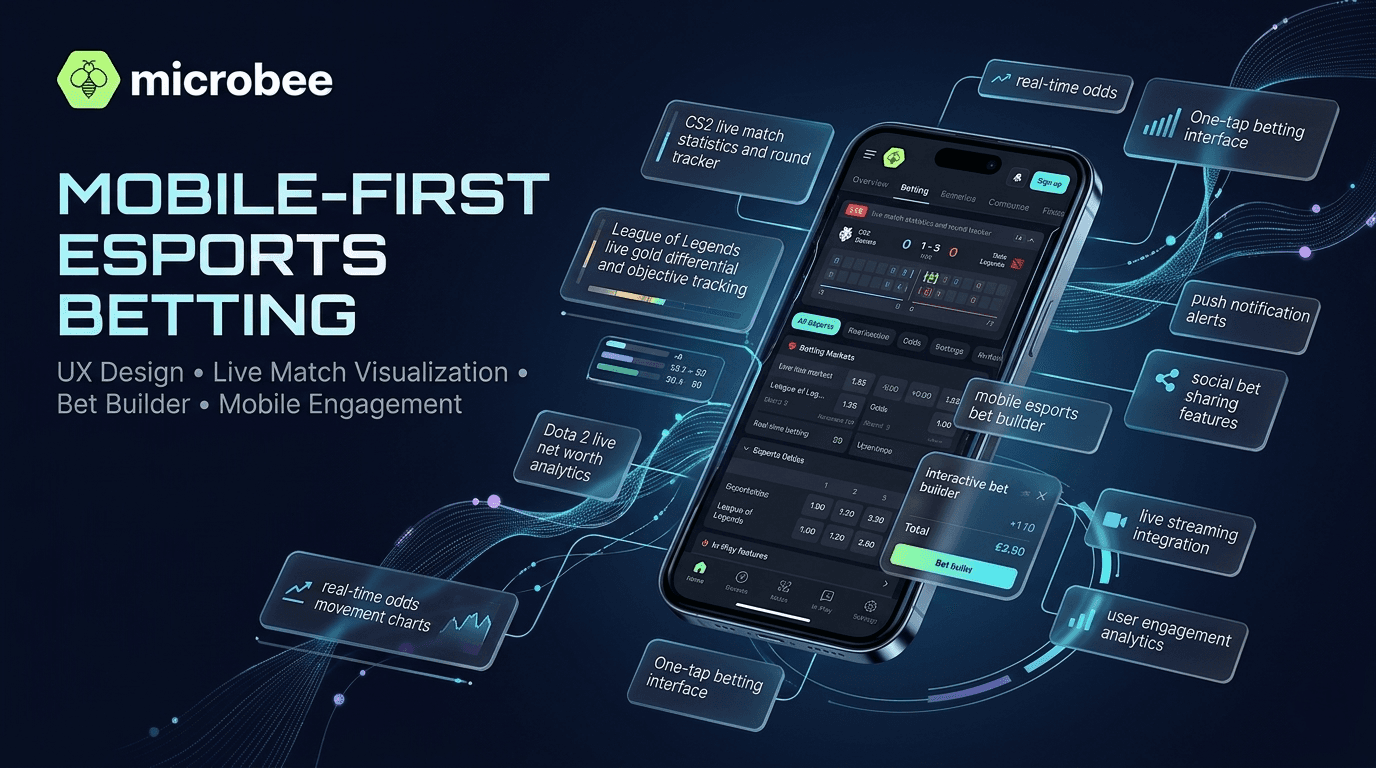
Live Match Visualisation
Esports bettors expect real-time match information within the betting interface — not just odds updates, but game-state visualisation that reflects what is happening in the match. The visualisation requirements vary by title.
CS2 visualisation should display the current round score, current round phase (buy phase, active round, post-round), team economies (money available per team), player alive count per team, and bomb status (planted/not planted/defusing). A minimap showing player positions is valuable but technically complex — many operators use simplified round-state displays instead.
League of Legends visualisation should display team gold totals and gold differential, tower status per lane, dragon and baron status (alive, dead, timer), current game time, and kill score. A timeline showing objective takes (dragon, herald, baron, tower) provides context for odds movements.
Dota 2 visualisation should display net worth differential, tower status, Roshan status and timer, kill score, and current game time.
These visualisations must update in real time (sub-5-second latency) and must be lightweight enough to render smoothly on mid-range mobile devices without impacting betting interface responsiveness.
Esports-Specific Bet Builder
Bet builder functionality — allowing bettors to combine multiple selections within a single match into an accumulator — is popular in traditional sports and even more engaging in esports. An esports bet builder should allow combinations like "Team A wins Map 1 + Over 26.5 rounds on Map 2 + Team B gets first blood on Map 3."
The technical challenge is correlation management. Within a single esports match, many markets are correlated (a team that wins a map is more likely to have had more kills on that map). The bet builder must calculate combined odds that account for these correlations — simply multiplying individual selection odds would significantly overstate the true combined probability and create risk for the operator.
Quick Bet and One-Tap Betting
For in-play esports betting, speed of bet placement is critical. Round-by-round CS2 markets have lifespans of 1–3 minutes — by the time a bettor navigates a traditional bet slip flow (select market, enter stake, confirm bet), the round may already be decided.
Quick bet functionality allows a bettor to pre-configure a default stake and place bets with a single tap — selecting a market instantly creates and confirms the bet at the current odds and default stake. This feature must include clear confirmation feedback (vibration, visual confirmation) and an undo window (3–5 seconds to reverse an accidental quick bet).
Streaming Integration
The ideal mobile esports betting experience integrates live streaming directly into the betting interface. This means the bettor can watch the match and place bets within the same app, without switching between a streaming platform and a betting platform.
Technical approaches include embedded Twitch/YouTube streams within the betting interface (using their respective embed APIs), picture-in-picture streaming where the stream floats as a small overlay while the bettor navigates markets, and native stream delivery for operators with direct streaming agreements with tournament organisers.
Streaming integration must handle bandwidth intelligently — streaming HD video while simultaneously maintaining a real-time WebSocket connection for odds updates consumes significant data and battery. The platform should offer stream quality controls and intelligently reduce stream quality when network conditions deteriorate rather than buffering.
Social Sharing
Esports bettors share bet slips within their communities — on Discord, Twitter/X, Reddit, and WhatsApp. The platform should generate shareable bet slip graphics that include the bettor's selections, odds, and potential return without revealing personal information (account ID, balance, real name).
The share functionality should produce a visually distinctive graphic (branded to the operator, styled consistently with the dark-mode aesthetic) that includes a deep link back to the same match/market on the platform. This turns every shared bet slip into a user acquisition touchpoint.
Notifications and Alerts
Mobile push notifications are the primary re-engagement channel for esports bettors. Effective notification types include pre-match alerts (configurable by title, team, or tournament — "Team Liquid vs Natus Vincere starts in 30 minutes"), in-play alerts (significant events during matches the bettor has active bets on — "Your bet on Team Liquid Map 1 is winning, score 13-10"), odds movement alerts (when odds on a followed team or match move beyond a configurable threshold), and result notifications (bet settlement with win/loss amount).
Notification frequency must be carefully managed. Esports audiences are accustomed to high-frequency notifications from Discord and gaming platforms, but excessive betting notifications create fatigue and drive opt-outs. The platform should allow granular notification preferences per title, tournament tier, and notification type.
Performance Optimisation for Mobile Esports
Battery and Data Efficiency
Esports betting sessions can last hours — a best-of-five CS2 series can run 3+ hours, and a day of tournament coverage can span 8–12 hours. The app's battery consumption during extended sessions must be managed carefully.
Optimisation strategies include reducing WebSocket polling frequency when the app is in background mode, pausing non-critical animations and visual updates when battery level drops below 20%, offering a "low data mode" that reduces stream quality and defers non-essential data loading, and using efficient data serialisation (binary WebSocket frames rather than JSON for real-time odds updates).
Offline Resilience
Mobile networks are imperfect. The betting interface must handle intermittent connectivity gracefully — caching the last known odds, queuing bet placement attempts for retry when connectivity returns, and clearly indicating when displayed odds may be stale due to connection interruption. Esports bettors will not accept a "network error" message that loses their carefully constructed bet slip.
MicroBee's Mobile Esports Platform
MicroBee's sportsbook platform delivers esports betting through the same mobile-optimised interface that serves traditional sports — with esports-specific UX adaptations built into the framework. Operators benefit from responsive mobile architecture optimised for one-handed esports betting, real-time match visualisation for CS2, LoL, Dota 2, and other supported titles, in-play odds delivery through MicroBee's low-latency data infrastructure, title-specific market generation with esports bet builder support, and cross-platform consistency between mobile and desktop experiences.
The platform is designed for the mid-range devices and variable networks that define mobile betting across global markets — not just flagship phones on fast connections. This ensures esports bettors in Southeast Asia, Latin America, and other growth regions receive the same responsive experience as those in Europe or North America.
With MGA and UKGC licensing, 12 years of B2B platform experience, and 300+ operators across 50+ jurisdictions, MicroBee provides the mobile esports infrastructure operators need to engage the next generation of sports bettors.
Related Reading
• Esports Odds API: Data Sources, Latency, and Integration for CS2, LoL, and Dota 2
• Esports Trading and Risk Management: How Sportsbooks Price Competitive Gaming
• Mobile Sportsbook Platform: Native App vs Web App vs Hybrid
• The Complete Guide to Esports Betting Platforms in 2026
Building a mobile esports experience? Contact MicroBee for a mobile platform demo with esports capabilities. |