
Microbee Tech Team
Reading Time :
8 Min
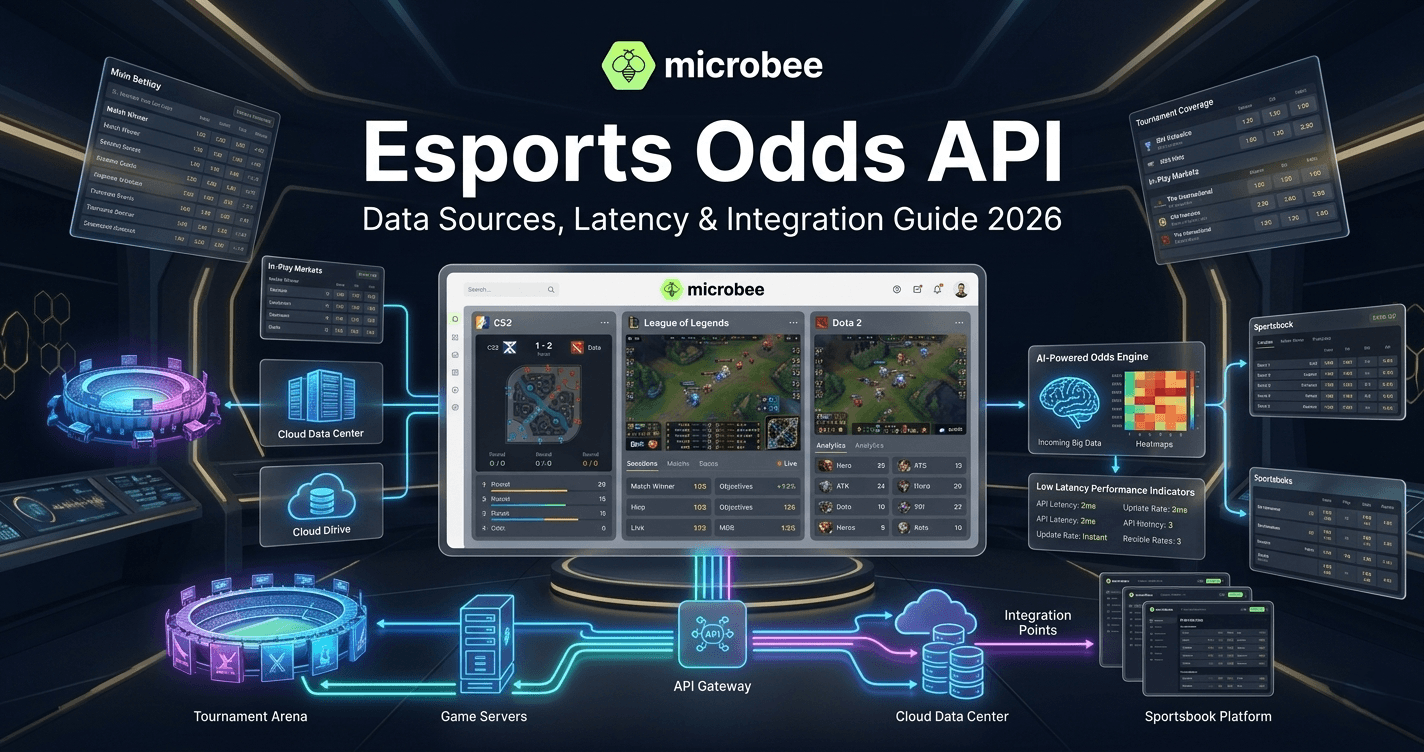
How Esports Odds Differ from Traditional Sports
Traditional sports odds are built on decades of statistical modelling, standardised data collection (official league statistics, broadcast feeds, in-stadium sensors), and well-understood market structures. Esports odds share the same fundamental principles — probability estimation and margin application — but the underlying data infrastructure is fundamentally different.
Data originates from game servers, not physical observation. In traditional sports, data is collected by human statisticians, camera tracking systems, and sensor arrays. In esports, the primary data source is the game server itself — the software running the match generates a continuous stream of structured data covering every action, event, and state change within the game.
Game mechanics create title-specific markets. A football match produces goals, corners, cards, and possession statistics regardless of the league or competition. An esports match produces data specific to the game being played. A CS2 match generates round wins, kills, bomb plants, and economy data. A League of Legends match generates tower kills, dragon takes, baron kills, and gold differentials. A Dota 2 match generates tower kills, Roshan kills, and net worth advantages. These title-specific events create markets that have no equivalent in traditional sports betting.
Match pacing varies by title. A football match follows a predictable 90-minute structure. Esports match duration varies dramatically — a CS2 map can last 20–50 minutes, a League of Legends game typically runs 25–40 minutes, and a Dota 2 game can extend beyond 60 minutes. The odds engine must adapt to variable match durations and the different phases of each game.
Roster and meta changes are more frequent. Esports teams change rosters more frequently than traditional sports teams, and game updates (balance patches) regularly alter the competitive meta — the strategies and character/weapon selections that are most effective. Odds models must account for roster changes and patch impacts more dynamically than traditional sports models.
Data Sources for Esports Odds
Official Game APIs
The ideal data source for esports odds is the game publisher's official API. These APIs provide authoritative, low-latency data directly from the game server.
Riot Games (League of Legends, Valorant) provides official esports data APIs with structured match data, live game state information, and historical statistics. The Riot API is well-documented and provides reliable data for professional tournament matches.
Valve (CS2, Dota 2) provides game data through GOTV (for CS2) and the Dota 2 Game Coordinator. Valve's approach to esports data is less centralised than Riot's — tournament organisers often provide data feeds independently, with varying levels of completeness and latency.
Other titles (Mobile Legends, Free Fire, Valorant, Rainbow Six Siege) have varying levels of official data availability. Some publishers provide comprehensive APIs; others provide minimal or no official data, requiring alternative data collection methods.
Third-Party Data Providers
Third-party esports data providers aggregate data from multiple sources — official APIs, tournament organisers, manual data collection, and proprietary parsing systems — and deliver it in a standardised format suitable for odds compilation.
Leading esports data providers include companies that specialise in parsing game data from broadcasts and demo files when official APIs are unavailable or insufficient. These providers add value by normalising data across titles, filling gaps in official coverage, and providing historical datasets for model training.
Data Quality Considerations
The quality of esports data varies significantly by title, tournament tier, and data source. Tier 1 tournaments (The International for Dota 2, League of Legends World Championship, CS2 Majors) typically have excellent data quality with low latency. Tier 2 and Tier 3 tournaments may have inconsistent data quality, delayed feeds, or incomplete coverage.
For odds compilation, data quality directly impacts pricing accuracy. An odds engine operating on delayed or incomplete data will produce prices that are either stale (exploitable by informed bettors) or inaccurate (creating risk for the operator). Operators must understand the data quality limitations per title and tournament tier and adjust their market offerings accordingly.
Title-Specific Market Types
Counter-Strike 2 (CS2)
CS2 is the most mature esports betting title with the deepest market structure. Standard market types include match winner (which team wins the best-of series), map winner (which team wins a specific map), map handicap (team to cover a round spread on a specific map), total rounds (over/under on the total rounds played in a map), round winner (which team wins the next round — a high-frequency in-play market), first kill (which team gets the first kill in a round), pistol round winner (which team wins the first round of each half — a popular specialist market), and bomb plant (whether the bomb will be planted in a specific round).
CS2's round-based structure creates natural in-play betting windows. Each round lasts 1–3 minutes, with a brief pause between rounds. The odds engine must recalculate probabilities after every round based on the updated score, team economy (money available to purchase weapons and equipment), and side (CT vs T).
Latency requirement: Sub-2-second data delivery is essential for round-by-round in-play markets. At the round level, the market lifespan is 1–3 minutes — data delays of more than 2–3 seconds create exploitable pricing windows.
League of Legends (LoL)
League of Legends markets reflect the game's objective-based structure. Standard markets include match winner, map winner (for best-of series), first blood (which team gets the first kill), first tower (which team destroys the first tower), first dragon (which team secures the first dragon objective), total kills (over/under on combined kills in a game), kill handicap (team to cover a kill spread), dragon kills (over/under per team), and baron kills (whether either team kills Baron Nashor, and which team does so first).
LoL's game flow creates distinct phases: early game (laning phase, 0–15 minutes), mid game (objective contests, 15–25 minutes), and late game (team fights and base pushes, 25+ minutes). Odds models must weight different data points differently based on the current game phase — an early-game kill advantage is less predictive of the match outcome than a late-game baron take.
Latency requirement: Sub-5-second data delivery is acceptable for most LoL markets because individual events (kills, tower takes) are spaced more widely than CS2 rounds. However, dragon and baron contest windows require faster updates.
Dota 2
Dota 2 markets are similar to LoL in structure but reflect Dota's distinct game mechanics. Standard markets include match winner, map winner, first blood, first tower (first barracks in Dota terminology), Roshan kills (Dota's equivalent of Baron Nashor), total kills, kill handicap, and game duration (over/under on match length).
Dota 2 games are generally longer than LoL games and feature more dramatic comeback potential — a team that is significantly behind in the early game can still win through superior late-game strategy. This comeback potential affects how aggressively odds should swing based on early-game advantages.
Latency requirement: Similar to LoL — sub-5-second for standard markets, faster for key objective contests.
Integration Architecture
Pre-Match Odds Integration
Pre-match esports odds integration follows the same architecture as traditional sports. The odds API delivers market data including the event identifier, market type, selection options, and prices. The operator's platform receives, stores, and displays this data on the front end, and sends bet placement requests back through the API.
The key difference is the volume of events. A busy esports weekend can include hundreds of matches across multiple titles and tournament tiers. The API must deliver and update odds for all active markets efficiently, with clear event metadata (title, tournament, tier, teams, format) so the operator's platform can organise and display markets coherently.
In-Play Odds Integration
In-play esports odds require a streaming data connection (typically WebSocket or server-sent events) that delivers real-time updates as match data changes. The data stream includes score updates (round wins, kills, objectives), odds recalculations triggered by each significant event, market suspensions (during uncertain moments like round transitions or technical pauses), and market settlements (when an in-play market resolves — for example, first blood has been achieved).
The in-play integration must handle market suspension gracefully. In esports, technical pauses (caused by hardware failures, network issues, or game bugs) can occur without warning. During a pause, all in-play markets must be suspended immediately to prevent bets on stale odds. The API should signal market suspension explicitly rather than relying on the absence of updates.
Esports-Specific API Considerations
Title-specific market schemas. The API must provide market types appropriate to each game title. A generic "match winner" market works across all titles, but title-specific markets (round winner for CS2, first dragon for LoL) require title-aware market schemas.
Tournament metadata. Esports tournaments have complex structures — group stages, playoffs, upper/lower brackets, grand finals with bracket resets. The API should provide tournament structure metadata so the operator's platform can display upcoming matches in context.
Team and player data. Esports rosters change frequently. The API should provide current roster information, recent team performance data, and player statistics to support front-end display and internal trading decisions.
MicroBee's Esports Betting Solution
MicroBee's esports solution provides operators with comprehensive esports data covering major titles (CS2, League of Legends, Dota 2, Valorant, and others) through the same API used for traditional sports. This unified approach means operators manage esports alongside football, basketball, and other sports in a single back office — no separate integration, no separate wallet, no separate reporting.
Key capabilities include pre-match and in-play markets across all supported esports titles, title-specific market types reflecting each game's unique mechanics, real-time odds delivery through MicroBee's low-latency data infrastructure, coverage of Tier 1 and Tier 2 tournaments with clear tier labelling, and integration with MicroBee's risk management and trading tools.
The esports betting module connects to MicroBee's existing platform services — wallet, CRM, bonus engine, compliance, and reporting — so operators can run esports promotions, track esports-specific player segments, and manage esports risk through the same tools they use for their entire sportsbook operation.
With 12 years of B2B platform experience, MGA and UKGC dual licensing, and 300+ operators across 50+ jurisdictions, MicroBee provides esports betting infrastructure that is regulated, scalable, and integrated — not a standalone product bolted onto a traditional sportsbook.
Related Reading
• The Complete Guide to Esports Betting Platforms in 2026
• E-Sports Betting API: Complete Integration and Provider Guide
• Complete Guide to Sports Betting APIs in 2026
• Top 10 Sports API Providers in 2026: B2B Operator's Guide
Ready to add esports to your sportsbook? Contact MicroBee for an esports integration demo and coverage overview. |