
MicroBee Tech Team
Reading Time :
10 Minute
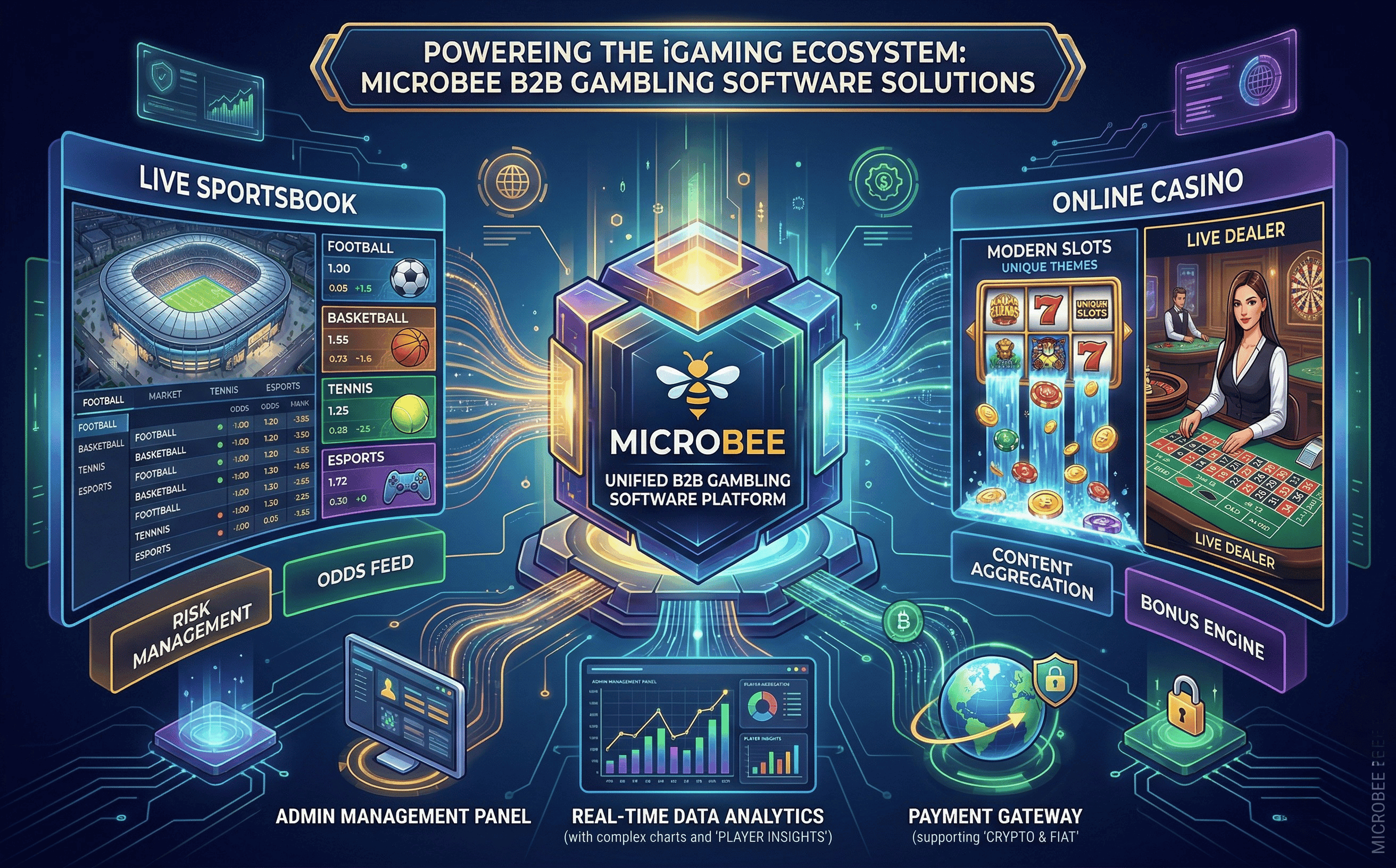
Every online casino, sportsbook, and betting platform runs on gambling software. It is the invisible infrastructure behind every bet placed, every withdrawal processed, and every player account managed. For B2B operators evaluating their technology stack in 2026, understanding what gambling software actually is — and the fundamental choice between platform and custom build — is the starting point for every other technology decision that follows.
This guide covers the full picture: what gambling software includes, the platform vs custom build comparison, key evaluation criteria, what separates tier-1 providers from the rest, and how MicroBee's 11 years and 300+ operator deployments across 50+ jurisdictions inform its approach.
What Is Gambling Software?
Definition: Gambling software is a collective term for the technology systems that power online betting and gaming operations. It encompasses game engines and content, player account management (PAM), payment processing, odds and risk management, back-office analytics, compliance and responsible gambling tools, and customer communication systems.
In B2B terms, gambling software is not one product — it is a stack. Understanding the layers of that stack is essential before evaluating any provider:
Software Layer | What It Does |
Game engines | Power casino games — slots, live dealer, poker, virtual sports |
Sportsbook / odds engine | Manages betting markets, in-play odds, and risk |
Player account management (PAM) | Registration, KYC, wallets, session management |
Payment processing | Deposits, withdrawals, currency conversion, fraud prevention |
Back-office and analytics | Player data, financial reporting, game performance |
Bonus and promotions engine | Free spins, deposit bonuses, loyalty programmes |
Compliance infrastructure | AML monitoring, self-exclusion, regulatory reporting |
API layer | Connects all components — and connects to third-party providers |
The most important thing to understand about these layers: you do not need to build them. You need to access them. The question is how — through a platform provider who delivers all layers through one integration, or through a custom build that assembles them one by one.
Platform vs Custom Build: The Fundamental Decision
Key comparison: Platform gambling software (via a B2B provider like MicroBee): $200K–$500K, 2–4 weeks to launch, pre-built and tested across 300+ live operators. Custom gambling software: $2M–$5M+, 12–18 months to build, untested on live traffic until launch day. For operators targeting revenue within 12 months, the platform route is the only commercially rational choice.
Factor | Platform (MicroBee) | White-Label | Custom Build |
Time to market | 2–4 weeks | 4–8 weeks | 12–18 months |
Upfront cost | $200K–$500K | $150K–$300K | $2M–$5M+ |
Regulatory licensing | MGA + UKGC B2B | Varies | Operator's own cost |
Customisation | High — modular | Limited | Full |
Maintenance cost | Included | Included | $500K+/year |
Integration timeline | 2–4 weeks | 4–8 weeks | 12–18 months |
Risk of failure | Low — battle-tested | Low | High — 60% of custom builds overrun |
Ongoing upgrades | Provider-managed | Provider-managed | Full internal cost |
As MicroBee outlined in detail in our build vs buy betting platform guide, the hidden cost of custom gambling software is almost always the ongoing maintenance, compliance updates, and regulatory reporting infrastructure — costs that become visible 18 months after launch, not at contract signing.
The 8 Core Components of Modern Gambling Software
1. Sportsbook and Odds Engine
The sportsbook layer manages betting markets, calculates and updates odds in real time, handles in-play betting, and executes bet settlement. Quality is measured by in-play latency (sub-500ms benchmark), market breadth (50+ sports minimum for competitive operations), and risk management sophistication. MicroBee's sportsbook platform covers 50+ sports with real-time pre-match and in-play markets.
2. Live Casino and Game Content
Live dealer games represent the fastest-growing revenue segment in online gambling, with global live casino revenue projected to exceed $20 billion by 2027. Quality gambling software includes HD live streaming, professional dealer management, and seamless mobile performance. MicroBee's live casino platform delivers this as a native component of the platform — no separate vendor relationship required.
3. Player Account Management (PAM)
PAM is the operational backbone of gambling software. It handles player registration, KYC verification, responsible gambling limits, session management, and player lifecycle marketing. Weak PAM design is one of the leading causes of regulatory non-compliance for online gambling operators.
4. Payment Processing Infrastructure
Payment processing in gambling software must handle multi-currency operations, fraud prevention, chargebacks, AML compliance, and a growing range of payment methods including crypto. Operators serving 50+ jurisdictions — as MicroBee does — need payment infrastructure that adapts to local regulatory requirements automatically. MicroBee's services infrastructure covers 50+ payment methods across all supported markets.
5. Real-Time Back-Office and Analytics
Modern gambling software's back-office should deliver real-time visibility across player activity, game performance, financial reconciliation, and compliance status. The gap between operators who run profitable gambling operations and those who struggle is often found entirely in back-office capability — as we explored in our casino back office system guide.
6. Bonus and Promotions Engine
Bonus mechanics — free spins, deposit bonuses, loyalty programmes, wagering requirements — require a sophisticated rules engine that can be configured by operators without developer intervention. The ability to run targeted promotions per player segment is now a standard expectation, not a premium feature.
7. Compliance and Responsible Gambling Tools
Regulatory compliance is embedded in every layer of modern gambling software — not bolted on as an afterthought. Self-exclusion, deposit limits, loss limits, session reminders, AML monitoring, and age verification must all function reliably and generate the audit trails regulators require. This is especially critical for operators targeting UKGC and MGA-licensed markets.
8. API and Integration Architecture
The API layer is what determines how quickly gambling software can be deployed, how easily new components can be added, and how future-proof the platform is. API-first gambling software — like MicroBee's unified platform — allows operators to integrate once and access all components simultaneously. Legacy or monolithic gambling software requires separate integration for each layer. See our sportsbook API integration guide for a technical breakdown of what well-designed gambling software APIs look like in practice.
What to Look for in a Gambling Software Provider
7 criteria: When evaluating gambling software providers, assess: (1) regulatory B2B licensing for your target markets, (2) integration timeline with reference deployments, (3) full-stack vs component-only offering, (4) back-office quality — demo it live, (5) real-world operator references in similar markets, (6) commercial model and 3-year total cost, (7) roadmap transparency and upgrade process.
1. Regulatory licensing: For European regulated markets, your gambling software provider must hold MGA and/or UKGC B2B licences. MicroBee holds both (MGA/B2B/203/2016). A provider who cannot supply licence references for your target jurisdiction creates regulatory risk for your operation.
2. Integration timeline: Quoted timelines without reference deployments are marketing claims. Ask for documented timelines from 3+ recent operator deployments in similar market profiles. MicroBee's 2–4 week timeline is validated across 300+ deployments.
3. Full-stack vs component: A platform provider who covers sportsbook, casino, payments, back-office, and compliance through one API eliminates the multi-vendor complexity that makes gambling software projects fail. As we covered in our casino software vs platform guide, the difference is operational, not just technical.
4. Back-office quality: Request a live demo of the back-office, not screenshots. Real-time liability monitoring, player segmentation, game performance analytics, and automated compliance exports are table stakes in 2026.
5. Operator references: Ask for references from operators who have been live on the platform for 12+ months in markets similar to yours. Recent case studies without contact details are not operator references.
6. Total cost of ownership: Model licensing fees, revenue share, integration cost, ongoing maintenance, and compliance update cost across 36 months — not just year one. Custom gambling software that appears cheaper at contract signing consistently exceeds platform costs by month 18.
7. Upgrade and roadmap process: How does the provider deploy platform upgrades? How are breaking changes communicated? MicroBee's modular architecture delivers upgrades as independent modules — live operators are never forced onto a simultaneous platform migration.
MicroBee's Gambling Software Platform
MicroBee provides a fully integrated gambling software platform for B2B operators — covering sportsbook, live casino, virtual sports, esports, data intelligence, and compliance infrastructure through a single API. Founded in 2014 and serving 300+ operators across 50+ jurisdictions, MicroBee holds MGA and UKGC B2B licences (MGA/B2B/203/2016).
• Sportsbook platform — 50+ sports, real-time pre-match and in-play, odds management, risk engine
• Live casino — HD streaming, professional dealers, mobile-optimised across all devices
• 5,000+ slot titles — deeply integrated via aggregation, unified wallet, single reporting layer
• Data intelligence back-office — real-time analytics, compliance exports, player management
• 50+ payment methods — including crypto, local payment rails, and multi-currency support
• 2–4 week integration timeline — validated across 300+ live operator deployments since 2014
Frequently Asked Questions
What is gambling software?
Gambling software is the technology infrastructure powering online casinos, sportsbooks, and betting platforms — including game engines, player account management, payment processing, odds management, back-office analytics, and compliance tools. MicroBee provides a complete integrated gambling software platform accessible via a single API. Details: microbee.net/sportsbook.
How much does gambling software cost?
B2B gambling software via a licensed platform provider costs $200K–$500K to launch, with ongoing revenue share. Custom-built gambling software costs $2M–$5M+ with 12–18 month timelines. For most operators, the platform route delivers faster revenue at significantly lower risk. See our white label vs turnkey vs custom comparison for a full breakdown.
What is the difference between gambling software and a gambling platform?
Gambling software refers to individual components — game engines, RNG systems, sportsbook modules. A gambling platform combines all those components into a unified operational system with PAM, payments, back-office, and compliance. See our casino software vs platform guide for the full breakdown.
Which gambling software providers hold MGA and UKGC licences?
MicroBee holds both MGA and UKGC B2B licences (MGA/B2B/203/2016). For operators targeting European regulated markets, always verify B2B supplier licence status before proceeding with procurement.
How long does it take to integrate gambling software?
With MicroBee's API-first platform, integration takes 2–4 weeks. Custom gambling software builds typically require 12–18 months. Contact MicroBee to discuss your specific integration timeline requirements.
Summary
Gambling software is the foundation of every profitable online betting operation. The choice between platform and custom build in 2026 is clear for most operators: platform delivers faster revenue, lower risk, and lower total cost of ownership. The critical procurement variables are regulatory licensing, integration timeline, back-office quality, and whether the provider operates as a genuine partner or a software vendor. MicroBee's 11-year track record across 300+ deployments reflects a consistent answer to all four.
To discuss gambling software requirements for your operation, speak to MicroBee's team.