
Microbee Tech Team
Reading Time :
8 Min
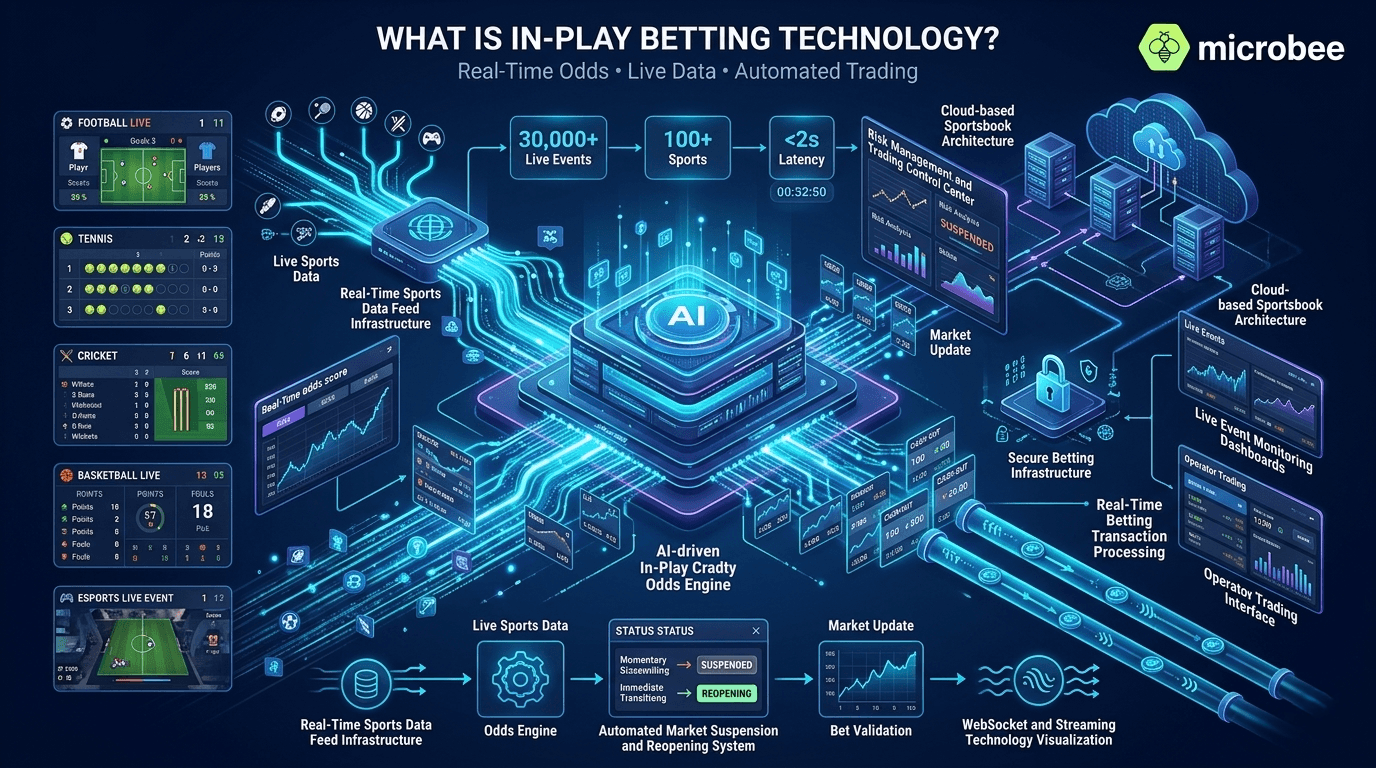
In short In-play betting technology (also called live betting or in-running) is the system that allows bettors to place wagers on sporting events while they are in progress. The technology continuously processes real-time match data, recalculates odds after every significant event, manages market suspension during uncertain moments, and handles high-frequency bet placement — all within milliseconds. In-play betting now accounts for 60–70% of total sportsbook revenue in mature markets, making it the most commercially important technology in a modern sportsbook. |
Definition
In-Play Betting Technology: The combination of real-time data feeds, odds engines, risk management systems, and front-end interfaces that enable bettors to place wagers on events already underway. The system must process live match data (scores, game events, statistics), recalculate odds in real time based on the evolving match state, suspend and reopen markets around key moments (goals, red cards, set points), accept and validate bets against rapidly changing prices, and manage operator liability across fast-moving markets.
How It Works
The in-play system operates as a continuous loop. Live data arrives from the sports data feed — a goal, a corner, a point won. The odds engine ingests the new data point and recalculates the probability of each outcome based on the updated match state. New odds are pushed to the front end via WebSocket or streaming connection. The bettor sees the updated odds and places a bet. The bet is validated against the current odds (which may have changed again in the milliseconds since display), and either accepted at the displayed price, accepted at the new price (with the bettor's consent), or rejected if the market has been suspended.
This loop repeats thousands of times per match, across hundreds of concurrent events. The technical demands on latency, throughput, and reliability are significantly higher than pre-match betting.
Why Latency Is Critical
In-play betting creates an information asymmetry challenge. A bettor watching a live broadcast may see a goal seconds before the data feed updates the sportsbook's odds. During that window, the bettor can place a bet at pre-goal prices — a guaranteed winning bet at the operator's expense. This is called "courtsiding" or "latency exploitation."
The defence is speed. The faster the data feed delivers match events to the odds engine, and the faster the odds engine recalculates and publishes new prices, the smaller the exploitable window. Tier 1 in-play systems operate with end-to-end latency (event to odds update) under 2 seconds for major sports. Market suspension during high-impact events (goals, penalties, red cards) provides an additional layer of protection.
MicroBee's In-Play Capabilities
MicroBee's sportsbook platform delivers 30,000+ live in-play events with real-time odds updates, automated market suspension, and integrated risk management. The in-play engine handles the latency, throughput, and reliability demands of live betting across 100+ sports — built on 12 years of platform experience serving 300+ operators.
Related Reading
• Complete Guide to Sports Betting APIs in 2026
• Sportsbook Trading Platform: Features, Tools, and Provider Comparison
See MicroBee's in-play platform in action. Request a demo |