
Microbee Tech Team
Reading Time :
10 Min
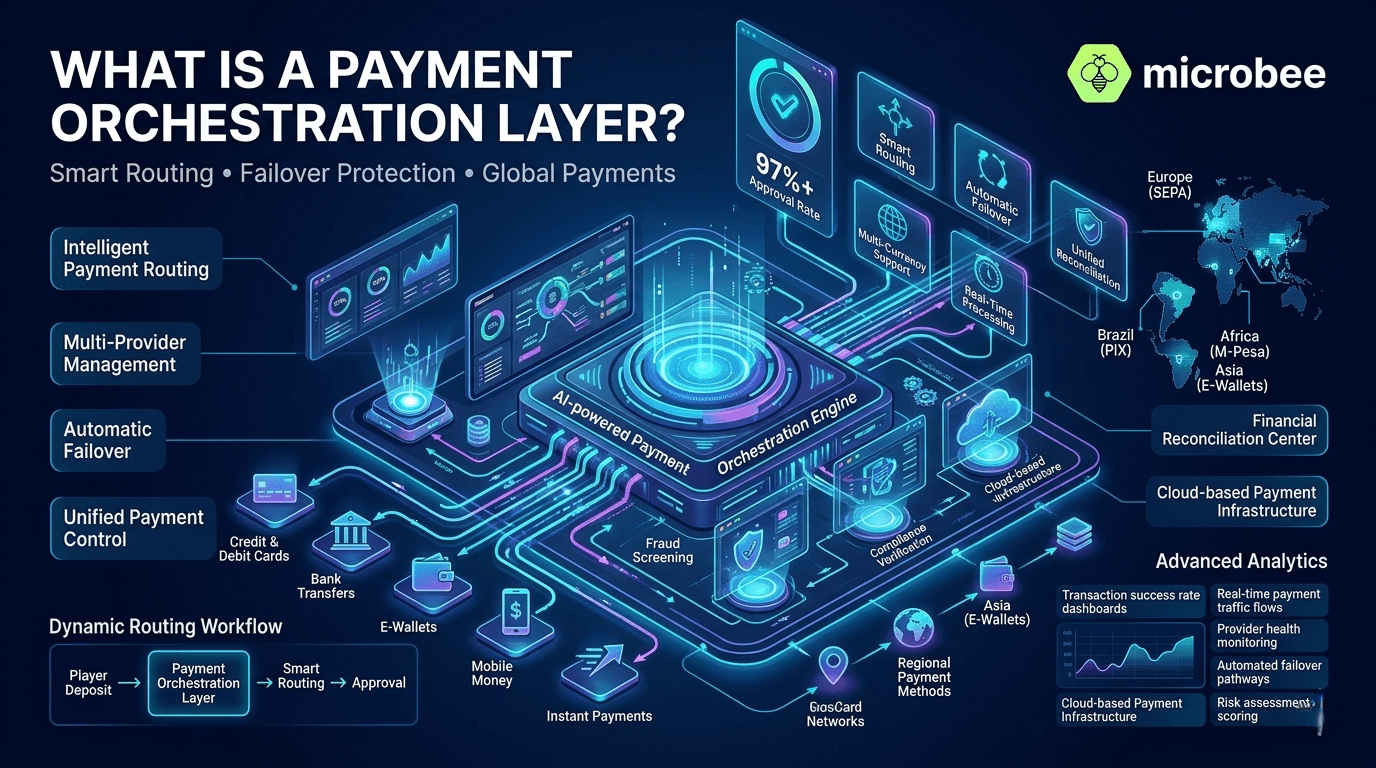
In short A payment orchestration layer is the software module within a betting or casino platform that manages all player deposit and withdrawal transactions across multiple payment providers, methods, and currencies. It routes each transaction to the optimal payment provider based on success rates, costs, speed, and availability — and handles failover when a provider is down. For operators serving multiple markets, the orchestration layer is what makes a single platform work with PIX in Brazil, M-Pesa in Kenya, SEPA in Europe, and credit cards globally. |
Definition
Payment Orchestration Layer: A middleware system that sits between the operator's platform and multiple payment service providers (PSPs), routing each transaction to the most appropriate provider based on configurable rules. The orchestration layer abstracts the complexity of managing multiple payment integrations into a single interface for the operator, while optimising for transaction success rates, processing costs, settlement speed, and regulatory compliance.
How It Works
Without orchestration, an operator integrating five payment providers must build and maintain five separate integrations, each with its own API format, authentication, reconciliation process, and error handling. The orchestration layer consolidates these into one interface.
When a player initiates a deposit, the orchestration layer evaluates the transaction parameters (amount, currency, payment method, player country, player risk profile) and routes it to the best available provider. "Best" is defined by configurable rules — the operator might prioritise the provider with the lowest processing fee for card transactions, the fastest settlement for mobile money, or the highest approval rate for a specific country.
If the primary provider declines the transaction or is unavailable, the orchestration layer automatically retries with a secondary provider (failover routing). This cascading retry mechanism significantly improves overall transaction success rates — a single provider might have a 92% approval rate, but cascading across three providers can push the effective rate above 97%.
Why It Matters for iGaming
Payment processing in iGaming is uniquely complex for several reasons. Gambling is a high-risk merchant category, meaning payment providers charge higher fees, impose stricter requirements, and decline transactions more frequently than for standard e-commerce. Operators serve multiple markets with different preferred payment methods — cards dominate in Europe, mobile money in Africa, instant bank transfers (PIX, PSE) in Latin America, and e-wallets in Asia. Regulators in some jurisdictions restrict which payment methods can be used for gambling transactions. Players expect instant deposits and fast withdrawals — payment speed is a competitive differentiator.
The orchestration layer handles this complexity transparently. The operator configures payment routing rules per market and the layer executes them automatically — including currency conversion, compliance checks, and reconciliation.
Key Capabilities
A mature payment orchestration layer provides smart routing (directing each transaction to the optimal provider based on rules and real-time performance data), failover and retry logic (automatically cascading to secondary providers when the primary declines or times out), unified reconciliation (consolidating transaction data from all providers into one format for the operator's finance team), fraud screening integration (connecting to fraud detection services before transactions are processed), multi-currency support (handling deposits and withdrawals in different currencies with real-time conversion), and compliance filtering (blocking payment methods not permitted in specific jurisdictions).
MicroBee's Payment Orchestration
MicroBee's payment orchestration layer is integrated into the core platform, supporting card payments, bank transfers, mobile money, e-wallets, and regional payment methods across 50+ jurisdictions. The layer handles smart routing, failover, reconciliation, and multi-currency management through the same back office that manages the operator's sportsbook, casino, and player operations — no separate payment management system required.
Related Reading
• Betting Platform with Payment Gateway: Complete Integration Guide
• Multi-Currency Betting Platform: Essential Guide for Global Operators
Explore MicroBee's payment capabilities. Contact us |