
Microbee Support Team
Reading Time :
10 Min
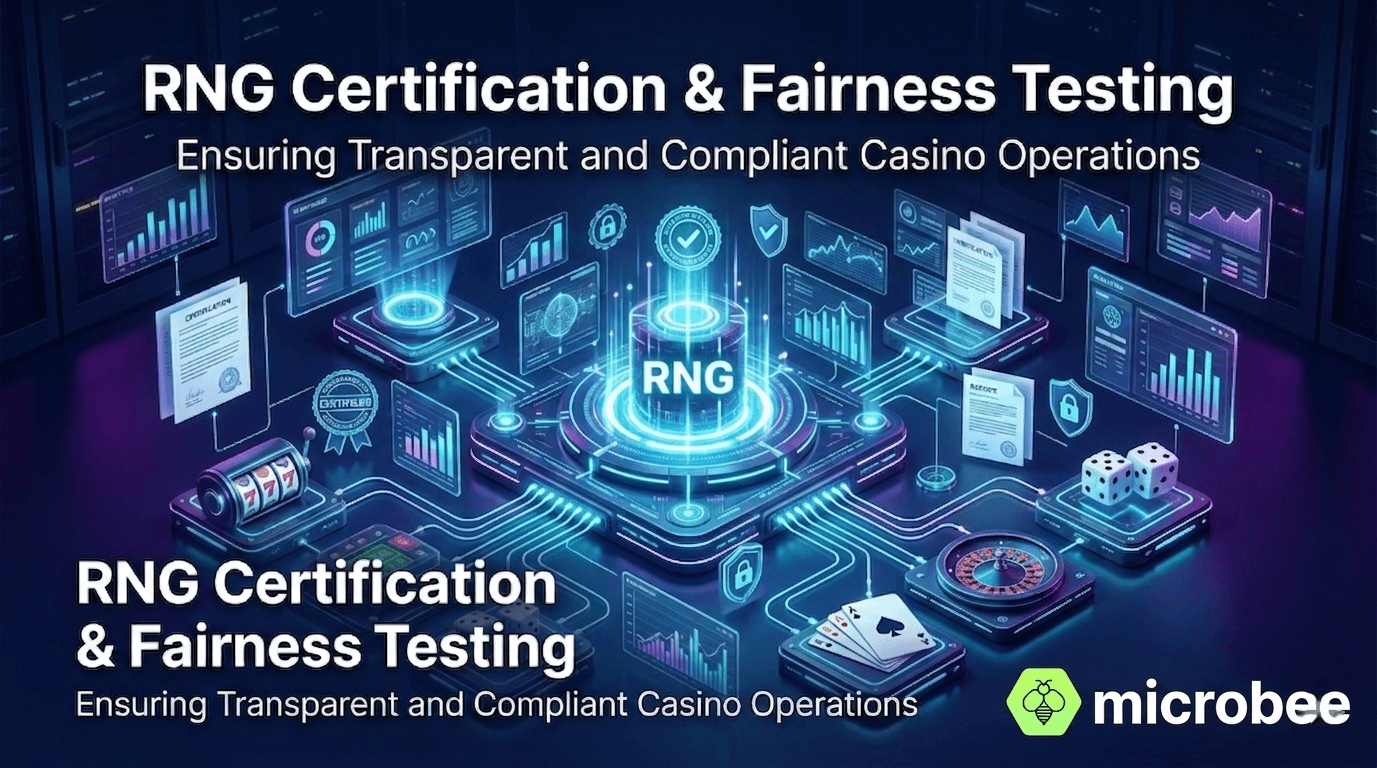
What Is RNG Certification?
Definition — RNG (Random Number Generator) A Random Number Generator is the algorithmic engine inside every digital casino game that determines outcomes — card draws, reel positions, dice rolls, ball landings. Certification is the process by which an independent testing laboratory verifies that the RNG produces statistically unpredictable results that cannot be influenced by the operator, the platform provider, or the player. |
Every slot spin, every blackjack hand, and every roulette outcome in a legitimate online casino is determined by an RNG. The certification process exists to ensure that the mathematical probability of each outcome matches the game's published odds, that patterns in the output cannot be predicted, and that the system has not been tampered with.
RNG certification is not a one-time event. Regulators require periodic re-testing, and any significant software update to a game's mathematics model triggers a re-certification requirement. For operators, this means certification is an ongoing operational consideration, not a box checked at launch.
How RNG Testing Works
The certification process follows a standardised methodology, though specific requirements vary by jurisdiction and testing laboratory.
Statistical Testing
Testing laboratories run the RNG through millions of simulated game rounds — typically 10 million or more — and apply a battery of statistical tests to the output sequence. The most widely used test suite is the NIST (National Institute of Standards and Technology) Statistical Test Suite, which includes 15 individual tests evaluating randomness properties.
The key tests evaluate frequency distribution (are all possible outcomes appearing at the expected frequency over large sample sizes), serial correlation (does any outcome influence the probability of the next outcome), and runs analysis (do sequences of identical outcomes occur at statistically expected rates). A properly functioning RNG will pass all tests within defined confidence intervals.
Source Code Review
Beyond statistical output testing, certification laboratories review the actual source code of the RNG implementation. This verifies that the algorithm is a recognised, published method (not a proprietary black box), that the seeding mechanism produces sufficient entropy, that no external input can influence the output sequence, and that the implementation matches the mathematical specification.
Source code review catches implementation errors that statistical testing alone might miss. A correctly specified algorithm with a flawed implementation could produce output that passes statistical tests over short sequences but exhibits patterns over longer periods.
RTP Verification
Return to Player (RTP) verification confirms that the game's actual payout percentage matches its published specification over a statistically significant number of rounds. If a slot game is certified at 96.5% RTP, the testing laboratory verifies that the game mathematics — the combination of base game wins, bonus features, and free spins — produces an aggregate return rate within an acceptable variance of 96.5%.
Most jurisdictions require RTP to be verified at each available configuration. If a game ships with 87%, 90%, 94%, and 96% RTP variants, each variant is tested independently.
Live Game Monitoring
For live dealer games, certification extends beyond software to encompass the physical equipment and streaming infrastructure. Testing laboratories verify that card shuffling machines produce random distributions, that roulette wheels are mechanically balanced, and that the video stream cannot be manipulated to show different outcomes than those determined by the physical equipment.
Major Testing Laboratories
The global casino testing market is served by a small number of accredited laboratories. Each holds accreditations from specific jurisdictions, meaning certification from one lab may not be accepted by all regulators.
eCOGRA
eCOGRA (eCommerce Online Gaming Regulation and Assurance) is one of the longest-established testing agencies in iGaming. Founded in 2003, it is accredited by regulators in the UK, Malta, Denmark, Romania, and several other European jurisdictions. eCOGRA provides both RNG certification and ongoing fair gaming audits, publishing monthly payout reports for certified operators.
iTech Labs
iTech Labs is an Australian-headquartered testing laboratory with accreditation across more than 20 jurisdictions including Malta, the UK, Isle of Man, Gibraltar, and multiple US states. iTech Labs is known for relatively fast turnaround times on certification — typically 4–8 weeks for standard RNG testing — making it a popular choice for operators entering new markets quickly.
GLI (Gaming Laboratories International)
GLI is the largest independent gaming testing laboratory globally, with offices across North America, Europe, Asia, and Africa. GLI certification is accepted in virtually every regulated jurisdiction worldwide. For operators targeting US state-by-state licensing, GLI certification is often the path of least resistance because most US state gaming commissions already have established relationships with GLI.
BMM Testlabs
BMM Testlabs provides testing and certification services across Asia-Pacific, European, and North American markets. BMM has particularly strong accreditation in emerging regulated markets — operators expanding into Latin American or African jurisdictions often find BMM certification recognised where other labs may not yet be accredited.
Jurisdiction-Specific Requirements
RNG certification requirements vary significantly by jurisdiction. Operators must understand these differences because certification for one market does not automatically cover another.
United Kingdom (UKGC)
The UK Gambling Commission requires all casino games to be tested by a UKGC-approved testing house. Key requirements include RTP must be published and accurate to the stated figure, games must be tested against the Remote Gambling and Software Technical Standards (RTS), progressive jackpot systems require separate certification, and any game modification triggers re-testing. The UKGC publishes its approved testing houses list and updates it periodically.
Malta (MGA)
The Malta Gaming Authority accepts certification from a list of approved laboratories including eCOGRA, iTech Labs, GLI, and BMM. MGA requirements include a minimum RTP of 92% for slot games, RNG testing to ISO 17025 standards, annual compliance audits, and game-specific approval before deployment. Malta's approach is slightly more prescriptive than the UK on minimum RTP thresholds but offers more flexibility in the choice of testing laboratory.
Curaçao
Curaçao has historically imposed lighter certification requirements compared to European regulators. Under the new 2023 regulatory framework, Curaçao now requires RNG certification from a recognised testing laboratory, but the specific testing standards and minimum RTP thresholds are less detailed than MGA or UKGC requirements. Operators using Curaçao as their primary licence should still obtain comprehensive RNG certification to support future expansion into more stringently regulated markets.
United States (State-by-State)
US casino regulation operates at the state level. Each state gaming commission sets its own certification requirements, approved testing laboratories, and minimum RTP thresholds. New Jersey, Pennsylvania, Michigan, and West Virginia — the most active regulated iGaming states — generally accept GLI and BMM certification. Minimum RTP requirements in US states typically range from 83% to 85% for slots, significantly lower than European thresholds.
RNG Certification for B2B Platform Providers
For B2B platform providers like MicroBee, RNG certification operates at multiple levels.
Platform-Level Certification
The platform itself — the software that routes game requests, manages player wallets, and handles transactions — must be certified as not interfering with game outcomes. This is separate from individual game certification and ensures that the platform layer cannot manipulate RNG output between the game server and the player.
MicroBee's platform holds B2B certifications under both MGA (MGA/B2B/203/2016) and UKGC (account 79852) licences. These certifications confirm that the platform infrastructure passes game data without modification and that the wallet, reporting, and transaction systems operate transparently.
Game-Level Certification Through Aggregation
When an operator accesses games through MicroBee's casino aggregation platform, the game-level RNG certification is the responsibility of the game provider (the studio that built the game). MicroBee's role is to ensure that only games with valid certification for the operator's licensed jurisdictions are made available.
This jurisdiction-based filtering is automated within MicroBee's platform. When an operator holds an MGA licence, only MGA-certified games appear in their available library. When the same operator adds a UKGC licence, UK-certified games become available separately. The operator cannot accidentally deploy an uncertified game in a jurisdiction where it lacks approval.
Certification Tracking and Maintenance
Game certifications expire, providers update their mathematics models, and regulators change their testing requirements. A B2B platform provider must maintain an up-to-date certification registry for every game from every provider across every jurisdiction.
MicroBee manages this certification lifecycle on behalf of operators. When a provider updates a game and triggers re-certification, MicroBee tracks the certification status and temporarily removes the game from affected jurisdictions until re-certification is confirmed. This prevents operators from inadvertently offering uncertified game versions — a violation that could result in regulatory sanctions.
Common RNG Misconceptions
"Hot" and "Cold" Machines
A properly certified RNG has no memory of previous outcomes. Each spin, hand, or round is an independent event. The notion that a slot machine is "due" for a payout after a losing streak is a statistical fallacy — the RNG does not compensate for previous results. Certification testing specifically verifies this independence property.
Operator-Controlled RTP
Operators select from pre-certified RTP configurations — they do not have a dial that adjusts payout percentages in real time. If a game is certified at 96% RTP, the operator cannot reduce it to 90% without deploying a different, separately certified RTP variant. Any change to the active RTP configuration is logged and auditable.
"Provably Fair" as a Substitute
Some operators in lightly regulated markets use "provably fair" cryptographic verification as an alternative to formal RNG certification. While provably fair systems allow players to verify individual outcomes, they do not replace the comprehensive statistical testing, source code review, and regulatory oversight that formal certification provides. No major regulated jurisdiction accepts provably fair as a substitute for independent laboratory testing.
Ensuring Fairness in Your Casino Operation
For operators building or expanding a casino platform, RNG certification compliance follows a clear sequence. First, identify the jurisdictions where you will operate and their specific certification requirements. Second, select game providers whose catalogues are certified for those jurisdictions. Third, choose a platform partner that automates jurisdiction-based game filtering. Fourth, maintain ongoing awareness of certification renewals and regulatory updates.
MicroBee simplifies this process by handling certification tracking, jurisdiction filtering, and provider management within its aggregation platform. Operators focus on their business — player acquisition, retention, and market expansion — while the platform ensures every game on offer meets the certification requirements of every active jurisdiction.
With 12 years of B2B platform experience, MGA and UKGC dual licensing, and 300+ operators served across 50+ jurisdictions, MicroBee's certification infrastructure is built on real-world regulatory scrutiny, not theoretical compliance frameworks.
Related Reading
• Casino Game Provider Integration: How Aggregators Connect 100+ Studios
• Casino Software vs Casino Platform: Which Does Your Operation Need?
• Licensed Sportsbook Platform: Jurisdiction Guide and Licensing Support
• Betting Platform Security: Essential Features and Provider Comparison
Need a certified casino platform for your target markets? Contact MicroBee to discuss jurisdiction requirements and go-live timelines. |