
MicroBee Support Team
Reading Time :
10 Minute
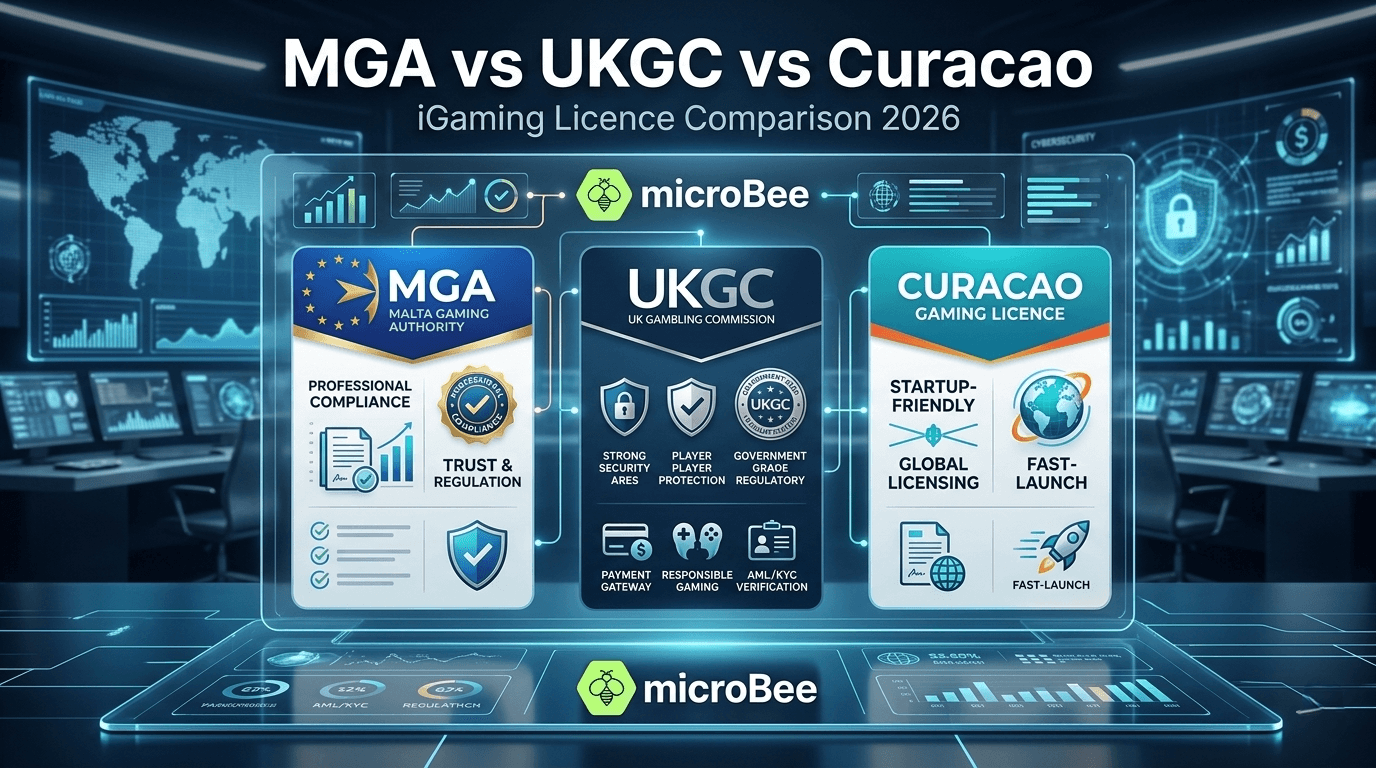
Licensing is the foundation of any iGaming operation. The licence an operator holds determines which markets they can serve, which payment providers will work with them, which game studios will supply content, and how credible their brand appears to both players and business partners.
For operators entering the market in 2026, three licensing jurisdictions dominate the conversation: Malta (MGA), the United Kingdom (UKGC), and Curaçao. Each serves a different operator profile, and many successful operators eventually hold two or all three. This guide provides the detailed comparison needed to make an informed licensing decision.
Licence Comparison at a Glance
Factor | MGA (Malta) | UKGC (UK) | Curaçao |
Application Cost | €25,000–€40,000 | £100,000+ (total Y1) | $15,000–$25,000 |
Annual Fee | €25,000–€35,000 + compliance | £55,000–£150,000+ | $10,000–$15,000 |
Processing Time | 4–6 months | 6–12 months | 4–8 weeks |
Market Reach | Europe + international (50+) | UK only | International (limited) |
Regulatory Rigour | High | Highest | Moderate (reforming) |
Player Trust / Credibility | High | Highest | Low–Medium |
Payment Provider Acceptance | Widely accepted | Required for UK PSPs | Challenging with tier-1 |
Game Studio Access | Full access | Full access | Limited with premium studios |
Physical Presence Required | Yes (Malta office) | No (but UK key personnel) | No |
Compliance Reporting | Monthly/quarterly | Monthly + ad hoc | Annual (increasing) |
Malta Gaming Authority (MGA)
Why Operators Choose MGA
The MGA licence offers the widest market coverage of any single licence. Operating from Malta, a European Union member state, gives operators access to EU passporting principles and acceptance across 50+ jurisdictions. The MGA is recognised as a Tier 1 regulatory body, meaning payment providers, game studios, and affiliate networks treat MGA-licensed operators as credible and low-risk partners.
MGA’s regulatory framework balances consumer protection with commercial viability. Requirements are substantial but not prohibitive for well-prepared operators. The licensing process is thorough but predictable, with clear guidance and responsive communication from the authority.
MGA Licence Requirements
• Registered company in Malta with a local office and at least one key person residing in Malta.
• Minimum share capital of €100,000 (for Type 1 and Type 2 licences).
• Fit and proper assessment of all directors, shareholders, and key personnel, including criminal background checks and financial due diligence.
• Technical systems audit covering random number generation, player fund segregation, and data protection.
• Responsible gambling programme with self-exclusion, deposit limits, and reality checks.
• AML/CFT compliance programme meeting EU Fourth Anti-Money Laundering Directive requirements.
UK Gambling Commission (UKGC)
Why Operators Choose UKGC
The UK is one of the world’s largest regulated online gambling markets, generating over £15 billion in annual gross gambling yield. Any operator targeting UK players must hold a UKGC licence — there is no alternative. The UKGC licence also carries the highest global credibility, making it valuable even for operators whose primary market is outside the UK.
UKGC Compliance Reality
UKGC compliance requirements are the most demanding in the industry. Operators should expect:
• Customer interaction and affordability checks for players depositing above thresholds (currently £1,000 net loss within 24 hours triggers enhanced checks).
• Source of funds verification for high-value customers, requiring documented evidence of income or wealth.
• Marketing restrictions including a prohibition on bonus offers to VIP customers without affordability verification.
• Regular regulatory returns covering financial, player protection, and anti-money laundering data.
• Potential for increased licence fees based on gambling yield brackets.
Curaçao e-Gaming
Why Operators Choose Curaçao
Curaçao has historically been the entry-level licence for new operators due to its low cost, fast processing, and minimal physical presence requirements. For operators targeting markets outside of Europe and the UK — particularly Latin America, Asia, and Africa — Curaçao provided a legally defensible operating framework at a fraction of MGA or UKGC costs.
2025–2026 Regulatory Reforms
Curaçao is undergoing significant regulatory reform. The new Gaming Control Board (GCB) is replacing the old sublicensing model with direct operator licensing, increased compliance requirements, and stricter technical standards. Key changes include:
• Direct licensing replacing the sublicence (master licence) system. Each operator must apply individually.
• Enhanced KYC/AML requirements bringing Curaçao closer to European standards.
• Player protection mandates including deposit limits and self-exclusion.
• Annual compliance audits (previously not consistently required).
These reforms will increase costs and timelines but should improve market acceptance over time. Operators currently holding Curaçao sublicences must transition to the new framework within the specified transition period.
Licensing Strategy: Which Should You Get First?
The licensing sequence depends on your target market, budget, and timeline:
• Targeting Europe broadly: Start with MGA. It provides the widest market coverage and opens doors to tier-1 payment providers and game studios. Budget €100K–€150K for full setup including legal, office, and compliance costs.
• UK is your primary market: You need UKGC. Many operators pursue MGA and UKGC simultaneously, launching in MGA markets first while the longer UKGC process completes.
• Emerging markets with tight budget: Curaçao for initial launch, with a plan to add MGA within 12–18 months. Use the Curaçao period to build operational history and revenue.
• Maximum credibility: Hold both MGA and UKGC. This combination covers the vast majority of desirable markets and signals the highest regulatory standards to partners and players alike. MicroBee holds both licences, supporting operators across 50+ jurisdictions.
B2B Provider Licensing: What Operators Should Verify
An operator’s B2B technology provider must also hold appropriate licences. Using an unlicensed or incorrectly licensed provider creates regulatory risk for the operator. Before signing with any B2B sportsbook, casino, or data provider, verify:
• The provider holds a valid B2B licence (not B2C) from a Tier 1 jurisdiction.
• The licence covers the specific products you plan to use (sportsbook data feeds, casino game aggregation, live casino, etc.).
• The licence is current and not subject to sanctions or conditions.
• The provider’s compliance team can supply certification documentation for your licensing application.
Frequently Asked Questions
Question | Answer |
Can I operate with just one licence? | Yes, but your market reach is limited. MGA covers the most markets with a single licence. UKGC covers only the UK. Most operators eventually hold 2–3 licences. |
How long does the MGA licensing process take? | Typically 4–6 months from complete application submission. Incomplete applications or issues identified during due diligence can extend this to 8–12 months. |
Do I need a physical office in Malta for MGA? | Yes. MGA requires a registered office in Malta with at least one key function holder residing in Malta. This is a non-negotiable requirement. |
Is Curaçao still a viable option after reforms? | Yes, particularly for operators targeting non-European markets. The reforms actually improve Curaçao’s credibility long-term, though costs and timelines are increasing. |
What’s the difference between B2B and B2C licensing? | B2C licences authorise operators to offer gambling to end players. B2B licences authorise technology providers (like MicroBee) to supply platforms, data, and services to licensed B2C operators. |