
MicroBee Onboard Team
Reading Time :
8 Min
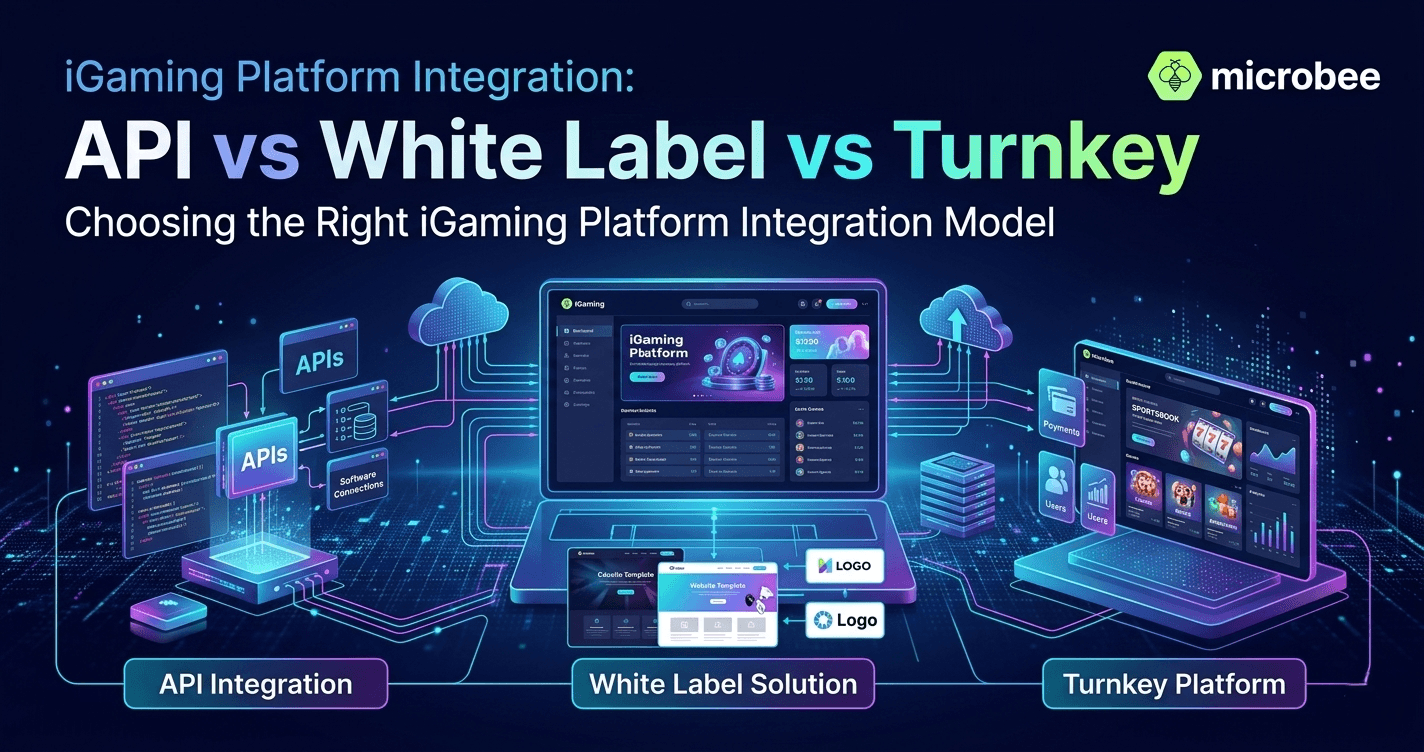
Every operator entering the iGaming market faces a fundamental architectural decision: how much of the technology stack to build versus buy. This decision determines launch timeline, operational control, ongoing costs, and the operator’s ability to differentiate in an increasingly competitive market.
The three primary integration models — API, white label, and turnkey — each serve different operator profiles. This guide provides the technical and commercial detail needed to make the right choice for your specific situation, rather than defaulting to whatever model the first provider you speak with happens to sell.
Understanding the Three Models
API Integration
API integration means connecting to a provider’s backend services (odds feeds, player management, risk management, settlement) through documented application programming interfaces while building and controlling your own frontend, user experience, and business logic layer.
This model gives operators maximum control over the player experience. Every UI element, every workflow, every promotional mechanic can be custom-built. The trade-off is development complexity: API integration requires a competent development team capable of building and maintaining a production-grade web and mobile application.
MicroBee’s Sports Data API provides real-time and historical data for 30+ sports with 150,000+ pre-match feeds and 30,000+ live in-play events. Integration with MicroBee’s API typically completes in 2–4 weeks, compared to the 3–6 month industry average, thanks to comprehensive documentation, sandbox environments, and dedicated integration support.
White Label Solution
A white label platform provides a pre-built, fully functional sportsbook or casino application that operates under the operator’s brand. The provider handles the technology infrastructure, software updates, and core platform maintenance. The operator manages branding, marketing, player acquisition, and customer relationships.
White label is the fastest path to market. Operators can launch a branded sportsbook within 4–6 weeks with customised UI themes, configured payment methods, and jurisdiction-specific compliance settings. The limitation is architectural: operators share the platform with other white label clients, which can restrict deep customisation.
Turnkey Solution
Turnkey goes beyond white label by including operational services: licensing support, payment processing setup, customer support staffing, compliance management, and sometimes marketing services. The operator receives a complete, ready-to-run business rather than just software.
This model suits operators entering iGaming from adjacent industries (land-based casinos going online, media companies adding betting, affiliates launching their own brands) who need operational expertise alongside technology.
Side-by-Side Comparison
Dimension | API Integration | White Label | Turnkey |
Setup Cost | $50K–$150K | $20K–$80K | $100K–$300K |
Time to Launch | 2–8 weeks (MicroBee) / 3–6 months avg | 4–6 weeks | 6–12 weeks |
UI Control | Full (you build everything) | Theme-level customisation | Theme-level + managed |
Dev Team Required | Yes (3–5 developers minimum) | No (optional for enhancements) | No |
Ongoing Maintenance | Your responsibility | Provider handles core | Provider handles all |
Scalability | Unlimited (you control infra) | Provider-dependent | Provider-dependent |
Brand Differentiation | Maximum | Moderate | Moderate |
Regulatory Compliance | You manage (provider assists) | Shared responsibility | Mostly provider-managed |
Revenue Share Model | Lower % (more self-managed) | Higher % (more included) | Highest % (full service) |
Switching Cost | Lower (you own the frontend) | Medium (vendor lock-in risk) | Highest (operational dependency) |
Which Model Fits Your Operator Profile?
The decision should be driven by three factors: technical capacity, time to market requirements, and long-term strategic vision.
• Choose API if: You have an in-house development team of 3+ engineers, want full control over user experience, plan to operate in multiple jurisdictions with localised features, and view technology as a competitive differentiator. This is the right choice for operators building long-term platforms.
• Choose White Label if: You need to launch quickly (under 6 weeks), have limited development resources, are testing a new market before committing to full platform development, or are an affiliate transitioning to operator status. This is the right choice for speed-to-market operators.
• Choose Turnkey if: You are entering iGaming from outside the industry, need operational support alongside technology, want a single vendor accountable for the entire operation, or are a land-based operator going digital. This is the right choice for operators who want to focus on marketing and player acquisition rather than technology.
The Hybrid Approach: Start White Label, Graduate to API
Increasingly, operators are adopting a staged approach: launch on a white label platform to generate revenue and validate the market, then migrate to API integration as the business scales and the team develops in-house capabilities.
MicroBee’s modular platform architecture supports this progression. Operators can start with a branded white label sportsbook or casino, begin building custom frontend components against MicroBee’s API, and transition to full API integration without changing their backend provider or migrating player data. This eliminates the switching cost penalty that typically traps operators in their initial integration model.
The management system, trading system, and affiliate system can be adopted individually, allowing operators to customise their service stack as needs evolve.
Integration Cost Breakdown: Hidden Expenses to Budget For
Beyond the headline setup costs, operators should budget for these commonly underestimated expenses:
• QA and testing: Allocate 20–30% of development costs for testing across browsers, devices, and payment methods. Insufficient testing is the most common cause of post-launch issues.
• Compliance setup: KYC/AML provider integration, responsible gambling tools, and jurisdiction-specific player limits each require configuration and testing time.
• Payment gateway integration: Each payment method (credit cards, e-wallets, crypto, bank transfers) requires separate integration, testing, and certification.
• Content localisation: Translating and culturally adapting the platform for each target market costs $5,000–$15,000 per language.
• Ongoing API versioning: Providers update their APIs periodically. Budget for developer time to test and implement API updates (typically 2–4 updates per year).
Frequently Asked Questions
Question | Answer |
Can I switch from white label to API later? | Yes, if your provider supports it. MicroBee’s modular architecture allows seamless graduation from white label to full API integration without player data migration. |
Do I need my own gaming licence for white label? | In most jurisdictions, yes. The B2B provider’s licence covers their technology, but you need a B2C operator licence. Some turnkey providers include licensing support. |
Which model has the lowest total cost over 3 years? | API integration, if you have the development team to support it. The lower ongoing revenue share compensates for higher upfront costs within 12–18 months. |
How do I evaluate API documentation quality? | Request documentation access before signing. Look for versioned endpoints, code samples in multiple languages, error handling guides, and a maintained changelog. |
What uptime SLA should I demand? | 99.99% for any live betting platform. This allows approximately 52 minutes of downtime per year. Anything below 99.9% is inadequate for production sportsbook operations. |