
Microbee Tech Team
Reading Time :
10 Minute
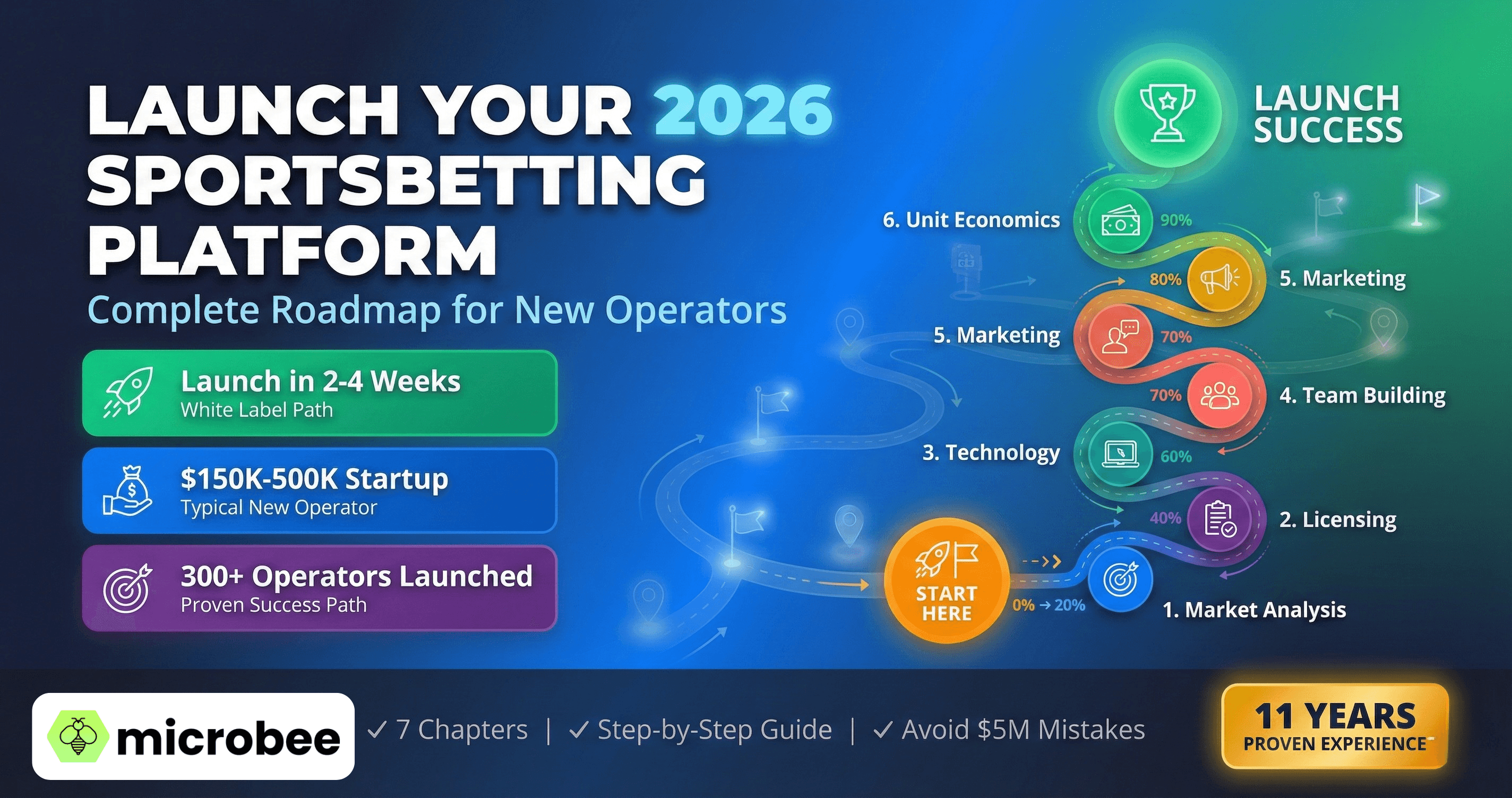
The sports betting industry has never been more accessible to new operators. What once required tens of millions in capital and years of development can now launch in weeks with the right approach. Yet accessibility has created crowded markets where undifferentiated operators struggle while well-positioned platforms thrive from day one.
We've worked with over 300 sports betting operators at MicroBee since 2014, helping launch platforms across 50+ jurisdictions. We've watched startups become market leaders and seen well-funded operators fail despite substantial investment. The difference rarely comes down to capital—it's about strategic decisions made before writing a single line of code or spending a dollar on marketing.
This comprehensive guide shares what we've learned actually works when launching sports betting platforms. We'll cover market selection, licensing pathways, technology decisions, operational requirements, marketing strategies, and common pitfalls that derail otherwise promising ventures. Whether you're an entrepreneur entering gambling for the first time, a traditional business diversifying into betting, or an operator expanding into new markets, this roadmap will help you launch strategically rather than hopefully.
Chapter 1: Market Analysis and Strategic Positioning
The first decision determines everything that follows: which market will you serve? This isn't just geographic—it's about identifying underserved player segments, competitive gaps, and sustainable positioning.
Understanding Market Maturity Levels
Sports betting markets exist across a maturity spectrum from emerging to saturated. Each presents different opportunities and challenges.
Emerging markets have recently legalized or are in early legalization phases. Think US states legalizing sports betting, Latin American countries opening to online gambling, or African nations developing regulatory frameworks. These markets offer first-mover advantages—less competition, lower customer acquisition costs, brand establishment opportunities. But they also carry higher risks: regulations may change unfavorably, market size might not meet projections, payment infrastructure could be underdeveloped, and player education requires more investment.
We've seen operators succeed spectacularly in emerging markets by arriving early with quality platforms that set standards competitors struggled to match. We've also watched operators burn through budgets in markets that never developed the betting volume projected. The key differentiator? Thorough analysis before commitment rather than optimistic assumptions.
Growth markets have established regulatory frameworks and active competition but continue expanding rapidly. Ontario after legalization, several European markets with growing online penetration, and Southeast Asian markets with increasing smartphone adoption. These markets balance opportunity with competition—proven demand exists, but you must differentiate to capture share.
Success in growth markets requires either superior product execution, better marketing efficiency, or unique positioning. You won't win by being a generic sportsbook with nothing special. One operator we worked with entered a competitive European market but focused exclusively on eSports betting with deep game knowledge and features tailored to that audience. They carved out a profitable niche despite dozens of generalist competitors.
Mature markets include the UK, major European markets, and established Asian betting hubs. Competition is intense, customer acquisition costs are high, players are sophisticated, and regulatory scrutiny is strict. Why would anyone enter mature markets? They're large, stable, and profitable if you can differentiate successfully. Moreover, winning in mature markets proves your platform can compete anywhere.
Operators entering mature markets typically succeed through one of three approaches: superior technology creating a better user experience, focused niche positioning rather than broad competition, or innovative features competitors haven't offered. Simply launching another sportsbook identical to existing options rarely works in mature markets.
Identifying Your Competitive Advantage
Every successful operator we've worked with can articulate their competitive advantage clearly. Operators who struggle usually answer this question vaguely or claim generic advantages ("we offer good odds and customer service").
Technology advantages mean genuinely superior platform performance, features, or user experience. Faster loading times, more comprehensive live betting, innovative features like bet builders with more flexibility, and mobile experiences that competitors can't match. Technological advantages are defensible but require continuous investment—competitors eventually catch up unless you keep innovating.
Market expertise advantages come from deep understanding of specific player segments. An operator founded by serious bettors who understand sharp players' needs. A platform built for casual entertainment bettors with gamification and social features. Deep knowledge of regional preferences—what payment methods players actually use, which sports they care about beyond obvious choices, and cultural factors affecting betting behavior.
Operational efficiency advantages enable profitability at lower margins or higher marketing spend than competitors. Better risk management protecting margins, more efficient customer acquisition through owned media rather than paid channels, lower technology costs through smart platform choices, and streamlined operations requiring smaller teams.
Brand and trust advantages matter enormously in gambling, where players entrust you with their money. Association with respected brands, licensing from prestigious regulators, partnerships with major sports properties, and testimonials from satisfied users. New operators start without these advantages but can build them strategically.
We worked with an operator targeting Nigerian sports bettors. Instead of generic sports betting, they partnered with popular Nigerian sports personalities for endorsements, sponsored local football leagues, integrated mobile money payments used throughout Nigeria, and hired customer support who spoke local languages naturally. Their Nigeria-specific positioning outperformed well-funded international operators who treated Nigeria as just another market.
Sizing Your Opportunity Realistically
Overly optimistic market sizing destroys more sports betting startups than any other factor. Founders project millions in revenue within months based on multiplication: "If we capture just 1% of this giant market..." But market share doesn't work that way, especially early on.
Calculate realistic player acquisition based on comparable markets or operators. If you're entering a US state, research how many active bettors competitive states have per capita. If you're launching in Europe, find operators in similar-sized markets and research their user bases. Don't assume you'll instantly match mature operators—build projections assuming you'll start small and grow.
Model customer acquisition costs accurately by researching what competitors actually spend. Google Ads for sports betting keywords, social media advertising, affiliate commissions, influencer partnerships—research current market rates in your target geography. Many founders plan for a $50-100 customer acquisition cost and discover mature markets require $300-500 or more.
Project lifetime value is conservatively based on retention data from similar operators if available. Gambling has high churn—many players try your platform once and never return. Some become regulars. Understanding retention curves in your target market helps project realistic revenue per acquired customer.
We encourage operators to model three scenarios: optimistic, realistic, and pessimistic. Then plan based on pessimistic projections while hoping for realistic outcomes. Operators who plan optimistically but then face pessimistic reality often run out of capital before reaching sustainability.
Chapter 2: Licensing and Regulatory Strategy
Licensing determines where and how you can legally operate. These decisions have profound implications for costs, timelines, available markets, and operational requirements.
Major Licensing Jurisdictions Compared
The UK Gambling Commission (UKGC) represents the gold standard but also the highest requirements. UKGC licensing requires substantial capital reserves, comprehensive compliance programs, strict advertising standards, robust responsible gambling tools, and detailed operational procedures. The application process takes 6-12 months and costs £100,000-300,000, including consulting and legal fees.
Why pursue UKGC despite high barriers? It allows serving the lucrative UK market directly, provides credibility globally, and demonstrates you can meet the strictest regulatory standards. Several other jurisdictions recognize UKGC licenses through reciprocal agreements. If you plan significant UK operations or want maximum regulatory credibility, UKGC makes sense despite costs.
The Malta Gaming Authority (MGA) offers EU market access with reasonable requirements. MGA licensing costs €25,000-100,000 depending on services and typically takes 4-6 months. Malta requires solid compliance infrastructure but is more accessible than the UKGC for newer operators. MGA licenses allow serving multiple EU markets from one license (though some countries like Sweden and the Netherlands require additional local licensing).
MGA makes sense for operators targeting European markets without massive capital to pursue UKGC initially. Many operators start with MGA, establish operations, and then later pursue UKGC or other licenses as they scale.
Curaçao eGaming provides low-cost international licensing. Curaçao licenses cost $10,000-40,000, are processed in 4-8 weeks, and have minimal ongoing compliance requirements. Curaçao allows serving most international markets (excluding strictly regulated jurisdictions) with relatively simple operational requirements.
The tradeoff? Curaçao licenses carry less prestige and regulatory protection. Some players distrust Curaçao-licensed operators. Payment processors may have higher fees or stricter requirements. But for operators serving emerging markets, testing concepts before major investment, or targeting regions where premium licenses don't matter much, Curaçao offers viable entry.
US state licensing varies dramatically by state. Nevada, New Jersey, Pennsylvania, Michigan, and other legal states each have separate licensing processes, requirements, and costs. State licenses typically require $500,000-1,000,000 per state in capital reserves, extensive background checks, detailed business plans, and 6-12 months for approval.
US market operators usually need technology partners already licensed in target states to expedite market entry rather than pursuing licenses independently initially. The market opportunity is substantial, but regulatory barriers are high for new operators.
White Label vs. Licensed Operation
Many new operators face a fundamental choice: operate under a white label arrangement where the licensed operator provides technology and holds licenses while you market under your brand, or pursue independent licensing and operate your own platform.
White label advantages include immediate market access without waiting for licensing, lower capital requirements (no license fees or capital reserves), simplified compliance (licensed provider handles it), faster time to revenue, and proven operational systems. White label lets you focus on customer acquisition and branding rather than technology and compliance.
White label disadvantages include limited control over platform features and roadmap, profit sharing with the white label provider (typically 20-50% of revenue), restrictions on operating practices, difficulty differentiating from competitors using the same platform, and challenges if you want to migrate to independent operations later.
Independent licensing advantages include complete control over the platform and operations, higher profit margins (no revenue sharing), flexibility to innovate and differentiate, the ability to operate across multiple markets under one infrastructure, and scalability without platform constraints.
Independent licensing disadvantages include higher upfront costs ($100,000-500,000+ for licensing), longer time to market (6-12 months for licensing plus platform development), complex ongoing compliance requirements, the need for a more sophisticated operational team, and higher risk if the venture doesn't succeed.
We've seen successful operators following both paths. White label makes sense for testing markets, getting quick proof of concept, or for marketers who want to focus on customer acquisition while outsourcing technology. Independent licensing makes sense for operators with significant capital, long-term vision, technical capabilities, or unique platform differentiation that white labeling can't support.
Regulatory Compliance from Day One
Many operators treat compliance as something to worry about later. This thinking creates disasters. Regulatory violations can mean license suspension, substantial fines, criminal liability, or permanent market exclusion.
Responsible gambling tools must be implemented and actively promoted from launch. This includes deposit limits, loss limits, time limits, self-exclusion, reality checks, and access to problem gambling resources. Don't bury these features—make them genuinely accessible. Regulators audit responsible gambling implementation closely, and courts show little sympathy to operators with inadequate protections when problem gambling cases arise.
Know Your Customer (KYC) verification must happen before players can deposit significant amounts or withdraw any funds. Different jurisdictions have different requirements, but best practice means verifying identity, age, and address for all players before substantial transactions. Implementation requires integrating with verification services, defining verification workflows, training support staff, and maintaining documentation for audits.
Anti-Money Laundering (AML) monitoring identifies suspicious transactions and betting patterns. High-value transactions, rapid deposit-withdrawal cycles, unusual betting patterns, and multiple accounts linked to one user all warrant investigation. You need AML policies, monitoring tools, investigation procedures, and reporting mechanisms to authorities when required.
Advertising compliance matters more than operators expect. Claims in advertising must be accurate and not misleading. Bonus terms must be clear. Advertising can't target minors or vulnerable populations. Different jurisdictions have specific requirements—the UK prohibits certain advertising during sports broadcasts, some US states restrict advertising methods, and others mandate responsible gambling messaging in all promotions.
We've seen operators fined six figures for advertising violations that seemed minor. Budget for compliance consulting from the beginning. It's vastly cheaper than fixing violations after regulators notice them.
Chapter 3: Technology Platform Selection
Technology decisions determine your platform's performance, feature capabilities, development timeline, ongoing costs, and ability to scale. These choices aren't easily reversed, making upfront analysis critical.
Build vs. Buy Analysis
The classic technology decision: build your own platform or use existing solutions.
Building from scratch gives complete control, unlimited customization, proprietary technology, and no ongoing vendor dependencies. It sounds appealing. But building competitive sports betting platforms from scratch requires 18-24 months, $2-5 million in development costs, teams of 15-25 specialized engineers, ongoing maintenance and updates, and significant operational risk.
We've watched well-funded operators spend 20 months building custom platforms, launch with missing features, poor performance, and bugs, only to realize competitors using established platforms reached the market 18 months earlier and captured market share they'll never recover. Unless you have specific requirements existing platforms absolutely cannot meet, or you're building something genuinely innovative requiring custom technology, building from scratch rarely makes economic sense for new operators.
Using established platform services means faster time to market (2-4 weeks vs. 18+ months), proven technology that's been tested under real load, continuous updates and new features, lower upfront costs, and focusing resources on marketing rather than development. The tradeoffs are less customization, vendor dependency, ongoing service fees, and sharing infrastructure with other operators.
The economics strongly favor established platforms for most operators. One example: Operator A spent $3 million and 22 months building a custom platform. Operator B integrated with MicroBee in 3 weeks and spent those 22 months acquiring customers. By the time Operator A launched, Operator B had 15,000 active customers and $8 million in lifetime betting volume. Operator A never caught up.
Hybrid approaches combine elements of both. Use established services for core betting engine, odds, and risk management where building competitive alternatives is prohibitively expensive. Build custom front-end interfaces for differentiated user experience. Integrate best-of-breed services for payments, CRM, and specific features while maintaining control over player experience.
This approach balances speed and cost (leveraging established services) with differentiation (custom elements where it matters). It requires a good technical team to integrate multiple services cohesively but avoids both extremes of building everything or controlling nothing.
Essential Platform Capabilities
Regardless of build vs. buy decisions, certain capabilities are non-negotiable for competitive platforms.
Mobile-first design isn't optional—it's fundamental. 70-85% of sports betting happens on mobile devices depending on the market. Your platform must work beautifully on phones first and desktops second. This means responsive design that adapts across screen sizes, touch-optimized interfaces with generous tap targets, performance optimized for mobile networks, and potentially progressive web apps or native mobile applications.
Testing exclusively on desktop during development and then discovering the mobile experience is poor happens surprisingly often. One operator launched with an excellent desktop experience but mobile usability problems. 78% of their traffic was mobile. User acquisition costs soared because most acquired players churned after a poor mobile first impression. They spent six months retrofitting mobile improvements, losing precious time and money.
Live betting infrastructure separates modern platforms from outdated ones. Live betting represents 60-70% of betting volume on advanced platforms. Players expect odds updating in real-time (every 1-5 seconds), instant market suspension when significant events occur (goals, red cards), and fast bet placement confirmation. This requires WebSocket technology for real-time data push, sophisticated odds engines that adjust to live game state, and infrastructure handling massive concurrent load during popular matches.
Comprehensive sports coverage means genuinely deep markets, not superficial presence. It's better to cover 15 sports extremely well than claim 60 sports but offer minimal markets on most. Focus on sports your target audience actually bets on. For European markets, that's football, tennis, and basketball. For American markets, add American football, baseball, and hockey. For Asian markets, football, basketball, and eSports matter most.
Payment flexibility supporting methods your target audience actually uses avoids conversion killers. Research payment preferences in your market carefully. European players expect SEPA transfers and e-wallets. Asian players want bank transfers and increasingly cryptocurrency. Latin American players need regional methods like Boleto or Mercado Pago. Americans expect cards and ACH. Supporting the right 3-5 payment methods matters more than offering 20+ obscure options.
Risk management and trading tools protect profitability. Automated liability monitoring, odds adjustment to balance books, suspicious pattern detection, and trading dashboards for human oversight—these features determine whether you maintain healthy margins or bleed money to sharp bettors and syndicates. Many operators underinvest in risk management initially, focusing on flashy features players see. Invisible risk management determines long-term viability.
Scalability Considerations
Platforms that work fine for 1,000 users sometimes collapse under a 10,000+ load. Plan for scale from the beginning even if you start small.
Auto-scaling infrastructure using cloud services (AWS, Google Cloud, Azure) enables handling traffic spikes during major events. Champions League finals, World Cup matches, major boxing events—traffic might spike 50-100x normal during these events. Your infrastructure must scale automatically without manual intervention or downtime.
Database architecture requires careful planning for sports betting's specific patterns: high-frequency reads (players checking odds constantly), periodic write spikes (major events causing thousands of simultaneous bets), complex queries across relational data (events, markets, bets, and users), and long-term data retention for compliance.
API rate limiting and usage quotas need architecture supporting your growth without hitting walls. If your platform provider limits API calls and you approach those limits as you scale, you either face service degradation or sudden cost increases. Understand limitations and growth pathways clearly before committing.
We've helped operators migrate from platforms that couldn't scale to our infrastructure after growth exceeded their original platform's capabilities. Migration during operation is painful and expensive and risks losing customers during transition. Planning for scalability initially costs less than migrating later.
Chapter 4: Operational Structure and Team Building
Technology matters, but humans operate platforms. Building the right team with clear operational structure determines execution quality.
Essential Roles for Launch
Founder/CEO must handle overall strategy, fundraising, major partnerships, regulatory relationships, and team leadership. In early stages, founders wear many hats, but they can't do everything. Clarity about what founders must own versus what to delegate or hire for prevents becoming operational bottlenecks.
Technical Lead/CTO (if building any custom technology) manages platform integration, oversees technical decisions, ensures system reliability, plans the technical roadmap, and leads the engineering team. Even if using platform services extensively, someone must own technical decision-making and vendor relationships. Don't delegate this to developers—it requires business context and strategic thinking.
Marketing Lead drives customer acquisition, manages the advertising budget, develops growth strategies, oversees brand building, and analyzes marketing performance. Sports betting is highly competitive; strong marketing differentiates between success and failure. Marketing leadership requires understanding performance marketing, creative development, brand positioning, and data analysis.
Compliance/Legal ensures regulatory adherence, manages license relationships, oversees responsible gambling, handles legal issues, and stays ahead of regulatory changes. This can be external consultants initially but needs someone owning it internally. Compliance failures end businesses, making this role critical despite not generating revenue directly.
Customer Support Manager leads support team, manages player issues, identifies recurring problems, escalates critical issues, and maintains player satisfaction. Quality support builds retention and word-of-mouth. Poor support destroys reputation quickly. Even small operations need dedicated support leadership, not just support representatives reporting to whoever has time.
Trading/Risk Manager (if operating independently, not fully relying on provider) monitors betting markets, manages liability, identifies suspicious patterns, optimizes odds competitiveness, and protects margins. Larger operations need dedicated traders. Smaller operators might rely on platform providers' risk management but should understand it deeply rather than blindly trusting.
Outsourcing vs. In-House
The right balance between in-house capabilities and outsourced services depends on budget, ambitions, and available talent.
Technology development almost always makes sense to outsource initially through platform services unless you have unique requirements or substantial technical talent and capital. Building in-house might make sense years later after proving the business model and accumulating resources.
Customer support can start outsourced to 24/7 support centers but typically should move in-house as you scale. Early outsourced support handles basic inquiries and establishes processes. As you grow and player issues become more complex, in-house support that deeply understands your brand, players, and operations provides a better experience.
Marketing execution often combines in-house strategy with outsourced execution. You might handle strategy, creative direction, and performance analysis in-house while outsourcing media buying, content production, or specific campaigns to agencies or contractors with specialized expertise.
Compliance and legal typically need strong external support (lawyers, compliance consultants) even with in-house team. Regulations are complex and change frequently. External specialists provide expertise across jurisdictions that in-house teams can't match early on.
Building Culture and Team Dynamics
Small teams in startups require everyone to contribute beyond narrow job descriptions while maintaining accountability and avoiding chaos.
Clear ownership means each person owns specific areas where they have decision-making authority and accountability. Ambiguity about who decides what creates paralysis. In early stages, ownership may span areas you'd separate later, but clarity about current ownership prevents thrashing.
Transparency with boundaries means sharing company performance, challenges, and decision-making reasoning while recognizing that some information (individual salaries, Board discussions, and upcoming investments) stays confidential. Teams perform better understanding context but not every detail needs sharing.
Bias toward action over endless planning suits early-stage operations. Analyze enough to make informed decisions but don't overanalyze. Ship features quickly, gather feedback, and iterate. Perfect planning without execution accomplishes nothing. Imperfect execution generates learning and forward progress.
Customer obsession throughout the team, not just customer-facing roles. Engineers who understand player needs build better features. Marketing that understands retention builds more sustainable growth. Finance that understands lifetime value allocates budgets more effectively. Everyone should spend time understanding customer perspective.
Chapter 5: Go-to-Market Strategy and Customer Acquisition
Your platform can work perfectly, but you fail without players. Customer acquisition determines growth trajectory and sustainability.
Pre-Launch Positioning and Branding
Brand identity communicated clearly before launch sets player expectations. Are you the premium platform for serious bettors? The fun, gamified experience for casual entertainment? The platform for specific sports or regions? Confused positioning leads to confused messaging that acquires players inefficiently.
We've seen operators spend heavily on generic "we offer sports betting" messaging that could describe anyone. Compare to operators with clear positioning: "The eSports betting platform built by competitive gamers for competitive gaming bettors" or "Latin America's leading mobile-first sportsbook." Clear positioning differentiates and attracts the right players.
Website and creative development should begin before platform launch. Landing pages that convert visitors to signups, promotional creative that grabs attention, brand guidelines ensuring consistency, social media presence building pre-launch awareness—these assets take time to develop well. Rushing creative in the final week before launch produces poor quality that damages first impressions.
Launch market definition means resisting temptation to target everyone everywhere. Focus on specific geographic market, player demographic, sports preference, or use case. "Everyone who bets on sports globally" isn't a strategy. "Serious NBA bettors in Northeast US" or "Casual European football fans who bet primarily on mobile" enables focused, efficient marketing.
Customer Acquisition Channels
Paid search through Google Ads captures high-intent users searching betting-related terms. This channel works but has become expensive in competitive markets—$50-500+ per acquired customer depending on geography and competition. Success requires excellent conversion optimization, lifetime value exceeding acquisition cost substantially (3-5x minimum), and willingness to sustain losses initially while optimizing.
Social media advertising on Facebook, Instagram, Twitter, TikTok reaches users based on interests and demographics rather than explicit search intent. Typically lower cost per customer than search ($30-200) but also lower intent, meaning potentially lower lifetime value. Social works well for building awareness and acquiring casual players. Success requires compelling creative, multiple creative variations to prevent ad fatigue, and sophisticated audience targeting.
Affiliate marketing pays commissions to affiliates who refer players. Affiliates include websites with betting content, tipsters, influencers, and comparison sites. Revenue share (20-40% of player losses) or CPA (flat fee per acquired player) structures exist. Affiliates can scale acquisition significantly but require recruiting quality affiliates, managing relationships, ensuring compliance with advertising regulations, and monitoring quality of referred players.
Content marketing through owned media (blog, YouTube channel, social media) builds audience organically over time. Educational betting content, match previews and predictions, sports analysis, betting strategy guides—valuable content attracts players searching for information. Content marketing has low direct cost but requires time and expertise to produce quality content consistently. Results compound over time rather than delivering immediate volume.
Influencer partnerships with sports personalities, professional bettors, or content creators can deliver substantial players if partnerships fit authentically. An influencer genuinely using and endorsing your platform creates trust. Forced, obviously paid promotions generate skepticism. Successful influencer marketing requires finding influencers whose audiences match your target players, allowing authentic endorsement rather than scripted promotion, and clear tracking of results.
Traditional media (TV, radio, outdoor advertising) works in some markets but requires substantial budget. Mass media builds brand awareness but lacks targeting and tracking of digital channels. Makes sense for established operators with significant budget competing in major markets. Rarely optimal for new operators with limited capital.
Conversion Optimization
Acquiring traffic means nothing without converting visitors to registered, deposited, betting players.
Landing page optimization dramatically impacts conversion rates. Elements that matter include clear value proposition immediately visible, prominent call-to-action buttons, trust signals (licenses, security badges, testimonials), simple registration process (minimal fields required), and mobile-optimized design. Testing variations of landing pages (A/B testing) identifies what actually converts your audience rather than assuming.
Registration friction reduction means collecting minimum information necessary initially. Asking for 15 fields during registration kills conversion. Collect email, password, basic info needed for compliance—everything else can wait. Progressive disclosure gathers additional information later when players are more committed.
First deposit optimization focuses on getting registered players to actually deposit and bet. Welcome bonuses incentivize first deposits but must be realistic and clearly explained. Match bonuses (100% bonus on first deposit up to $100) work well. Confusing wagering requirements or unrealistic turnover requirements frustrate players and damage trust.
Payment method availability directly impacts deposit conversion. If your target players prefer payment method X but you don't support it, they can't deposit regardless of how convinced they are. Research actual payment preferences in your market and support at minimum the top 3-5 methods.
One operator we worked with saw 42% of registration to deposit conversion initially. After landing page redesign, registration simplification, welcome bonus clarity improvement, and adding two key payment methods, conversion increased to 67%. Same traffic, same platform, dramatically more depositing players through conversion optimization.
Chapter 6: Financial Planning and Unit Economics
Sports betting businesses live or die based on unit economics and financial management. Understanding and monitoring key metrics determines sustainability.
Key Metrics Every Operator Must Track
Customer Acquisition Cost (CAC) measures total marketing spend divided by new customers acquired. This seems simple but requires careful definition: Do you count only depositing players or all registrations? Do you include brand marketing spend or only direct response? How do you attribute multi-touch conversions? Consistent methodology matters more than perfect attribution.
Lifetime Value (LTV) predicts total gross profit generated by average customer over their entire relationship with your platform. This requires understanding retention curves (how many customers remain active after 1 month, 3 months, 6 months, 12 months), average betting volume per customer, and your hold percentage (profit margin). LTV calculations require assumptions about future behavior based on historical data.
LTV:CAC Ratio indicates acquisition sustainability. Ratios above 3:1 suggest healthy, sustainable acquisition where lifetime value substantially exceeds acquisition cost. Ratios between 1:1 and 3:1 work if you have cheap capital and belief in improving retention or monetization. Ratios below 1:1 mean you lose money on every customer—unsustainable unless fixing something specific rapidly.
Hold Percentage measures your profit as percentage of total bets placed. If players collectively bet $1 million and your gross profit is $50,000, hold percentage is 5%. Typical hold varies by sport, bet type, and player sophistication. Casual players betting accumulators might generate 10-15% hold. Sharp players betting single matches with extensive research might generate 2-3% hold. Overall hold of 5-7% is typical for balanced sportsbooks.
Monthly Active Users (MAU) and retention cohorts track how many customers remain active over time. Retention cohorts show what percentage of users acquired in specific month remain active 1, 2, 3, 6, 12 months later. Improving retention increases LTV without increasing CAC—highest ROI improvement most operators can make.
Financial Modeling for Sustainability
Startup costs for launching sports betting platform include licensing fees ($10,000-300,000 depending on jurisdiction), platform integration or development ($20,000-500,000 depending on approach), initial marketing budget ($50,000-500,000 for meaningful customer acquisition), compliance and legal fees ($20,000-100,000), and working capital for operations (team salaries, operational expenses before revenue sustainability).
Total startup capital requirements typically range $150,000-1,500,000 depending on market, licensing approach, technology decisions, and growth ambitions. Undercapitalization kills more startups than bad ideas—plan for 12-18 months of operations before expecting break-even.
Operating expenses include platform service fees (typically percentage of betting volume or revenue share), payment processing fees (2-5% of transactions), marketing spend (typically 20-50% of revenue in growth phase), team salaries, compliance costs, customer support, and general administrative expenses.
Revenue projections should model conservatively. Better to exceed pessimistic projections than miss optimistic ones. Model different scenarios for customer acquisition (what if CAC is 50% higher than expected?), retention (what if retention is 20% lower?), and hold percentage (what if margin compresses due to competition?).
Cash flow management matters more than profitability initially. Sports betting has interesting cash flow dynamics—you collect customer deposits immediately but only recognize revenue after bets settle. You pay customer withdrawals immediately but may wait for payment processor settlements. Managing timing of cash flows prevents being profitable on paper but unable to pay bills.
Funding Considerations
Bootstrapping using founder capital or early revenue works if you have sufficient personal resources, can reach profitability with limited capital, are willing to grow slowly and sustainably, and can resist temptation to overspend on growth. Bootstrapping maintains founder control and avoids dilution but limits growth speed and market capture.
Angel investment from wealthy individuals provides $100,000-1,000,000 typically with less formal process than venture capital. Angels often bring industry expertise, valuable networks, and mentorship beyond just capital. They typically accept higher risk than later-stage investors, making them accessible for early-stage operators.
Venture capital provides larger capital ($1,000,000-10,000,000+) enabling faster growth and market capture. VCs typically want significant ownership (20-40%+), Board seats, and influence over strategy. They expect aggressive growth and eventual large exit (sale or IPO). VC suits operators with large market opportunities requiring capital to capture market share before competitors.
Strategic investors from gambling industry (established operators, technology providers, media companies) provide capital plus industry expertise, partnerships, or distribution. Strategic investors may have conflicts of interest or limit future options (acquisition by investor's competitor becomes complicated). But strategic value often exceeds pure financial investment.
We've seen successful operators funded through all these approaches. Choose funding matching your ambitions, market opportunity, willingness to dilute ownership, and growth timeline. Don't raise unnecessary capital (diluting ownership for money you won't use efficiently) but also don't undercapitalize (running out of money before reaching sustainability).
Chapter 7: Common Pitfalls and How to Avoid Them
We've watched hundreds of operators launch over eleven years. Successful operators avoid predictable mistakes that sink competitors.
Technology Pitfalls
Choosing technology based on features lists rather than performance testing leads to platforms that look good in demonstrations but perform poorly under real load. Always sandbox test extensively under realistic conditions before committing. Measure actual API response times, test during high-traffic sporting events, verify mobile performance, and confirm integration complexity matches your technical capabilities.
Underestimating integration complexity causes timeline disasters. What vendors promise as "two-week integration" often becomes six weeks when you encounter edge cases, integration issues, and unanticipated technical challenges. Add buffer to all technology timelines and plan for problems rather than optimistic best-case scenarios.
Building custom features you don't actually need wastes resources on differentiation that doesn't matter to players. Every custom feature increases development time, ongoing maintenance burden, and potential bugs. Build only features that genuinely differentiate your offering or solve player problems. Resist feature creep stealing resources from marketing and customer acquisition.
Market and Positioning Pitfalls
Targeting everyone instead of specific segments dilutes marketing effectiveness. Generic "we offer sports betting" messaging competes with every operator. Specific positioning enables focused marketing, clearer messaging, and efficient customer acquisition.
Entering overly competitive markets without differentiation means competing on price (unsustainable) or hoping superior execution alone wins (rarely works). If entering competitive markets, have clear differentiation—better product, unique positioning, superior marketing, or operational advantages enabling profitability at lower margins than competitors.
Underestimating customer acquisition costs destroys unit economics. Research actual acquisition costs in your target market before assuming you'll acquire customers cheaply. Plan for 2-3x your initial CAC estimates and understand you must improve over time through optimization.
Operational Pitfalls
Inadequate customer support damages retention and reputation. Players encounter issues, have questions, need help. Slow, unhelpful, or unavailable support drives churn and generates negative reviews that harm acquisition. Invest in quality support from launch, not as afterthought.
Poor risk management losing money to sharp bettors happens when operators don't understand risk management importance. Sharp bettors and syndicates identify operators with weak risk management and exploit them systematically. By the time you notice, you've lost substantial money. Use sophisticated risk management from day one or rely on platform providers with proven capabilities.
Regulatory compliance failures risk license suspension, fines, or permanent market exclusion. Compliance isn't optional or something to address later. Build compliance into operations from the beginning. Budget for compliance consulting and stay ahead of regulatory changes rather than reacting after violations.
Financial Pitfalls
Running out of capital before reaching sustainability** kills promising businesses. Raise sufficient capital for 12-18 months of operations, not just 6 months. Market entry takes longer and costs more than projected almost universally. Financial cushion prevents desperation decisions or dying right before reaching profitability.
Chasing growth without understanding unit economics leads to value-destroying customer acquisition. Growing monthly active users feels good but means nothing if you lose money on every customer. Understand your LTV:CAC ratio and only scale acquisition when economics work. Growing unprofitably hoping "we'll figure out monetization later" rarely works.
Underpricing to acquire customers damages long-term sustainability. Offering unsustainably generous bonuses, extremely low margins, or uneconomical promotions acquires price-sensitive customers who leave when you normalize pricing. Build sustainable economics from the beginning even if it means slower initial growth.
How MicroBee Helps Operators Launch Successfully
We've shared what successful platform launches require based on eleven years helping 300+ operators across 50+ jurisdictions. Now let's explain specifically how MicroBee helps operators navigate these challenges.
Rapid Integration and Time to Market - Our platform services enable launch in 2-4 weeks rather than 6-18 months building from scratch. You reach market faster, start generating revenue sooner, and capture competitive advantage through speed.
Comprehensive Services Reducing Operational Complexity - Our integrated sportsbook, casino, payments, risk management, player management, and compliance services eliminate the complexity of managing multiple vendors. One integration, one support team, one clear service agreement.
Proven Technology Handling Scale - Our infrastructure has been tested under extreme load during major sporting events across hundreds of operators. When you launch, you're using technology proven at scale, not hoping your custom-built platform handles growth.
Expert Guidance Throughout Launch - Our team has launched hundreds of platforms across diverse markets and regulatory environments. We help you avoid common pitfalls, make informed technology decisions, understand realistic timelines, and launch successfully rather than struggling through preventable mistakes.
Flexible Commercial Terms Aligned with Your Growth - We structure agreements that scale with your success rather than extracting maximum fees upfront. Start at reasonable cost and grow into higher volumes with pricing that makes economic sense at each stage.
Continuous Platform Evolution - We continuously invest in platform improvements, new features, regulatory adaptation, and emerging technologies. Your platform benefits from these improvements without internal development investment.
Launching sports betting platforms requires making numerous critical decisions correctly while avoiding common pitfalls. The operators who succeed combine strategic thinking, realistic planning, operational excellence, and the right technology foundation.
We've built MicroBee to provide that technology foundation while helping operators navigate strategic decisions effectively. Our eleven years in this industry have taught us what works, what fails, and how to help operators launch successfully.
Ready to explore launching your sports betting platform? Contact MicroBee for detailed consultation about your specific market, regulatory approach, and platform requirements. We'll help you develop realistic plans, understand true costs and timelines, and decide whether sports betting represents viable opportunity for your specific situation. Our team is ready to share insights from hundreds of successful launches across diverse markets and regulatory environments.