
Microbee Tech Team
Reading Time :
25 Minute
Introduction: The Esports Betting Revolution
When We first started working with sports betting operators at MicroBee eleven years ago, esports was barely mentioned. Operators focused exclusively on traditional sports—football, basketball, tennis. The few who asked about esports treated it as a novelty, something to add as an afterthought to attract younger players.
Today, that conversation has completely reversed. In 2026, esports isn't a novelty—it's a necessity. Operators who ignore esports are actively choosing to exclude themselves from the fastest-growing segment of the betting market.
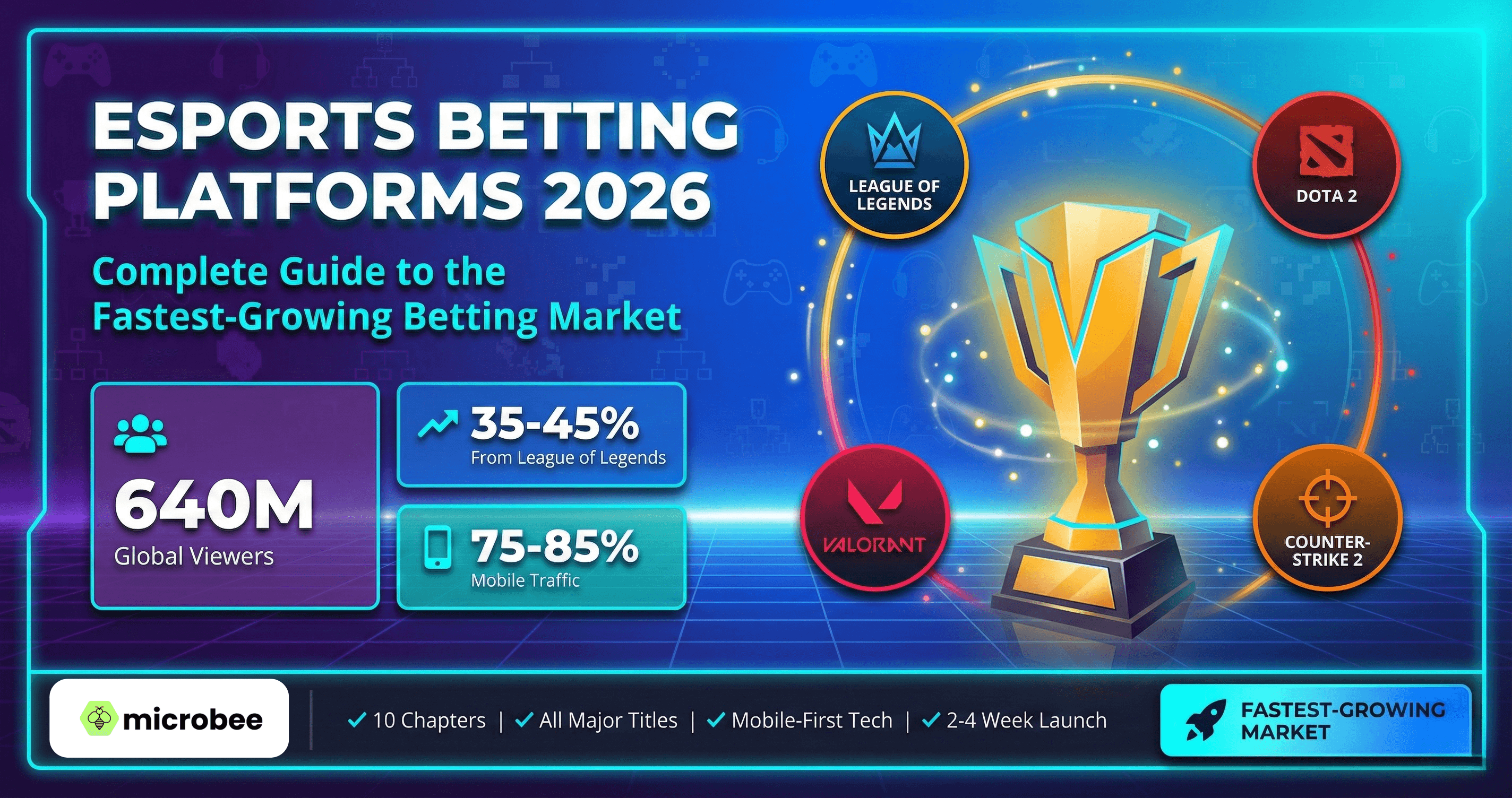
The numbers tell the story. Global esports viewership exceeded 640 million in 2025. The League of Legends World Championship attracted more viewers than the Super Bowl. Major esports tournaments now fill stadiums that hold 20,000+ spectators. Prize pools for The International (DOTA2) regularly exceed $40 million. And critically for betting operators, esports fans are digitally native, comfortable with online transactions, and eager to engage with the games they love through betting.
Yet esports betting presents unique challenges that traditional sports operators often underestimate. The games are fundamentally different. The pace is faster. The data is more complex. The audience has different expectations. Strategies that work perfectly for football betting can fail spectacularly in esports.
This comprehensive guide draws from MicroBee's experience helping over 300 operators navigate esports betting. We've seen what works, what fails, and what separates successful esports betting platforms from those that struggle. Whether you're launching a dedicated esports betting platform or adding esports to an existing sportsbook, this guide provides everything you need to know.
Chapter 1: Understanding the Esports Betting Market
The Scale and Growth of Esports
Esports has evolved from basement LAN parties to a global phenomenon with mainstream recognition. Understanding this evolution is crucial for operators entering the market.
Global Viewership and Engagement:
Esports viewership has grown exponentially. In 2026, over 640 million people worldwide watch esports content regularly. This isn't passive viewing—esports fans are highly engaged. Average viewing sessions for major tournaments last 3-4 hours, far exceeding traditional sports. Fans watch on multiple platforms: Twitch, YouTube Gaming, Facebook Gaming, regional platforms like Huya and Douyu in China, and AfreecaTV in Korea.
The demographics are operator's dream: 18-34 year olds represent 75% of the audience. This group is digitally native, comfortable with online transactions, familiar with cryptocurrencies, and actively seeks ways to engage more deeply with the content they love. Unlike aging traditional sports audiences, esports viewership skews younger and grows younger every year.
Geographic Concentration:
Esports betting isn't evenly distributed globally. Three regions dominate:
Asia-Pacific represents approximately 55% of global esports betting volume. China, South Korea, Southeast Asia—these markets have embraced esports completely. In China, esports athletes are celebrities rivaling traditional sports stars. Government support is substantial, with esports now included in some school curricula. South Korea has been the esports heartland for decades, with dedicated esports stadiums, television channels broadcasting tournaments 24/7, and professional infrastructure unmatched anywhere else.
For operators, Asian markets present both enormous opportunity and complexity. Chinese players prefer mobile-first platforms, expect WeChat/Alipay integration, and demand League of Legends and Honor of Kings (王者荣耀) coverage. Korean players are sophisticated bettors who analyze statistics intensively and expect deep market coverage for games like League of Legends, StarCraft, and Korean-developed titles.
Europe accounts for roughly 25% of market share. Western and Eastern Europe show different preferences. Western Europe (UK, Germany, France, Scandinavia) favors Counter-Strike 2, FIFA, and increasingly Valorant. Eastern Europe (Russia, Ukraine, Poland) shows strong interest in DOTA2, CS2, and World of Tanks. European players expect high-quality platform experiences, comprehensive responsible gambling tools, and strict regulatory compliance.
North America represents about 15% of esports betting volume but is growing rapidly as more US states legalize esports betting. American players favor League of Legends, Call of Duty, and increasingly Valorant. The market is characterized by higher average bet sizes but smaller overall volume compared to Asia. American players expect sophisticated mobile apps, detailed statistics, and seamless integration with traditional sports betting.
The Remaining 5% comes from Latin America, Middle East, Africa, and other regions. These are emerging markets with rapid growth potential, particularly Brazil, Argentina, Turkey, and South Africa.
Key Differences from Traditional Sports Betting
Operators who treat esports betting as "just another sport" inevitably struggle. Esports has fundamental differences that require different approaches.
Game Updates and Meta Changes:
Traditional sports are relatively stable. Football's rules change incrementally over decades. Basketball added the three-point line but the core game remained constant. Esports games receive major updates every few weeks.
A "patch" or game update can completely transform competitive balance. A champion that was dominant before a patch might become unviable after. Teams that excelled with one strategy must adapt to entirely new approaches. This creates enormous complexity for odds compilation.
Real example: In League of Legends patch 14.10, Riot Games completely reworked several champions. Teams that had built strategies around these champions saw their entire approach invalidated overnight. Betting odds on those teams shifted dramatically because their competitive advantage disappeared with the patch.
For operators, this means odds algorithms must account for patch recency. You can't simply use historical performance data—recent performance post-patch is exponentially more relevant than older data. Teams adapt at different rates. Some organizations have analysts who understand new patches immediately and adjust strategies quickly. Others lag behind. This creates opportunities for sophisticated odds compilation and risks for operators using simplistic models.
Player Transfers and Roster Volatility:
Traditional sports have transfer windows and relatively stable rosters. Esports rosters change constantly. A star player might switch teams mid-season. Teams might replace entire rosters between tournaments. Five-player teams mean individual changes represent 20% roster turnover—equivalent to replacing multiple key players in a football team.
Player substitutions happen much more frequently than traditional sports. A team might bring in a substitute player for a single match because they perform better on specific game modes or maps. This creates complexity in odds compilation—you need to know not just team strength but current roster configuration.
Language and communication also matter more in esports. Traditional sports have universal skills—a talented striker can adapt to new teammates relatively quickly. Esports requires intense, split-second coordination through voice communication. Adding a player who doesn't speak the team's primary language creates immediate disadvantage. Korean players joining Chinese teams, European players joining North American teams—these transitions face language barriers that significantly impact short-term performance.
Match Format Complexity:
Traditional sports have straightforward formats: 90 minutes of football, four quarters of basketball. Esports match formats vary dramatically by game, tournament, and stage.
Best-of series are standard: Best-of-1 (BO1), Best-of-3 (BO3), Best-of-5 (BO5). Each format has different dynamics. BO1 matches are volatile—one mistake can determine the outcome, making upsets more likely. BO3 matches allow teams to adapt, rewarding strategic depth. BO5 matches, used for finals, test endurance and mental fortitude as much as skill.
Map/Draft dynamics add another layer. In CS2, teams play specific maps—some teams excel on certain maps while struggling on others. In League of Legends and DOTA2, the draft phase (champion/hero selection) can determine match outcome before gameplay even begins. Teams might deliberately lose a BO3 opener to observe opponent strategies, then counter in subsequent games.
Tournament progression affects motivation. Teams already qualified for playoffs might not try as hard in final group stage matches, saving strategies for elimination rounds. Teams eliminated from tournament contention might experiment with unusual strategies or give substitute players match experience. Traditional sports have similar dynamics, but they're more pronounced in esports.
For betting operators, this means you need sophisticated markets:
Series winner (not just match winner)
Exact series score (3-0, 3-1, 3-2 in BO5)
First map winner
Total maps over/under
Individual map handicaps
Draft phase markets (first champion picked, total bans)
Schedule Fluidity:
Traditional sports schedules are published weeks in advance and rarely change. Esports schedules are more fluid. Tournament organizers might schedule matches with 24-48 hours notice. Start times shift regularly. Online tournaments (still common in esports) occasionally reschedule due to server issues, DDoS attacks, or technical problems.
This creates operational challenges. Your platform needs to handle:
Late-added events (sometimes announced day-of)
Schedule changes with minimal notice
Match postponements mid-tournament
Venue changes (online to offline or vice versa)
Operators accustomed to traditional sports' predictable scheduling find this challenging. You need processes to quickly add new events, communicate changes to players who've already bet, and handle potential disputes when matches don't occur as scheduled.
Understanding Esports Audiences
Esports bettors are different from traditional sports bettors in ways that significantly impact platform design and operation.
Digital Native Expectations:
Esports fans grew up with smartphones, expect instant gratification, and have zero tolerance for slow platforms. If your site takes more than 2 seconds to load, they're gone. If bet placement takes more than 1 second to confirm, they'll assume it failed and click again (creating potential duplicate bets).
They expect mobile-first design. Over 80% of esports betting happens on mobile devices. They'll primarily access your platform from phones while watching matches on their computer, or from phones while at events, or from phones while commuting. Your mobile experience must be flawless.
They expect dark mode. Unlike traditional sports betting audiences who might prefer traditional light interfaces, esports audiences overwhelmingly prefer dark-themed designs. It matches their viewing environment (Twitch defaults to dark mode), reduces eye strain during long gaming sessions, and aligns with gaming aesthetic preferences.
They expect real-time updates that feel instantaneous. They're watching the stream, they see a team win the first map, and they expect odds to update on your platform within seconds—not minutes. Delays they'd tolerate in traditional sports feel broken in esports context.
Data-Driven Approach:
Esports fans are intensely analytical. They consume statistics extensively. Websites like Oracle's Elixir (League of Legends), HLTV (Counter-Strike), Dotabuff and OpenDota (DOTA2) provide granular statistics that fans study religiously.
They expect your platform to provide similar depth:
Recent performance trends (last 10 matches, not just last 3)
Head-to-head history between teams
Performance on specific maps/sides
Individual player statistics
Team composition preferences
Recent roster changes
Providing this data serves multiple purposes. It helps users make informed bets (increasing their satisfaction). It builds trust (users see you understand the games). It increases engagement time on platform (users studying statistics aren't leaving to research elsewhere). And it differentiates you from competitors with minimal data.
Community Integration:
Esports fans are highly social. They discuss matches intensely on Reddit, Discord, Twitter, Twitch chat. They form strong community bonds around favorite teams and players.
Successful esports betting platforms integrate with this social nature:
Easy sharing of bet slips to social media
Community discussions or chat features
Leaderboards showing top bettors
Following favorite teams for notifications
User predictions and community consensus displays
One operator implemented a feature showing what percentage of users bet on each outcome. This simple transparency created engagement—users wanted to see if they agreed with consensus or were going against the crowd. It became one of their most popular features despite not being gambling functionality per se.
Cryptocurrency Preference:
Esports bettors show much higher cryptocurrency adoption than traditional sports bettors. Several factors drive this:
They're younger and more comfortable with crypto. They've grown up hearing about Bitcoin and Ethereum. They likely own some cryptocurrency already. Using it for betting feels natural.
Many esports fans come from regions with banking restrictions or complex international payment processes. Cryptocurrency offers simpler cross-border transactions.
Privacy concerns are higher. Younger users are more privacy-conscious and appreciate cryptocurrency's pseudonymous nature.
Esports betting operators see 25-40% of transactions occurring in cryptocurrency, compared to 5-10% in traditional sports betting. This has implications for payment processing, accounting, regulatory compliance, and platform development priorities.
Chapter 2: Essential Esports Titles and Coverage Requirements
Not all esports titles are equal from a betting perspective. Understanding which games matter and what coverage they require is fundamental.
Tier 1: Must-Have Titles
These games are non-negotiable for any serious esports betting platform. Launching without comprehensive coverage of these titles means forfeiting the core esports betting market.
League of Legends (LoL)
League of Legends is the undisputed king of esports betting. It represents 35-45% of all esports betting volume globally. If you only offered one esports title, it would have to be League of Legends.
Why League of Legends Dominates:
The game has unmatched global reach. Every major region has a professional league: LCK (Korea), LPL (China), LEC (Europe), LCS (North America), PCS (Pacific), VCS (Vietnam), CBLOL (Brazil), LLA (Latin America), LCO (Oceania), LJL (Japan). Major international tournaments (Worlds, MSI) attract 50+ million viewers.
The game structure works perfectly for betting. Matches are typically Best-of-3 or Best-of-5. Games last 25-35 minutes on average—long enough for substantial events but short enough for sustained attention. The draft phase adds strategic depth that creates unique betting opportunities.
Coverage Requirements for League of Legends:
Essential Leagues:
LCK (Korea) - The most prestigious league, highest skill level
LPL (China) - Enormous betting volume from Chinese market
LEC (Europe) - Major Western league
LCS (North America) - Important for North American market
Worlds Championship - The biggest tournament annually
Mid-Season Invitational (MSI) - Mid-year international tournament
Important Secondary Leagues:
VCS (Vietnam) - Rapidly growing, passionate fanbase
PCS (Pacific) - Covers Taiwan, Hong Kong, Macau, Southeast Asia
CBLOL (Brazil) - Latin American market leader
Market Requirements:
Pre-match markets must include:
Match winner (Team A vs Team B to win the series)
Exact score (3-0, 3-1, 3-2 for BO5)
First blood (which team gets first kill)
First tower (which team destroys first tower)
First dragon (which team kills first dragon)
First Baron Nashor
Total game time over/under
Total kills over/under
Map handicaps (Team A -1.5 maps)
Live betting markets should include:
Live match winner (updated based on current game state)
Next objective (dragon, baron, tower, inhibitor)
Next kill
Team to reach 10/15/20 kills first
Game length remaining
Current gold lead markets
Advanced markets that differentiate platforms:
Draft phase betting (first champion picked/banned)
Individual player performance (kills, deaths, assists over/under)
Pentakill to occur (extremely rare, high odds)
Ace (entire enemy team eliminated) to occur
Individual map outcomes within series
DOTA2
DOTA2 represents 15-20% of esports betting volume. It has smaller but intensely dedicated audience.
Why DOTA2 Matters:
DOTA2 has the most sophisticated competitive scene. The International (TI), DOTA2's world championship, consistently features the largest prize pools in esports (often $40+ million). This creates enormous prestige and spectator interest.
The game attracts older, more experienced gamers. Average DOTA2 player/viewer is 23-28 years old compared to 18-23 for League of Legends. This demographic typically has more disposable income and places larger average bets.
DOTA2 betting community is highly analytical. They study detailed statistics, understand complex game mechanics, and bet based on sophisticated analysis rather than casual fandom. This creates a more "sharp" betting market requiring sophisticated odds compilation.
Coverage Requirements for DOTA2:
Essential Tournaments:
The International (TI) - The world championship, annually
DPC (Dota Pro Circuit) Majors - Multiple major tournaments yearly
Regional DPC leagues (Western Europe, Eastern Europe, China, SEA, North America, South America)
Market Requirements:
Pre-match markets:
Match winner (series)
Exact score
First blood
First Roshan (major objective)
Total game time
Total kills over/under
Map handicaps
Live betting:
Current match winner (odds update based on gold/experience lead)
Next Roshan kill
Next barracks destroyed
Mega creeps to occur (one team loses all barracks)
Team to destroy ancient first (alternate win condition)
DOTA2-specific considerations:
Games are longer (35-50 minutes average)
Comeback mechanics are stronger (easier to recover from early deficit)
Hero draft is even more impactful than LoL champion draft
Pause abuse is possible (teams can pause for technical issues)
Counter-Strike 2 (CS2)
CS2 represents 20-25% of esports betting volume and is the strongest title in European markets.
Why CS2 Matters:
Counter-Strike has 25+ years of competitive history. It's the original esports title with established tournament infrastructure, fan loyalty spanning generations, and deep betting market sophistication.
The game is easier for non-players to understand. Unlike MOBAs (League, DOTA) with complex mechanics, CS2 is conceptually simple: team combat, plant/defuse bomb, simple objective. This broader comprehension increases casual betting participation.
Match frequency is high. Major teams play multiple matches weekly across various tournaments and leagues. This consistent content flow keeps bettors engaged year-round.
Coverage Requirements for CS2:
Essential Tournaments/Leagues:
CS2 Majors (Valve-sponsored championships)
ESL Pro League
BLAST Premier
IEM (Intel Extreme Masters) series
Regional leagues (various organizers)
Market Requirements:
Pre-match markets:
Match winner (series)
Exact score
Map winner (individual map outcomes)
Map handicaps (Team A -1.5 maps)
Total rounds over/under (per map or series)
Pistol round winner (first round each half)
Live betting:
Live match/map winner
Next round winner
Current score exact result
Overtime yes/no
Bomb planted/defused markets
CS2-specific considerations:
Map pool matters tremendously (seven competitive maps currently)
Teams have strong map preferences (might veto certain maps always)
Side advantage on maps (some maps favor Counter-Terrorist or Terrorist side)
Pistol rounds are disproportionately important (winning both pistol rounds in a map gives huge advantage)
Valorant
Valorant is the newest Tier 1 title, launched in 2020 but rapidly growing to represent 10-15% of esports betting volume.
Why Valorant Matters:
Riot Games (League of Legends developer) created Valorant specifically to compete in tactical shooter space. They brought extensive esports experience and substantial financial backing. The result is professional infrastructure rivaling games with decades of history.
The game appeals to both MOBA and FPS audiences. It has character abilities (like MOBAs) combined with tactical shooting (like CS2). This hybrid nature attracts diverse viewership.
Growth trajectory is extraordinary. Major tournaments now fill 15,000+ seat arenas. Viewership doubled year-over-year for 2024-2025. The game is particularly strong in North America and Asia-Pacific.
Coverage Requirements for Valorant:
Essential Tournaments:
VCT (Valorant Champions Tour) International Events
VCT Regional Leagues (Americas, EMEA, Pacific, China)
Valorant Champions (World Championship)
VCT Masters (mid-year international tournaments)
Market Requirements:
Similar to CS2 but with Valorant-specific additions:
Agent pick markets (which characters selected)
First blood
Spike plant/defuse markets
Ability usage markets (ultimate abilities used)
Ace (one player eliminates entire enemy team)
Valorant-specific considerations:
Newer game means less historical data for odds compilation
Meta changes more frequently (agent balance updates)
Best-of-3 format standard
Four map pool (smaller than CS2's seven)
Tier 2: Important Supplementary Titles
These titles don't generate the volume of Tier 1 but are important for market completeness and attracting specific demographics.
Mobile Legends: Bang Bang (MLBB)
Mobile MOBA extremely popular in Southeast Asia, particularly Indonesia, Philippines, Malaysia. Represents opportunity in rapidly growing markets. Professional scene is well-established with MPL leagues across Southeast Asia.
Honor of Kings (王者荣耀)
Dominant mobile MOBA in China with over 100 million daily active users. Essential for Chinese market operators. However, coverage outside China is limited due to game's regional focus.
Call of Duty
Long-running FPS franchise with established competitive scene. The Call of Duty League (CDL) features city-based franchising model. Important for North American market. Betting volume is moderate but loyal fanbase.
Rocket League
Soccer with cars. Unique gameplay creates distinctive betting audience. Smaller volume but consistent year-round competition. Appeals to both sports and esports audiences.
Rainbow Six Siege
Tactical FPS with strategic depth. Smaller but dedicated competitive scene. European and Latin American strength. Growing slowly but steadily.
FIFA / EA Sports FC
Football simulation. Appeals to traditional sports fans entering esports. eSports scene features professional footballers and dedicated esports athletes. Important bridge title between sports and esports betting.
Tier 3: Niche and Emerging Titles
These titles have smaller audiences but can differentiate your platform:
StarCraft II - Korean market importance, older dedicated fanbase Overwatch 2 - Declining but still relevant, franchise league model Apex Legends - Battle royale with competitive scene Fortnite - Casual viewership high but competitive betting limited Fighting games - Street Fighter, Tekken, Mortal Kombat have tournament scenes
Chapter 3: Technical Requirements for Esports Betting Platforms
Esports betting platforms have unique technical requirements that differ significantly from traditional sports betting.
Real-Time Data Integration
Esports data moves faster than traditional sports. Understanding why and how to handle it is critical.
The Data Speed Challenge:
In football, significant events (goals, cards, substitutions) happen every few minutes. Systems handling 20-30 second delays are acceptable because TV broadcasts have similar delays.
Esports events happen constantly. A League of Legends game might have:
50+ champion ability uses per minute
10-20 last-hit minion kills per minute
Jungle objective spawn and capture every 2-5 minutes
Tower damage and destruction
Champion kills and deaths
Gold and experience changes every second
Betting-relevant events occur every 30-60 seconds. First blood (first kill), first tower, first dragon—these happen within first 10 minutes of a 30-minute game. If your data is 30 seconds behind, your odds are already outdated.
Data Provider Selection:
Several companies specialize in esports data:
Bayes Esports offers comprehensive coverage across major titles with official data partnerships. They provide real-time match data, player statistics, team performance metrics, and historical databases. Their API delivers updates within 1-3 seconds of actual events.
GRID Esports specializes in real-time data and has particularly strong Valorant and CS2 coverage. They differentiate through visual data feeds that can be embedded directly in betting interfaces.
PandaScore provides wide esports coverage with good developer documentation and reasonable implementation complexity. Popular with mid-size operators.
The choice depends on coverage needs, budget, technical capabilities, and geographic focus. Premium providers offer better latency, more reliable uptime, and deeper statistics, but cost more. Operators must balance data quality with commercial viability.
Handling Data Latency:
Even the best data providers have 1-3 second latency from actual events. This creates a window where informed bettors watching live streams might know outcomes before your odds reflect them.
Mitigation strategies:
Market suspension on critical events - When data provider indicates significant event (first blood, objective capture), immediately suspend related markets for 10-15 seconds while odds recalculate. This prevents betting on known outcomes.
Odds hold periods - When presenting odds to users, hold them valid for only 5-10 seconds. If user doesn't confirm bet within this window, present refreshed odds. This reduces risk from odds becoming stale.
Stream delay awareness - Most streams (Twitch, YouTube) have 8-15 second delay. Very few viewers watch true live feeds. Your 2-second data delay is still 6-13 seconds ahead of most viewers, minimizing advantage.
Bet validation against multiple timestamps - When accepting bets, check: Was market open at time user clicked? Was market open at time bet submitted? Is market currently open? Reject if any check fails.
Mobile-First Development
Esports betting is overwhelmingly mobile. Platform design must prioritize mobile from the beginning, not adapt desktop designs for mobile screens.
Mobile Usage Statistics:
Research consistently shows 75-85% of esports betting occurs on mobile devices. This is higher than traditional sports (60-70% mobile) because esports audiences are younger and more mobile-centric.
Mobile sessions are shorter but more frequent. Users might check odds 10-15 times daily for quick match checks rather than desktop's longer research sessions. Your mobile interface must support these quick interactions.
Mobile Design Principles:
Vertical scrolling dominates - Mobile users expect to scroll vertically. Horizontal scrolling, common in desktop betting interfaces, frustrates mobile users. All essential information should be accessible through vertical navigation.
Touch targets must be generous - Apple's Human Interface Guidelines recommend minimum 44x44 pixel touch targets. For betting where mistakes are costly, go larger. Betting buttons should be minimum 60x60 pixels.
Critical information above the fold - Match details, current score, primary betting market (match winner) should be visible without scrolling. Users should understand the situation instantly.
Minimize input requirements - Every field users must type reduces conversion. Implement:
Saved payment methods
One-tap bet amounts (buttons for $10, $20, $50, $100)
Remember last stake amount
Auto-complete for search
Face ID / Touch ID for login
Progressive disclosure of complexity - Show essential markets first. Advanced markets available through clear "More Markets" expansion. Don't overwhelm with 50+ markets immediately visible.
Mobile Performance Requirements:
Page load under 2 seconds - Mobile users on 4G expect fast loading. Anything over 2 seconds feels broken.
Time to interactive under 1 second - Once page loads, users should interact immediately. Heavy JavaScript that delays interactivity creates poor experience.
Betting confirmation under 1 second - From clicking confirm to seeing confirmation screen. Longer delays make users think something failed.
Adaptive to network conditions - Detect slow networks (3G or congested 4G). Reduce image quality, limit auto-refresh frequency, prioritize essential data.
Platform Architecture Considerations
WebSocket Implementation for Live Betting:
REST API (request-response) is insufficient for esports live betting. The update frequency is too high. Making dozens of requests per minute creates massive overhead.
WebSocket connections allow the server to push updates to clients automatically. Your application subscribes to specific matches. When anything changes (score, odds, market status), the server pushes the update instantly.
This requires different backend architecture from traditional sports betting. Your infrastructure must maintain thousands of simultaneous WebSocket connections, route updates to appropriate connections, and handle connection failures gracefully.
Caching Strategy:
Esports platforms need sophisticated caching:
Do cache (with appropriate TTL):
Team logos and icons (cache for days)
Player photographs (cache for days)
Historical match results (cache for hours)
Team rosters (cache for 30 minutes, frequently changes)
Tournament schedules (cache for 10 minutes)
Do not cache:
Live match scores (always fetch fresh)
Live odds (always fresh)
Market status (suspend/open changes constantly)
User account balances
Active bets
Short TTL cache (30-60 seconds):
Pre-match odds
Upcoming match lists
Team statistics
Database Considerations:
Esports betting creates unique database demands:
High write volume - Odds update every few seconds during live matches. If you have 20 simultaneous live matches with 30 markets each, that's 600 records updating every 3 seconds. Your database must handle this write load.
Complex relational data - Matches relate to tournaments, teams, players, games, patches. Queries often need to join across these relationships. Relational databases (PostgreSQL) handle this better than NoSQL.
Time-series data - Odds history, score progression, statistical tracking are all time-series. Consider specialized time-series storage (TimescaleDB, InfluxDB) for this data type.
Geo-distributed users - Esports is global. Users in Korea, Brazil, and Germany might all bet on the same match. Consider database replication across regions for read performance.
Chapter 4: Creating Effective Esports Betting Markets
The markets you offer determine whether esports bettors find your platform interesting or generic.
Essential Market Types
Match Winner Markets:
The fundamental market: Which team wins the series?
For Best-of-3: Team A or Team B to win 2 games first. For Best-of-5: Team A or Team B to win 3 games first.
This market generates 60-70% of betting volume. It must be present for every match with competitive odds.
Map/Game Winner Markets:
Individual game outcomes within a series. In a Best-of-3, three markets:
Map 1 winner
Map 2 winner (might not occur if 2-0)
Map 3 winner (only if series goes to 2-1)
These markets attract more sophisticated bettors who understand map-specific team strengths.
Handicap Markets:
Apply virtual advantage/disadvantage to equalize odds when teams are mismatched.
Example: Team A is heavily favored. Match winner odds might be Team A: 1.20, Team B: 4.50. Not attractive.
Apply handicap:
Team A -1.5 maps at 2.10 (must win 2-0 in BO3)
Team B +1.5 maps at 1.75 (can lose 2-1 and bet still wins)
Handicaps make mismatched contests bettable.
Over/Under Markets:
Total quantity predictions:
Total maps Over/Under - In a Best-of-3, will it be 2 maps (2-0) or 3 maps (2-1)?
Over 2.5 maps means 2-1 result
Under 2.5 maps means 2-0 result
Game duration Over/Under - Will a game exceed 30 minutes? Useful in MOBAs where game length varies significantly.
Kills Over/Under - Total kills in a game. League of Legends averages 20-30 kills per game, but can range from 10 (defensive play) to 50+ (chaotic matches).
Game-Specific Advanced Markets
League of Legends Specific Markets:
First Objective Markets:
First Blood (first kill) - High value market
First Tower - Strategic importance
First Dragon - Major objective
First Baron - Game-changing objective
First Inhibitor - Late-game structure
Champion Selection Markets:
First champion picked
First champion banned
Specific champion will be picked/banned
Total unique champions in match
Late-Game Markets:
Will Baron be killed 3+ times in game?
Will Elder Dragon spawn?
Will game reach 40+ minutes?
Will there be an Ace (team wipe)?
DOTA2 Specific Markets:
Roshan Markets:
First Roshan kill
Total Roshan kills Over/Under
Roshan kills before 20 minutes
Barracks Markets:
First barracks destroyed
Total barracks destroyed
Mega creeps to occur (all barracks lost)
Counter-Strike 2 Specific Markets:
Round Markets:
Pistol round winner (Round 1 and Round 13)
Rounds 1-5 handicap
Exact round score (16-14, 16-10, etc.)
Map-Specific Markets:
Side to win more rounds (CT or T side)
Overtime yes/no
Total rounds Over/Under (26.5 is common line)
Weapon Markets:
First kill weapon type
AWP (sniper rifle) kills Over/Under
Knife kill to occur (rare, high odds)
Live Betting Market Dynamics
Live betting represents 55-65% of esports betting volume, significantly higher than traditional sports (40-45%).
Why Esports Live Betting is Dominant:
Information asymmetry is lower - Unlike in-stadium sports where some bettors see events before others, esports is watched via streams with relatively consistent delay. This makes live betting fairer.
Action is constant - Something bettable happens every minute. This sustained engagement keeps users actively betting throughout matches.
Momentum is visible - Viewers can see when teams gain advantages. Gold leads in MOBAs, round streaks in CS2, economic advantages—these create obvious betting opportunities that engage viewers.
Strategic depth rewards knowledge - Knowledgeable viewers understand significance of objective trades, draft advantages, economy management. This expertise creates confidence to bet live.
Live Market Management Strategies:
Dynamic Odds Adjustment:
Live odds must reflect current game state accurately. In League of Legends, a team with 5,000 gold lead at 15 minutes has approximately 75% win probability. Your odds should reflect this reality, not pre-match expectations.
Sophisticated operators use real-time game state data:
Current gold difference
Experience lead
Objective control (dragons, towers, barons)
Team composition scaling (some teams are stronger early, others late)
Player death timers (dead players can't defend)
When a team secures Baron Nashor (major objective in League of Legends), win probability typically jumps 15-20%. Odds should immediately reflect this, or sharp bettors will exploit the lag.
Market Suspension Timing:
Critical moments require immediate market suspension:
In MOBAs:
Major objective fights beginning (teams positioning around Baron/Roshan)
Team fight initiation (suspend for duration of fight)
Base siege situations (high-pressure, game-deciding moments)
In FPS games:
Clutch situations (1v1, 1v2 scenarios in final seconds)
Bomb plant with low time (increases tension dramatically)
Match point rounds (final round to win map)
The challenge is balancing risk management with user experience. Over-suspension frustrates users. Under-suspension exposes you to informed betting. Quality esports betting platforms find the optimal balance through experience and sophisticated algorithms.
Live Betting UI Considerations:
Real-time score display must be prominent. Users watching matches on separate screens need your platform to match what they're seeing. Any discrepancy creates distrust.
Update indicators should show when odds change. Brief highlighting (500ms flash) draws attention without being distracting. Users need to know when odds are fresh versus stale.
Market availability indicators clearly show which markets are currently open, suspended, or closed. Color coding works well: green (open), orange (suspended), gray (closed).
Quick bet functionality enables one-tap betting on primary markets. During exciting match moments, users don't want to navigate through multiple screens. Quick bet buttons allow instant engagement.
Chapter 5: Odds Compilation and Risk Management for Esports
Esports odds compilation requires fundamentally different approaches from traditional sports.
The Unique Challenges of Esports Odds
Limited Historical Data:
Traditional sports have decades of statistical history. You can analyze 20 years of Manchester United vs Liverpool matches. Esports teams often exist for 1-3 years before roster changes make historical data less relevant.
Games themselves change constantly. League of Legends data from 2 years ago is minimally relevant to today's game because the meta has completely transformed. You can't build odds models on extensive historical data when the game itself has evolved.
Player skill development is rapid. A player who was mediocre 6 months ago might have improved dramatically. Unlike physical sports where athletic improvement is gradual, esports skill can increase sharply with practice and coaching.
Solution Approaches:
Emphasize recent performance - Last 20 matches matter far more than last 100. Weight recent matches exponentially higher in your algorithms.
Incorporate patch data - Track performance since most recent major patch. Older data across patch boundaries has reduced relevance.
Monitor roster stability - Teams with stable rosters have more predictable performance. Recent roster changes increase uncertainty.
Player-level analysis - Individual player skill matters enormously in 5-player teams. One superstar or one weak link significantly impacts team strength.
Patch Impact on Odds Compilation
Game patches are the single biggest challenge for esports odds compilation.
Understanding Patch Cycles:
Major esports titles patch on regular schedules:
League of Legends - Major patches every 2 weeks, with mid-patch updates for critical issues. Competitive play often runs on patches 1-2 weeks behind live servers to allow teams practice time.
DOTA2 - Major patches every 4-6 months with frequent smaller balance updates. Major patches completely reshape the game (7.35 to 7.36 changed 50+ heroes).
Counter-Strike 2 - Less frequent balance changes than MOBAs, but map changes and weapon adjustments still occur. New map additions to competitive pool are rare but highly impactful.
Valorant - Agent balance changes every few weeks. New agent releases approximately quarterly. Map pool adjustments periodically.
Immediate Post-Patch Period:
The first 3-5 days after a major patch are chaotic for odds compilation. Teams are still learning the patch. Some adapt faster than others. Historical data becomes less reliable.
Conservative approach: Widen margins during this period. If you normally run 5% margin, increase to 7-8% post-patch. This protects against uncertainty while teams adapt.
Monitor early matches intensely: The first teams to play on new patches reveal meta trends. If a previously weak champion/hero suddenly dominates, this information must immediately influence odds for subsequent matches.
Team adaptation rates vary: Some organizations have excellent analysts who quickly understand patches. Others lag behind. Track which teams historically adapt well to patches—this becomes a competitive advantage in odds compilation.
Meta Stability Recognition:
After 10-15 competitive matches on a patch, meta typically stabilizes. Optimal strategies emerge. Team strengths on the patch become clear.
This is when you can return to normal operations:
Standard margin levels
More confidence in odds
Greater willingness to take larger bets
Re-introduce more exotic markets
Track meta stability indicators:
Champion/hero pick diversity (high diversity = unsettled meta)
Strategic approach consistency (teams converging on similar approaches = stable meta)
Upset frequency (many upsets = unstable meta)
Expert consensus (analysts agreeing = stable meta)
Managing Esports-Specific Risks
Stream Sniping and Information Advantages:
Most esports betting concerns center on information asymmetry. Unlike in-stadium sports, esports happens online or in controlled venues with broadcast delays.
The Risk:
Someone with access to a faster feed (venue attendee, insider with backstage access, production staff) could see events before general public. They could place bets on outcomes they already know.
Mitigation Strategies:
Enforce minimum odds hold times - When user clicks an odd, don't allow immediate placement. Require 2-3 second hold before confirmation. This slight delay minimizes value of instant information.
Bet timing analysis - Flag bets placed immediately before significant events. If someone consistently bets 2-3 seconds before first blood, they're likely seeing a faster feed.
Limit bet sizes on fast-changing markets - First blood, first objective, next kill markets have highest information advantage risk. Keep maximum stakes lower on these markets.
Monitor betting patterns - Users who win at suspiciously high rates on timing-sensitive markets warrant investigation. They might have information advantages.
Pause Protocol Abuse:
In DOTA2 and League of Legends, teams can pause matches for technical issues. Some teams abuse this for strategic advantage—pausing before crucial fights to discuss strategy or disrupt opponent momentum.
The Betting Risk:
When matches pause, do you suspend markets? For how long? What if the pause extends? What if it's a tactical pause disguised as technical issue?
Management Approach:
Immediate suspension on pause - The moment a match pauses, suspend all markets. Don't wait to understand the reason.
Time-based reopening - If pause resolves within 2 minutes, reopen markets. If pause extends beyond 5 minutes, consider voiding recent bets and closing markets until match resumes.
Tournament rule awareness - Some tournaments penalize pause abuse. Others are lenient. Adjust your policies based on tournament standards.
DDoS and Technical Disruptions:
Online matches (still common in esports) occasionally face DDoS attacks, server issues, or internet outages. Matches might be postponed mid-game.
The Betting Challenge:
You've accepted thousands of bets on a match that doesn't complete. How do you handle this?
Standard Industry Practice:
If less than 50% of match completed - Void all bets. Return stakes. Treat as if match never happened.
If more than 50% completed but doesn't finish - Settlement based on official tournament decision. If organizer declares a winner, settle accordingly. If organizer voids match, void bets.
If match postponed and rescheduled - Keep bets valid for rescheduled match unless postponement exceeds 48 hours. Communicate clearly with bettors about status.
Roster Changes and Substitutions:
Unlike traditional sports with injury reports hours before matches, esports substitutions sometimes happen minutes before match starts.
The Risk:
Users bet on Team A based on their star player participation. Minutes before match, star player is replaced with substitute due to illness. Team strength dramatically changes.
Management Approach:
Roster verification - Check official tournament streams and team announcements for last-minute changes. If significant substitution occurs, consider voiding markets and reopening with adjusted odds.
Clear settlement rules - Your terms must address this: "Bets stand regardless of roster changes unless team fields more than 2 substitutes from registered roster."
Substitute impact assessment - Not all substitutions matter equally. A substitute mid-laner in League of Legends typically impacts team strength more than a substitute support. Assess significance before deciding whether to adjust odds or void markets.
Building Competitive Advantage Through Odds Quality
Specialized Knowledge:
Operators who develop deep game expertise create odds that sharp bettors respect and recreational bettors trust.
Hire game specialists - Staff who actually play these games at high levels understand nuances algorithms miss. A former professional DOTA2 player on your trading team provides insights no statistical model can match.
Monitor community discussions - Reddit, Discord, Twitter, team/player streams. The esports community openly discusses team strengths, player issues, meta strategies. This qualitative information complements quantitative models.
Track roster changes obsessively - Know when teams announce tryouts, practice partners, rumored transfers. Roster changes impact team strength before they're officially announced.
Understand team-specific tendencies - Some teams always ban certain champions. Some teams perform differently online versus LAN. Some teams have specific player rivalries that affect performance. These patterns create edge in odds compilation.
Statistical Model Integration:
Combine traditional sports betting statistical approaches with esports-specific factors:
Base model inputs:
Recent match results and margins
Head-to-head history
Tournament stage (playoffs vs group stage)
Side selection advantage (blue/red in MOBAs, CT/T in CS2)
Esports-specific adjustments:
Patch recency weighting
Roster stability factor
Recent scrim results (if available through leaks or announcements)
Player streaming performance (sometimes visible before competitive matches)
Travel and timezone considerations (less critical in online era but still relevant for LAN events)
Continuous model refinement:
Track your odds accuracy. Compare your opening odds to closing odds and actual outcomes. Where are you consistently wrong? What factors are you over-weighting or under-weighting?
Leading operators review odds quality weekly:
Accuracy by game title
Accuracy by tournament tier
Accuracy by market type
Performance against competitor odds
Sharp bettor win rates on your platform
Chapter 6: User Experience and Platform Features
Esports betting platforms must feel native to esports culture, not like traditional sportsbooks with esports added as an afterthought.
Visual Design and Branding
Dark Mode as Standard:
Esports audiences expect dark interfaces. Twitch, Steam, Discord, most gaming platforms—all default to dark themes. A bright white interface feels alien to esports users.
Design principles for esports:
Dark backgrounds (near-black, not pure black which can strain some displays)
High contrast text (pure white or light gray on dark)
Accent colors that pop (electric blue, neon green, bright purple)
Minimal use of bright backgrounds
Toggle to light mode for those who prefer it, but dark as default
Gaming Aesthetic:
The look and feel should resonate with gaming culture:
Angular, modern design elements
Subtle animations and transitions
Hover effects that feel responsive
Loading indicators that entertain rather than frustrate
Success confirmations that feel rewarding (brief celebratory animations)
Avoid corporate/traditional betting aesthetics:
No green felt or poker chip imagery
No traditional sports photography
No suited businessmen or corporate stock photos
No gold/luxury brand positioning (esports is casual, accessible)
Team Branding Integration:
Esports teams have strong brand identities. Users often have favorite teams they follow passionately.
Feature team branding prominently:
High-quality team logos throughout interface
Team color theming in match displays
Team merchandise/jerseys visible in team pages
Official team social media feeds integrated
Example: When user views a match featuring Team Liquid, incorporate Liquid's signature blue/white colors into that match's display. Show Liquid's logo prominently. This creates connection between your platform and teams users care about.
Content and Information Richness
Match Information Depth:
Provide comprehensive pre-match context:
Team information:
Current roster with player names and roles
Recent results (last 10 matches with scores)
Tournament standing/ranking
Head-to-head history with opponent
Notable achievements (tournament wins, rankings)
Tournament context:
What's at stake (prize money, qualification implications)
Format details (Best-of-3, Best-of-5, single elimination, double elimination)
Prize distribution
Schedule (when is next match, rest days between matches)
Game-specific information:
Current patch/meta status
Recent hero/champion picks by these teams
Map preferences (in CS2, Valorant)
Side preference (in MOBAs)
Statistical Analysis:
Stats matter enormously to esports bettors. Provide:
Performance metrics:
Win rate overall and recent
Win rate on specific maps/sides
Average game length
Kill/death ratios
Objective control statistics
Economic ratings (in relevant games)
Trend analysis:
Form graphs showing recent performance trajectory
Comparison against tournament average
Strength of schedule analysis
Player spotlight:
Individual player statistics for key players
Recent performance highlights
Champion/hero pools (what they play)
Impact metrics (damage dealt, kill participation rate)
Social and Community Features
Live Chat and Community:
Esports fans love discussing matches in real-time. Integrate this into your platform:
Match discussion threads - Allow users to chat during matches they're watching. Moderate to prevent spam/abuse but embrace the community feeling.
Prediction games - Free-to-play prediction contests where users guess match outcomes for points. Leaderboards create competition. Prize draws for top predictors create engagement without requiring betting.
User statistics sharing - Allow users to share their betting history, win rates, best bets to social media or platform community. Gamify the experience.
Following system - Users can follow teams, players, specific tournaments. They receive notifications when followed entities have upcoming matches.
Content Integration:
News and updates - Aggregate esports news from reputable sources. Team roster changes, tournament announcements, patch notes, player interviews.
Video highlights - Embed highlight reels from recent matches. Users browsing upcoming matches can watch highlights from previous encounters.
Match previews - Written or video analysis of upcoming high-profile matches. Help users make informed betting decisions while increasing engagement time on platform.
Player/team profiles - Comprehensive pages for major teams and players. History, achievements, statistics, upcoming matches, news. These pages drive organic search traffic and increase platform authority.
Mobile App Considerations
Given 75-85% of esports betting happens mobile, your mobile app quality determines success.
Native App vs Progressive Web App:
Progressive Web App (PWA) advantages:
Single codebase for all platforms
Instant updates (no app store approval delays)
Easier maintenance
No app store fees
Accessible directly through browsers
Native App advantages:
Better performance on older devices
Deeper integration with device features (notifications, biometrics)
Presence in app stores (discovery channel)
Slightly smoother animations and transitions
Offline functionality more robust
Recommendation for 2026: Start with PWA for speed and flexibility. Build native apps later if user demand justifies investment.
Push Notifications Strategy:
Esports users want notifications, but too many creates annoyance:
High-value notifications:
Matches starting soon for followed teams (30 minutes before)
Significant odds changes on active bets (10%+ movement)
Bet settlements (wins especially)
Major tournament announcements for followed games
Avoid:
General promotional messages
Daily "come back and bet" nudges
Notifications about games user hasn't shown interest in
Multiple notifications about same event
Provide granular notification controls. Let users choose exactly what they want. Some want everything. Others want only bet results. Respect preferences absolutely.
Responsible Gambling in Esports Context
Younger audience demographics require heightened focus on responsible gambling.
Age Verification:
Esports attracts many viewers under legal gambling age. Verification must be robust:
Multi-factor age verification:
Document verification (ID check)
Payment method verification (credit cards have age requirements)
Behavioral analysis (usage patterns inconsistent with stated age)
Continuous monitoring (not just one-time at registration)
Enhanced monitoring for young adults - Users 18-22 warrant additional responsible gambling attention. This age group has higher problem gambling risk. Lower default limits, more frequent reality checks, and enhanced educational resources.
Educational Content:
Provide esports-specific responsible gambling education:
"Understanding odds in esports" - Explain that even with game knowledge, gambling involves risk. Statistical literacy education.
"Betting vs watching" - Emphasize that betting should enhance entertainment, not be the primary purpose of watching esports.
"Chasing losses" - Common trap for young bettors. Clear explanation with examples.
"Esports betting is not investment" - Some young users view betting as income opportunity. Disabuse this notion clearly.
Limit Tools Tuned for Esports:
Standard responsible gambling limits apply, but consider esports-specific adjustments:
Event-based limits - Beyond time-based limits (daily, weekly), consider event limits: "Maximum $100 per tournament" or "Maximum $50 per match day."
Cooldown periods - After significant loss (20%+ of their typical weekly amount), trigger mandatory 24-hour cooldown. Prevents immediate chasing losses.
Streak awareness - After 5 consecutive losing bets, display reality check: "You've lost 5 straight bets. Taking a break might be wise."
Chapter 7: Marketing and User Acquisition for Esports Betting
Esports audiences respond to different marketing than traditional sports bettors.
Understanding Esports Marketing Channels
Twitch and YouTube Gaming Integration:
Esports fans live on streaming platforms. This is where you must reach them.
Streamer Partnerships:
Partner with esports streamers for promotion:
Mid-tier streamers (1,000-10,000 viewers) often provide better ROI than top-tier. They're more affordable, have engaged communities, and audiences trust them more than celebrity endorsers.
Authentic integration matters - Streamers who genuinely use your platform and naturally mention it outperform those reading scripts. Allow streamers to gamble on your platform themselves (provide accounts with bonus funds). When they naturally discuss bets during streams, it's authentic marketing.
Exclusive streamer promotions - Give each partnered streamer unique promo codes for their audience. Trackable attribution, and viewers appreciate exclusive offers from streamers they follow.
Tournament Sponsorships:
Official partnerships with esports tournaments provide:
Brand visibility - Logo placement during broadcasts, arena signage, social media association with tournament.
Content rights - Ability to use tournament footage, player interviews, highlight clips in your marketing.
Market access - Direct connection to tournament audiences—exactly your target demographic.
Credibility - Official partnerships signal legitimacy and commitment to esports community.
Social Media Marketing:
Twitter/X - Fast-paced, real-time platform perfect for live betting updates, odds announcements, match predictions. Post actively during matches with relevant odds, statistics, engagement questions.
Discord communities - Create your own community server. Invite users to discuss matches, share betting tips, connect with other users. Modern community building happens on Discord.
TikTok - Younger demographic presence. Short highlight clips, betting tips, team content, player interviews. Fast-growing discovery channel for brands.
Instagram - Visual storytelling. Team/player features, behind-scenes tournament content, winning bet celebrations, data visualizations.
Content Marketing Strategy
Data-Driven Content:
Esports audiences respect analytical content:
Statistical analysis articles - "Which League of Legends teams perform best on red side?" "CS2 map win rates analysis" "Patch 14.12 impact on jungle meta."
Betting guides - "Understanding handicap betting in DOTA2" "How to bet on CS2 map picks" "Valorant live betting strategies."
Tournament previews - Before major events, comprehensive guides covering teams, storylines, betting opportunities, predictions.
Post-match analysis - Review interesting matches, discuss what happened, analyze why odds moved certain ways.
This content serves multiple purposes: SEO value, user education, platform authority building, and engagement during non-match periods.
Video Content:
YouTube presence - Create channel with:
Match previews and predictions
Betting tips and strategy
Tournament recaps and highlights
Educational content about esports betting
Platform feature tutorials
Short-form video - TikTok and Instagram Reels for:
Quick betting tips
Highlight reels
Upset predictions
Top plays of the week
Community Building and User Retention
Loyalty Programs Designed for Esports:
Traditional sportsbook loyalty programs (bet to earn points, redeem for bonuses) can work, but esports-specific additions create stronger engagement:
Team allegiance rewards - Users declare favorite teams. Earn bonus points when those teams play. Creates emotional investment and gives users reasons to bet on more matches.
Prediction streak bonuses - Reward consecutive correct predictions (whether placed bets or free predictions). Gamifies the experience.
Tournament completion bonuses - Users who bet on all matches in a specific tournament earn completion bonuses. Encourages consistent engagement throughout multi-week tournaments.
Achievement systems - Gaming audiences love achievements. Create esports betting achievements:
"First Blood" - Place first bet on an esports match
"Underdogs Champion" - Win 5 underdog bets
"Perfect Series" - Correctly predict exact 3-0 or 3-1 series score
"Multi-game Master" - Place bets across 5 different esports titles
User-Generated Content:
Encourage users to create content about your platform:
Betting slip sharing - Easy social media sharing of interesting bet slips before matches. Other users can copy or fade those bets.
Results bragging - Winners love sharing successes. Make it effortless to share big wins (with responsible messaging about gambling risks).
Prediction competitions - Monthly prediction contests. Top predictors featured on platform. Creates competitive environment and showcases successful users.
Chapter 8: Regulatory Considerations for Esports Betting
Esports betting faces unique regulatory challenges and opportunities.
Age and Audience Challenges
Underage Audience Presence:
Esports viewership includes many under-18 individuals. YouTube Gaming and Twitch have millions of teenage viewers. Your marketing must never target minors:
Advertising restrictions:
No advertising on content primarily targeting children/teens
No use of esports personalities under 25 in marketing (they appeal to younger demographics)
No cartoonish or childish branding elements
Clear "18+/21+" messaging on all marketing
Age-gated social media and advertising campaigns
Platform safeguards:
Robust age verification before account creation
No "guest" or trial betting without verification
Block common methods of age falsification
Facial recognition or liveness checks for high-value accounts
Regulatory Scrutiny:
Gambling regulators increasingly focus on esports betting due to young audience. Expect:
Enhanced compliance requirements - More frequent audits, stricter responsible gambling mandates, detailed record-keeping of player protection measures.
Marketing review - Regulators may require pre-approval of esports-focused marketing campaigns.
Youth protection plans - Documented strategies for preventing underage access, staff training on youth protection, cooperation with age verification services.
Integrity and Match-Fixing Concerns
The Problem:
Esports has experienced match-fixing scandals. CS:GO skin betting era (2014-2016) saw widespread integrity issues. Lesser-known leagues and regions remain vulnerable.
Why Esports is Vulnerable:
Low player salaries in tier 2/3 - Players in minor leagues often earn minimal income. Match-fixing offers tempting additional revenue.
Online play enables collusion - Unlike in-stadium sports, online matches lack physical oversight. Players communicate via voice chat, making collusion difficult to detect.
Younger players - Many professional esports athletes are 18-22 years old with limited financial education. More vulnerable to manipulation.
Lack of player unions - Traditional sports have players associations that educate about gambling integrity. Esports players often lack this support.
Operator Responsibilities:
Monitoring suspicious betting patterns:
Unusual betting volume on low-tier matches
Sudden odds movements without news justification
Late heavy betting on specific outcomes
Insider betting patterns (accounts linked to team organizations)
Cooperation with integrity bodies:
ESIC (Esports Integrity Commission)
Game publishers (Riot, Valve, Blizzard)
Tournament organizers
Other betting operators
Reporting protocols:
Established channels for reporting suspicious activity
Documented procedures for investigation
Cooperation with law enforcement when appropriate
Market restrictions:
Lower maximum stakes on tier 2/3 matches (higher manipulation risk)
Avoid offering obscure markets on minor leagues
Enhanced monitoring of matches with integrity concerns
Licensing Considerations
Esports-Friendly Jurisdictions:
Not all gambling jurisdictions equally embrace esports betting.
UK (UKGC License) - Permits esports betting but with strict oversight. Requires robust age verification, responsible gambling measures, and advertising restrictions.
Malta (MGA License) - Esports friendly with reasonable requirements. Many esports betting operators choose Malta licensing.
Curaçao - Flexible licensing with lower costs. Popular for international operators but less regulatory prestige.
Isle of Man - Esports supportive with strong regulatory framework. Balance between oversight and operator flexibility.
US State Licenses - Varies dramatically by state. Nevada, New Jersey, Pennsylvania permit esports betting. Some states explicitly prohibit. Regulations evolve rapidly.
Jurisdictions to Avoid or Approach Cautiously:
Some regions prohibit or heavily restrict esports betting:
Several US states ban esports betting entirely
Some European countries restrict betting on events involving competitors under 18
Australian regulations prohibit in-play betting online, limiting esports options
Several Asian countries prohibit all online gambling
Compliance Challenges Specific to Esports:
Age of competitors - Some esports tournaments include 17-year-old players. Regulations in various jurisdictions may prohibit betting on events with underage competitors.
Virtual goods integration - Some games (CS:GO previously, others currently) have in-game items with real-world value. Regulatory boundaries between gambling, gaming, and virtual goods markets remain unclear.
Skill-based game classification - Some jurisdictions distinguish between skill and chance in gambling regulation. Esports being skill-based creates ambiguous classification in certain legal frameworks.
Cross-border nature - Online tournaments with teams from multiple countries, played on servers in another country, organized by company in yet another country—jurisdiction determination becomes complex.
Chapter 9: How MicroBee Empowers Esports Betting Success
MicroBee has spent eleven years building infrastructure specifically designed to handle esports betting's unique challenges.
Comprehensive Esports Coverage
Our platform provides complete coverage of all major esports titles:
League of Legends - All major regional leagues (LCK, LPL, LEC, LCS, VCS, PCS, CBLOL) plus international tournaments. Over 800 matches monthly during peak season. Pre-match and live betting on all competitive matches. Complete market coverage including game-specific markets like First Blood, First Dragon, Baron control.
DOTA2 - Complete DPC circuit coverage including regional leagues and majors. The International receives premium coverage with enhanced markets. Real-time integration with game client for precise data. Roshan timing markets, barracks markets, extended game markets.
Counter-Strike 2 - Coverage of ESL Pro League, BLAST Premier, IEM series, and regional leagues. Individual map betting, round betting, pistol round markets, overtime markets. All seven competitive maps supported with map-specific statistics.
Valorant - Complete VCT coverage including international events and regional leagues across all regions. Agent selection markets, spike plant/defuse betting, round-by-round markets. Rapid adaptation to agent releases and map pool changes.
Mobile Legends: Bang Bang - Comprehensive MPL coverage across Southeast Asia. Critical for Southeast Asian market operators. Game-specific markets including turtle, Lord, and base race situations.
Additional titles - Call of Duty League, Rainbow Six Siege Pro League, Rocket League Championship Series, fighting game tournaments, and emerging titles. We continuously evaluate and add titles based on betting demand.
Real-Time Data and Performance
Sub-50ms API Response Times:
Speed is critical in esports. Our infrastructure delivers:
Average API response: 38ms globally
99th percentile response: 52ms
WebSocket update frequency: 1-3 seconds for live events
Geographic distribution across 5 continents for low latency worldwide
Esports-Specific Optimizations:
Our system is built specifically for esports pace:
High-frequency odds updates (3-5 second cycles during live matches)
Instant market suspension on critical events (goal scored, objective taken)
WebSocket connection pools handling 100,000+ simultaneous connections
Automatic scaling during major tournaments
Real Stress Test Example:
During League of Legends World Championship 2024 Finals, our platform handled:
180,000 concurrent users
2.3 million total bets across the event
Peak load of 15,000 bets per minute during crucial game moments
Zero downtime, zero performance degradation
99.99% successful bet placements
Sophisticated Esports Odds Compilation
Game-Specific Algorithms:
We don't use one-size-fits-all odds compilation. Each esports title receives dedicated algorithmic treatment:
League of Legends odds algorithms account for:
Current patch and meta trends
Side selection advantage (blue vs red)
Champion pick/ban patterns
Recent scrim results (when available)
Player individual champion proficiency
Team strategic tendencies
Tournament stage pressure (playoffs vs groups)
DOTA2 odds algorithms incorporate:
Hero pick timing and counter-picking
Position priority (which role gets favorable picks)
Roshan timing windows
Late-game scaling compositions
Team coordination metrics
Individual player hero pools
CS2 odds algorithms factor:
Map-specific team strengths
Recent map pool changes
Side advantages on each map
Economic situational performance
Clutch player statistics
Tournament experience on LAN vs online
Continuous Odds Improvement:
Our odds algorithms improve continuously:
Machine learning models trained on millions of matches
Regular backtesting against actual outcomes
A/B testing of algorithmic improvements
Expert trader oversight for major matches
Community feedback integration
Risk Management Tools Built for Esports
Automated Esports-Specific Risk Controls:
Patch-aware liability management - Our system automatically adjusts maximum liabilities during post-patch periods when uncertainty is highest. As meta stabilizes, limits gradually increase.
Player-level monitoring - Track individual player betting patterns. Detect if someone has information advantages (consistently betting seconds before events, unusual success on timing-dependent markets).
Tournament-stage risk adjustment - Early group stage matches receive different treatment than playoffs. Teams tanking matches they don't need creates risk that our system accounts for.
Roster change detection - Automatically flag matches where teams have substituted players within 24 hours of match start. Alert operators to review odds.
Manual Trading Support:
For major tournaments, operators can access enhanced trading tools:
Real-time trader dashboard showing:
Current liability across all active matches
Highest-risk markets requiring attention
Unusual betting patterns flagged automatically
Quick odds adjustment controls
Market suspension/reopening controls
Trader alert system - Notifications for:
Liability exceeding preset thresholds
Suspicious betting activity
Last-minute roster changes
Technical issues during matches
Community discussing potential integrity concerns
Mobile-First Architecture
Our platform is built mobile-first from the ground up:
Progressive Web App Technology:
Single codebase serving all devices
Instant updates without app store delays
Home screen installation on mobile devices
Offline capabilities for basic functionality
Push notification support
Mobile Performance:
First Contentful Paint under 1 second on 4G
Time to Interactive under 1.5 seconds
Optimized touch targets (60x60px minimum)
Swipe gestures for navigation
Bottom-sheet design patterns for easy thumb reach
Responsive Design:
Adapts beautifully from 320px phones to 4K desktop monitors
Touch and mouse input both supported
Landscape and portrait orientations optimized
Foldable device support
Integration and Support
Rapid Integration Timeline:
Operators typically integrate MicroBee's esports betting platform in 2-4 weeks:
Week 1: Foundation
Authentication and basic connectivity
Understanding esports data structures
Displaying sports, leagues, and upcoming matches
Basic odds display
Week 2: Core Betting
Bet placement flow
Pre-match betting fully functional
Payment integration
User account management
Week 3: Live Betting
WebSocket integration
Real-time odds updates
Live bet placement
Score displays and match tracking
Week 4: Polish and Launch
Comprehensive testing
Mobile optimization
Responsible gambling tools
Final adjustments and go-live
Dedicated Esports Integration Support:
Every operator receives:
Assigned esports integration specialist (engineers who actually play these games)
Daily check-ins during integration
Direct communication channel (Slack, Teams, or preferred platform)
Access to complete esports betting documentation
Code examples specific to esports features
Video tutorials for complex features
Post-Launch Support:
24/7 technical support for live operation:
Immediate response to critical issues during major tournaments
Dedicated support during Champions League, Worlds, TI, etc.
Proactive monitoring and issue prevention
Regular platform updates and improvements
Odds consulting - Our esports experts are available to discuss:
Market coverage strategies
Odds compilation approaches for specific games
Risk management best practices
Emerging esports titles worth adding
Chapter 10: The Future of Esports Betting
Understanding where esports betting is heading helps operators prepare for coming changes.
Emerging Technologies
AI and Machine Learning Evolution:
Esports betting is perfectly suited for AI advancement:
Predictive AI models will incorporate:
Real-time game state analysis (reading actual game data feeds)
Player micro-performance metrics (APM, reaction times, decision quality)
Strategic pattern recognition (identifying team strategies during draft/early game)
Emotional state analysis (using player cameras and voice analysis)
Social media sentiment tracking (community predictions, player confidence indicators)
The operators who invest in AI capabilities now will have significant competitive advantages as these technologies mature.
VR and Immersive Viewing:
Virtual reality esports viewing is emerging:
Watch tournaments from virtual stadium seats
See game action from multiple viewpoints
Access real-time statistics overlaid in 3D space
Place bets within VR environment
Social viewing with friends in virtual space
This creates new user experience paradigms. Operators should monitor VR betting interface development and prepare for eventual integration.
Blockchain and NFT Integration:
While controversial, blockchain technology offers esports betting applications:
Provably fair bet settlement (all odds, bets, outcomes recorded immutably)
NFT-based loyalty programs (unique digital collectibles for platform achievements)
Cryptocurrency payment optimization
Smart contract automated settlement
Whether these technologies prove valuable long-term remains uncertain, but esports audiences are more crypto-native than traditional sports bettors, suggesting higher adoption potential.
Evolving Esports Ecosystem
Publisher Involvement:
Game publishers (Riot, Valve, Blizzard, Riot) increasingly involve themselves in betting:
Official data partnerships - Publishers may offer premium data feeds directly, bypassing third-party providers. This ensures data accuracy and speed but may increase costs.
Integrity monitoring - Publishers actively combat match-fixing through their own monitoring systems. Expect increased cooperation requirements between operators and publishers.
Licensing requirements - Some publishers may eventually require betting operators to license their game data officially, similar to traditional sports league arrangements.
Revenue sharing discussions - As betting on their games grows, publishers will likely seek revenue share from betting operators.
Franchising and Stability:
Esports is moving toward franchise models similar to traditional sports:
League of Legends franchised leagues in major regions
Call of Duty League city-based franchising
Overwatch League franchise model
This creates stability—teams exist long-term with consistent rosters and branding. Historical data becomes more relevant. Fan loyalty deepens. Betting markets mature accordingly.
Mobile Esports Growth:
Mobile gaming dominates in Asia and increasingly globally:
MLBB continues growing in Southeast Asia
Honor of Kings (王者荣耀) massive in China
PUBG Mobile has established competitive scene
New mobile esports titles launching regularly
Operators must balance PC/console esports (dominant currently) with mobile esports (future growth potential).
Regulatory Evolution
Standardization Efforts:
Esports betting regulation is maturing globally:
Unified age standards - Movement toward consistent 18+ requirement worldwide for both competing and betting on esports.
Integrity frameworks - Development of industry-standard protocols for detecting and reporting match-fixing.
Responsible gambling mandates - Specific requirements for platforms targeting young adult demographics.
Data usage regulations - Clear frameworks for how betting operators can use game data, player information, and tournament content.
Cross-Border Licensing:
As esports is inherently international, pressure grows for cross-border licensing frameworks:
EU exploring unified online gambling regulations
Regional cooperation in Asia-Pacific
Reciprocal license recognition agreements
This could simplify multi-jurisdiction operations or create additional compliance complexity depending on implementation.
Conclusion: Building Success in Esports Betting
Esports betting represents one of the most exciting opportunities in the gambling industry. The audience is young, digitally native, engaged, and growing. The content is abundant with thousands of matches monthly. The technology infrastructure enables innovative betting experiences impossible in traditional sports.
But success requires understanding that esports is fundamentally different. The games change constantly. The players are younger. The audiences have different expectations. The technology demands are higher. Approaches that work perfectly for football or basketball betting often fail in esports context.
Operators who succeed in esports betting share common characteristics:
They respect the games and culture. They don't treat esports as a novelty or afterthought. They invest in understanding the games, hire people who genuinely follow esports, and build platforms that feel native to gaming culture.
They prioritize speed and technology. They understand that esports audiences expect instant responses and modern experiences. They invest in performance, mobile optimization, and real-time data.
They commit to comprehensive coverage. They offer all major esports titles with deep market selection, not just match winners. They provide the data and context esports bettors demand.
They build for the future. They recognize esports is still evolving. They choose flexible technology platforms that can adapt as esports changes.
MicroBee has spent eleven years building the infrastructure and expertise to power successful esports betting operations. Our platform provides comprehensive coverage, sophisticated odds compilation, robust risk management, and rapid integration—all specifically designed for esports' unique requirements.
The esports betting market is growing rapidly. The opportunities are enormous. But the window for establishing strong market positions won't remain open indefinitely. Operators who enter the market now with quality platforms and proper understanding can build sustainable competitive advantages.
The question isn't whether esports betting will become mainstream—it already is. The question is whether your platform will be part of that success story.
Frequently Asked Questions About Esports Betting Platforms
Q: What makes esports betting different from traditional sports betting?
A: Esports betting differs in several critical ways. Games receive constant updates (patches) that change competitive balance, meaning historical data becomes less relevant quickly. Players are younger and rosters change more frequently. Match formats are more complex with Best-of series and game-specific mechanics. The audience is almost entirely mobile-first and expects extremely fast platform performance. Data updates must happen in seconds, not minutes, because the pace of play is faster than traditional sports.
Q: Which esports titles should operators prioritize?
A: League of Legends is non-negotiable—it represents 35-45% of all esports betting volume. DOTA2, Counter-Strike 2, and Valorant are also essential for comprehensive coverage. For Asian markets, Mobile Legends: Bang Bang is critical. For complete platforms, add Call of Duty, Rainbow Six Siege, and Rocket League. Start with these core titles and expand based on your specific market's preferences.
Q: How quickly can operators launch an esports betting platform?
A: With quality API infrastructure, operators typically launch in 2-4 weeks. Week 1 covers basic integration and pre-match betting. Week 2 adds live betting functionality. Week 3 implements payments and user management. Week 4 focuses on testing and launch preparation. This assumes using established platforms—building from scratch takes 18-24 months minimum.
Q: What are the biggest technical challenges in esports betting?
A: Real-time data integration is the primary challenge. Esports generates more frequent betting-relevant events than traditional sports, requiring sub-second data processing. Mobile performance is critical since 75-85% of esports betting occurs on mobile devices. WebSocket implementation for live betting is more complex than traditional REST APIs. Patch updates mean odds algorithms must adapt continuously, unlike stable traditional sports rules.
Q: How do operators handle game patches affecting odds?
A: Immediately after major patches, operators typically widen margins (from 5% to 7-8%) to account for increased uncertainty. They monitor early matches intensively to understand meta changes. As the patch meta stabilizes after 10-15 competitive matches, margins return to normal. Algorithms weight recent performance much more heavily than historical data. Tracking which teams adapt quickly to patches becomes a competitive advantage in odds compilation.
Q: What responsible gambling considerations are specific to esports?
A: The younger audience requires enhanced age verification beyond simple ID checks. Marketing must never target minors, avoiding young personalities and childish branding. Educational content should be esports-specific, addressing concepts like "betting to enhance viewing" versus "betting as income." Event-based limits (per-tournament or per-match) complement time-based limits. Enhanced monitoring for 18-22 year-olds who statistically face higher problem gambling risks.
Q: How important is mobile optimization for esports betting platforms?
A: Absolutely critical. 75-85% of esports betting occurs on mobile devices—significantly higher than traditional sports' 60-70%. Esports audiences are younger and mobile-native. Your mobile experience must be flawless with sub-2 second load times, generous touch targets (60x60 pixels minimum), and vertical scrolling navigation. Progressive Web Apps offer advantages over native apps for faster deployment and updates. Mobile performance directly determines success or failure in esports betting.
Q: What data do esports bettors expect to see?
A: Far more than traditional sports bettors. They want recent performance (last 20 matches), head-to-head history, patch-specific performance, individual player statistics, team composition preferences, roster change information, map/side win rates, tournament context, and draft phase insights. This data should be comprehensive but presented progressively—essential info immediately visible, advanced stats available through expansion. Quality data builds trust and differentiates platforms.
Q: How do operators manage match-fixing risks in esports?
A: Monitor suspicious betting patterns including unusual volume on low-tier matches, sudden odds movements without news, late heavy betting on specific outcomes. Cooperate with integrity organizations like ESIC and game publishers. Implement lower maximum stakes on tier 2/3 matches where manipulation risk is higher. Avoid obscure markets on minor leagues. Establish clear reporting protocols for suspicious activity and cooperate with investigations.
Q: What licensing considerations exist specifically for esports betting?
A: Some jurisdictions prohibit betting on events involving competitors under 18, which affects some esports tournaments. The cross-border nature of online esports creates jurisdictional ambiguity. Virtual goods integration in some games creates regulatory gray areas. UK, Malta, Isle of Man, and Curaçao are generally esports-friendly. Several US states explicitly prohibit esports betting. Australian regulations limiting live betting online affect esports options. Regulatory landscapes evolve rapidly—continuous monitoring is essential.
Q: How can operators differentiate their esports betting platform?
A: Provide comprehensive game-specific markets beyond basic match winners. Integrate rich statistical data and match context. Develop sophisticated live betting with game-state-aware odds. Create esports-specific loyalty programs with achievements and team allegiance bonuses. Build community features like chat, prediction games, and social sharing. Produce quality content including analysis, previews, and educational guides. Partner with esports teams, tournaments, and streamers for authentic marketing. Superior mobile experience and platform performance create lasting competitive advantages.
Q: What future developments should esports betting operators prepare for?
A: AI and machine learning will dramatically improve odds compilation through real-time game state analysis and strategic pattern recognition. VR viewing experiences may integrate betting interfaces directly into immersive environments. Blockchain technology could enable provably fair betting and NFT-based loyalty programs. Game publishers will likely increase involvement through official data partnerships and possibly licensing requirements. Mobile esports (MLBB, Honor of Kings, PUBG Mobile) will continue growing, especially in Asian markets. Regulatory frameworks will mature and potentially standardize across jurisdictions.
Ready to enter the rapidly growing esports betting market? MicroBee's comprehensive esports betting platform provides everything operators need to launch successfully—complete coverage of all major titles, sophisticated odds compilation, robust risk management, and integration support from esports experts. Our platform powers successful esports betting operations across 50+ jurisdictions worldwide.
Contact our team to explore how MicroBee can help you capture this extraordinary market opportunity.
Website: https://www.microbee.net
Email: support@microbee.net
Schedule Demo: https://www.microbee.net/contact