
Microbee Tech Team
Reading Time :
8 Min
What Is a Casino Game Provider?
Definition — Casino Game Provider A casino game provider (also called a game studio, game supplier, or content provider) is a company that designs, develops, and licenses casino games — slots, table games, live dealer titles, crash games, and specialty products — to online casino operators. Providers host their games on a Remote Gaming Server (RGS) and deliver them to operator platforms via API. |
The casino game provider landscape in 2026 is vast. There are more than 500 active studios globally, ranging from industry titans with decades of experience to emerging studios launching a handful of titles per year. For B2B operators building or scaling a casino platform, the challenge is not finding providers — it is integrating them efficiently without drowning in technical debt.
A single direct integration with one game provider typically takes 4–8 weeks of development time. Multiply that across 20, 50, or 100 providers, and the integration burden becomes the dominant cost centre in a casino launch. This is the problem aggregation solves.
How Casino Game Aggregation Works
The architecture behind game aggregation is conceptually straightforward, but the execution separates good platforms from problematic ones.
The Single-API Model
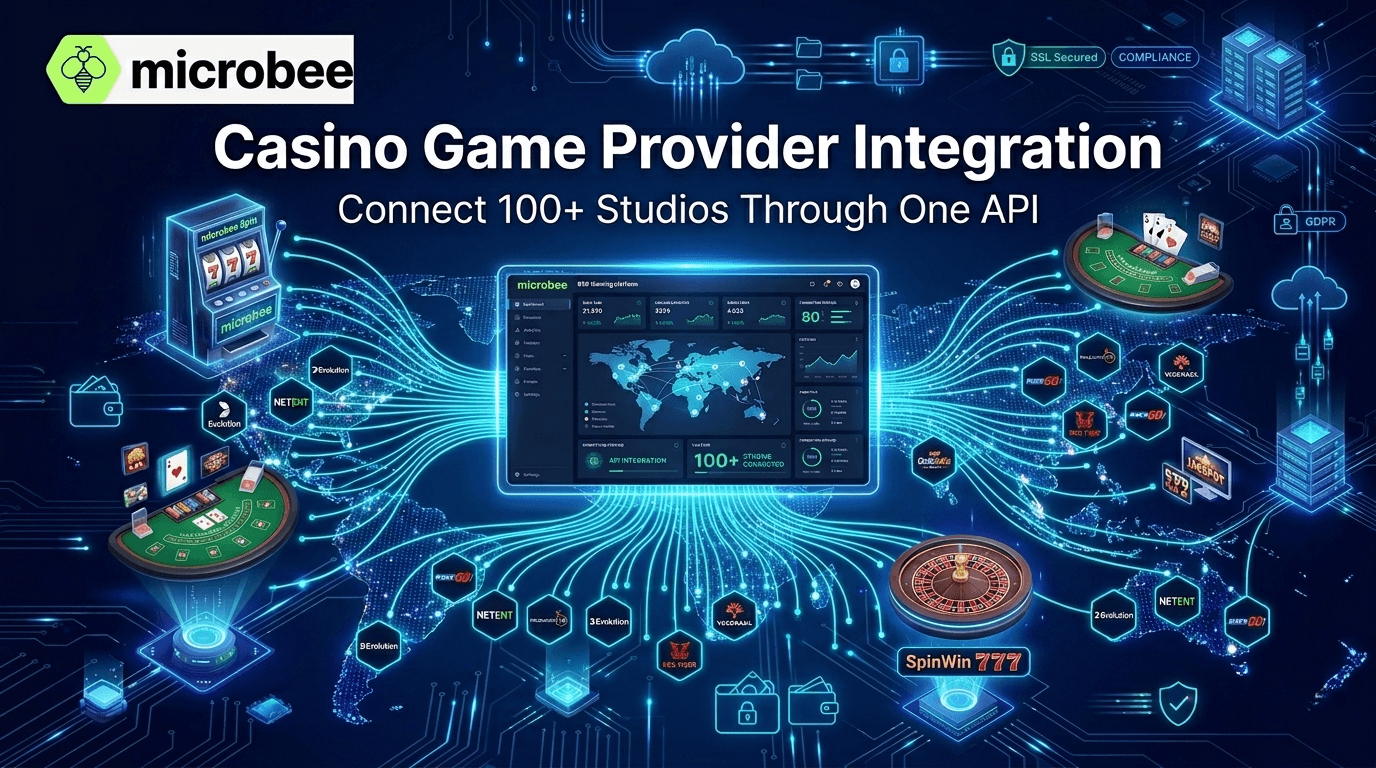
An aggregator sits between the operator's platform and the game providers' RGS instances. Instead of the operator integrating with each provider individually, the operator integrates once with the aggregator's unified API. The aggregator then manages all downstream provider connections.
The data flow for a player launching a slot game follows this sequence. The player selects a game on the operator's site. The operator's platform sends a game-launch request to the aggregator API. The aggregator authenticates the session and routes the request to the correct provider's RGS. The provider's RGS returns the game client. All bet and win transactions pass through the aggregator's unified wallet layer, which communicates with the operator's player account system.
This means the operator's development team builds and maintains one integration instead of dozens.
Wallet Unification
This is where aggregation quality diverges sharply. A properly unified wallet means every game from every provider uses the same player balance, the same transaction format, and the same reconciliation process. The operator sees one ledger, not 80 separate ones.
Shallow aggregation — which is more common than the industry admits — often maintains separate wallet calls per provider. The player's balance appears consistent on the front end, but behind the scenes, the operator's finance team is reconciling multiple transaction formats, currencies, and settlement schedules. This creates operational overhead that erases much of the integration time savings.
MicroBee's aggregation layer uses a single-wallet architecture where all provider transactions pass through one standardised transaction engine. This means one reconciliation process, one reporting format, and one settlement cycle regardless of how many providers are connected.
Game Delivery and RGS Hosting
Game providers host their titles on their own RGS infrastructure. The aggregator does not typically host the games themselves — they route traffic to the provider's servers. This means game performance (load times, graphical quality, RTP execution) depends primarily on the provider's infrastructure, not the aggregator's.
What the aggregator does control is the reliability of the routing layer, the speed of the game-launch handshake, and the graceful handling of provider downtime. If a provider's RGS goes offline, a well-architected aggregator isolates the failure so the rest of the casino continues operating normally. A poorly architected one can cascade the failure across multiple providers.
Evaluating Casino Game Providers
Not all game studios deliver equal value to an operator's casino. The following evaluation criteria determine which providers are worth prioritising in your game library.
1. Game Quality and Player Engagement Metrics
Raw game count is a vanity metric. An operator with 8,000 games where 90% of GGR comes from 200 titles is not better off than an operator with 2,000 carefully curated games. The metrics that matter are average session duration per game, bet frequency (rounds per minute), and player return rate (percentage of players who return to a specific game within 7 days).
Top-tier providers like Pragmatic Play, Evolution, Play'n GO, and NetEnt consistently outperform on these engagement metrics because they invest heavily in mathematics models, visual production, and feature design. Emerging studios can offer innovative mechanics but often lack the data-driven optimisation that comes from operating at scale.
2. Regulatory Coverage
Every game must be certified for the jurisdictions where the operator holds licences. A provider's game may be available in Malta but not certified for the UK, or available in Curaçao but not tested to Swedish Spelinspektionen standards.
The certification status of a provider's portfolio directly affects how quickly an operator can go live in a new market. Operators should verify certification coverage per jurisdiction before committing to any provider integration.
3. RTP Configuration and Flexibility
Most modern slot games ship with multiple RTP configurations (typically 87%, 90%, 94%, and 96% variants). The operator selects the appropriate RTP based on regulatory requirements and commercial strategy. Some jurisdictions mandate minimum RTP thresholds — the UK requires publication of actual RTP, while Malta mandates a minimum of 92% for slots.
Operators need providers whose RTP configurations align with their target jurisdictions and whose back-office tools allow RTP selection per market.
4. Localisation and Language Support
A provider's games should support the languages and currencies relevant to the operator's target markets. This includes not just UI translations but also customer-facing elements like game rules, paytable displays, and help screens. Providers with strong Asian market penetration (for example) will typically support Simplified Chinese, Traditional Chinese, Korean, Japanese, Thai, and Vietnamese — while European-focused studios may only cover EN, DE, FR, ES, IT, and PT.
5. Mobile Performance
With 70–80% of casino sessions occurring on mobile devices, game performance on smartphones is non-negotiable. Evaluation should include load time on mid-range Android devices (not just flagship phones), touch-target sizing for bet controls, and battery consumption during extended sessions. HTML5 is the universal standard, but implementation quality varies enormously between providers.
The Aggregator vs. Direct Integration Decision
When Direct Integration Makes Sense
Direct integration with a game provider is justified when the operator requires deep customisation of the game client (branded tables, exclusive game variants), when the provider offers a revenue-share model that improves with direct-integration volume commitments, or when the operator has a dedicated integration team with capacity to maintain the connection long-term.
Large-scale operators with 50+ person engineering teams often maintain a hybrid approach: direct integrations with their top 5–10 revenue-generating providers and aggregated access to the remaining studios.
When Aggregation Is the Right Choice
For the majority of operators — particularly those launching a new casino, expanding into new markets, or operating with engineering teams under 20 people — aggregation is the pragmatic choice. The integration time savings alone typically justify the aggregator's margin.
Aggregation ROI calculation: If a direct integration takes 6 weeks of developer time and the operator needs 30 providers, that is 180 weeks (3.5 years) of integration work. An aggregator delivers the same 30 providers in a single integration taking 2–4 weeks. Even accounting for the aggregator's revenue share (typically 1–3% of GGR), the time-to-market advantage almost always outweighs the cost.
How MicroBee Delivers Casino Game Content
MicroBee's casino aggregation platform connects operators to 5,000+ games from 80+ studios through a single API integration. The platform is built on the following principles.
Unified wallet architecture. All provider transactions pass through one wallet layer. The operator maintains a single player balance system regardless of how many providers are active. Reconciliation is automated and standardised.
2–4 week go-live timeline. Operators using MicroBee's aggregation typically go from signed contract to live casino in 2–4 weeks. This includes API integration, game library configuration, jurisdiction-specific RTP selection, and testing.
Provider management. MicroBee handles all provider relationships, contract negotiations, certification tracking, and technical maintenance. When a provider releases new games, they appear in the operator's back office for activation without additional integration work.
Jurisdiction compliance. MicroBee holds MGA (MGA/B2B/203/2016) and UKGC (account 79852) licences. Game availability is automatically filtered by jurisdiction — operators can only activate games that are certified for their licensed markets.
Back-office game management. Operators control game visibility, lobby positioning, RTP selection, and promotional tagging through MicroBee's back-office interface. No developer intervention is required to add, remove, or reorder games.
Provider Tiers: How to Structure Your Game Library
A well-structured casino game library follows a tiered approach.
Tier 1 — Anchor Providers (3–5 studios). These are the providers whose games drive the majority of your GGR. They should have proven player engagement metrics, strong brand recognition, and comprehensive jurisdiction coverage. Typical Tier 1 providers include Pragmatic Play, Evolution, Play'n GO, NetEnt, and Red Tiger.
Tier 2 — Volume Providers (10–20 studios). These providers add breadth and variety to the library. They may specialise in specific game types (crash games, Asian-themed slots, classic table games) or regional markets. Their games fill out categories and give players choice without cannibalising Tier 1 revenue.
Tier 3 — Niche and Emerging Providers (20+ studios). These are smaller studios offering innovative mechanics, exclusive content, or region-specific themes. Their individual GGR contribution is small, but collectively they differentiate the operator's library from competitors. The low integration cost via aggregation makes including them a no-risk decision.
Key Takeaways for Operators
Selecting and integrating casino game providers is one of the most consequential decisions in building a casino platform. The right aggregation partner reduces integration time from years to weeks, unifies operational complexity into a single system, and gives operators access to a provider ecosystem they could never build alone.
The critical evaluation criteria are not game count but game quality, not provider quantity but wallet unification depth, and not feature lists but actual go-live timelines backed by operator references.
MicroBee's casino aggregation connects operators to 80+ providers and 5,000+ games through one API, with a unified wallet, automated compliance filtering, and a 2–4 week deployment timeline — built on 12 years of B2B iGaming platform experience serving 300+ operators across 50+ jurisdictions.
Related Reading
• Casino Software vs Casino Platform: Which Does Your Operation Need?
• The Game Aggregator Dilemma: Integration Depth vs. Mere Quantity
• Slot Game API Integration: Complete Provider and Integration Guide
• B2B Casino Platform Provider: Complete Selection and Comparison Guide
Ready to launch your casino with 5,000+ games? Contact MicroBee for a platform demo and game library walkthrough. |