
MicroBee Tech Team
Reading Time :
10 Minute
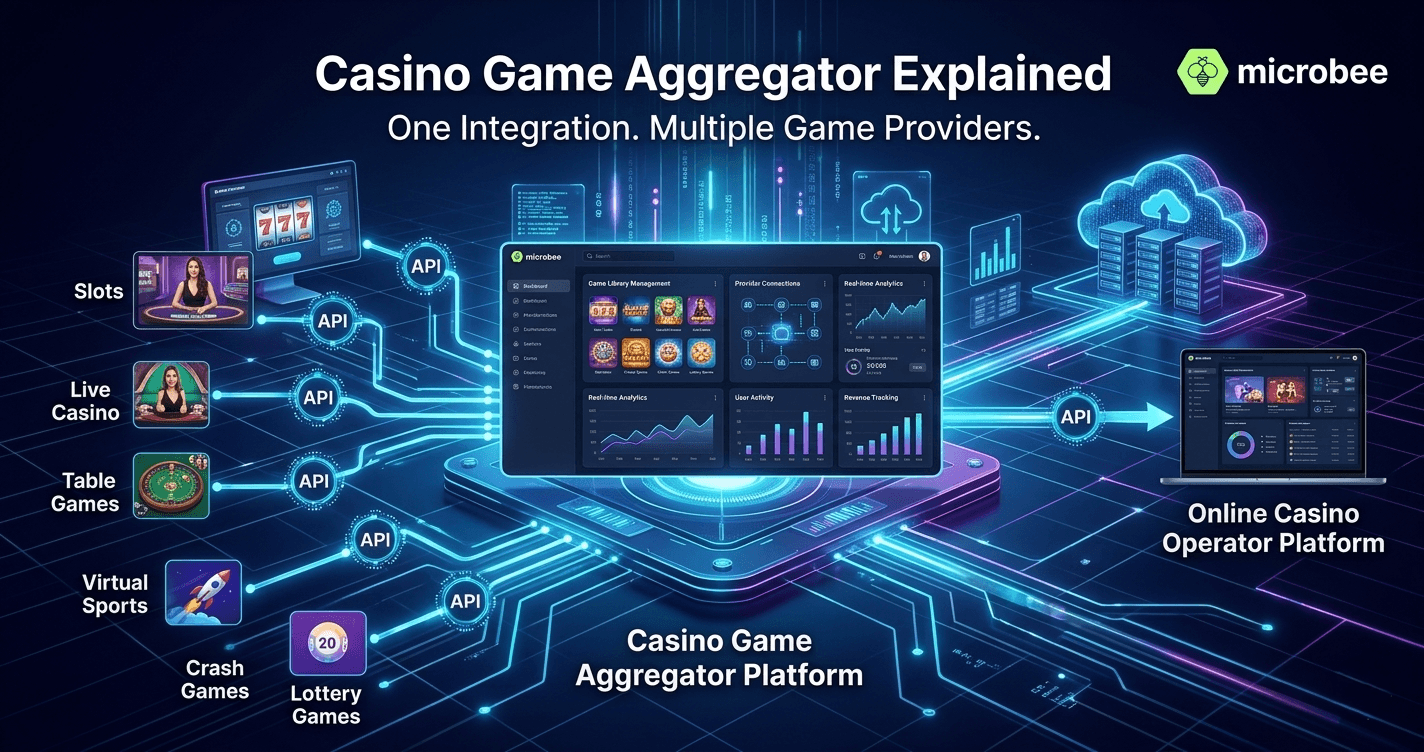
A casino game aggregator is a B2B platform that connects online casino operators to multiple game studios through a single API integration. Instead of negotiating separate contracts and building individual technical connections with each game provider, operators integrate once with the aggregator and gain access to the aggregator’s entire portfolio.
For operators evaluating their casino technology stack, the aggregator model fundamentally changes the economics and timeline of building a competitive game library. This guide explains how aggregation works technically, what it costs, and how to evaluate competing aggregator platforms.
How Game Aggregation Works
The aggregator sits between the operator’s platform and the game studios. When a player launches a slot game, the request flows through the operator’s frontend to the aggregator’s API, which routes it to the appropriate game provider. The game session runs on the provider’s servers, but the aggregator handles authentication, wallet transactions, regulatory compliance checks, and session management.
From the operator’s perspective, every game behaves identically regardless of which studio built it. Player balances, bonus systems, and responsible gambling controls operate through a unified interface. From the game studio’s perspective, the aggregator handles distribution to hundreds of operators without the studio needing individual commercial relationships with each one.
This architecture creates a marketplace effect: operators want aggregators with the most games, and studios want aggregators with the most operators. The result is rapid portfolio growth — leading aggregators add 20–40 new titles monthly.
Direct Integration vs Aggregator: The Numbers
Factor | Direct Integration (per provider) | Aggregator (single integration) |
API Integrations Required | 1 per provider (typically 8–15) | 1 total |
Contract Negotiations | Individual with each studio | Single agreement |
Time to First Game Live | 4–8 weeks per provider | 2–4 weeks total |
Time to Full Library | 6–12 months | 2–4 weeks |
Development Resources | 1–2 developers per integration | 1–2 developers total |
Certification/Compliance | Per provider, per jurisdiction | Aggregator handles centrally |
Game Updates & Patches | Coordinate with each provider | Automatic via aggregator |
Revenue Settlement | Multiple invoices/reports | Single consolidated report |
Platform Fees | Varies (some charge) | Zero with MicroBee |
Estimated Total Cost (Year 1) | $150K–$400K | $20K–$60K |
What Operators Should Evaluate in an Aggregator
Not all aggregators are equal. The following criteria separate platforms that accelerate growth from those that create new bottlenecks:
1. Game Portfolio Size and Quality — Raw game count matters less than the quality and popularity of included titles. An aggregator with 500 games from tier-1 studios (Pragmatic Play, NetEnt, Evolution, Play’n GO) delivers more player value than one with 2,000 games from unknown studios. Verify the portfolio includes the top 50 most-played titles in your target markets.
2. Platform Fee Structure — Some aggregators charge operators a platform fee (2–5% of GGR) on top of the game provider’s revenue share. MicroBee’s aggregator charges zero platform fees — operators pay only the underlying studio revenue share. Over 12 months, eliminating a 3% platform fee on $1M GGR saves $30,000.
3. Integration Complexity — Evaluate the API documentation, sandbox environment, and support during integration. A well-designed aggregator API should require no more than 200 lines of integration code for the basic wallet and session management connection.
4. Regulatory Coverage — The aggregator must hold game certifications for your target jurisdictions. Verify that games are certified for each market, not just available in the portfolio. Uncertified games create compliance risk.
5. Content Management Tools — Operators need the ability to enable/disable games by market, configure lobby ordering, set per-game betting limits, and manage promotional free rounds. The aggregator’s back-office tools should handle all of this without API calls.
6. Uptime and Performance — Game aggregators process every player transaction. Any downtime means zero casino revenue. Demand 99.99% uptime SLAs with financial penalties for breaches.
Revenue Model: How Operators Make Money Through Aggregators
The revenue flow in an aggregated model follows a clear chain. The player wagers on a slot game. The game provider takes their revenue share (typically 10–20% of GGR depending on the studio and title). The aggregator takes their platform fee (0% with MicroBee; 2–5% with others). The operator retains the remainder.
On a $100 GGR example: with a 15% studio revenue share and a 3% aggregator fee, the operator retains $82. With MicroBee’s zero-fee model, the operator retains $85. At scale, this 3% difference compounds significantly — an operator generating $2M annual GGR from casino saves $60,000 per year.
Beyond direct GGR, game content drives cross-sell to sportsbook products. Players who engage with casino games between sporting events show 35–45% higher lifetime value than sports-only customers, making the aggregator’s portfolio a strategic growth lever rather than just a standalone revenue line.
Common Pitfalls When Choosing an Aggregator
• Prioritising game count over game quality — A portfolio padded with low-quality titles dilutes the lobby experience and increases player churn.
• Ignoring regional game preferences — European players prefer different titles than Asian or Latin American players. Verify the aggregator’s portfolio includes culturally relevant content for each target market.
• Overlooking mobile performance — 70%+ of casino sessions occur on mobile devices. Test game load times and rendering quality on mid-range Android devices, not just flagship phones.
• Not negotiating exclusive promotions — Some aggregators can arrange exclusive game launches or custom free-round campaigns with studios. These promotional opportunities differentiate your platform from competitors using the same aggregator.
Frequently Asked Questions
Question | Answer |
What is the difference between a game aggregator and a game provider? | A game provider (studio) creates the actual games. An aggregator connects operators to multiple providers through a single API, handling distribution, compliance, and settlement. |
Can I integrate individual providers alongside an aggregator? | Yes. Many operators use an aggregator for broad portfolio coverage and integrate their highest-volume providers directly for better commercial terms or exclusive content. |
Do aggregators support cryptocurrency payments? | This depends on the specific aggregator and game provider. MicroBee’s platform supports multiple payment methods including crypto, but game-level support varies by studio. |
How quickly can I add new game providers through an aggregator? | With an aggregator, new providers are typically available within days of the aggregator completing their integration. No additional development work is required on the operator side. |
What happens if a game provider leaves the aggregator? | The aggregator handles the transition. Games are removed from the lobby, active sessions are settled, and the operator’s integration remains unaffected. |