
Microbee Tech Team
Reading Time :
8 Min
Why CRM Is the Highest-Leverage System in a Casino Operation
The economics of online casino operations are straightforward but unforgiving. Acquiring a new depositing player costs between $150 and $500 depending on the market, channel, and jurisdiction. If that player churns within 7 days — which 60–70% of first-time depositors do across the industry — the operator has lost the entire acquisition cost with minimal GGR to offset it.
Retention is where casino profitability lives. A player who remains active for 90 days generates 8–12 times more lifetime value than one who churns after a single session. The CRM system is the mechanism through which operators influence whether a player stays or leaves.
Yet in many B2B platform evaluations, operators spend weeks scrutinising the game library, days negotiating payment gateway fees, and approximately thirty minutes reviewing CRM capabilities. This is an allocation error. The game library determines whether a player has something to play. The CRM determines whether they come back to play it.
Casino CRM Architecture
A casino CRM is not a generic customer relationship tool adapted for gambling. It is a purpose-built system that integrates with the casino platform's player wallet, game engine, bonus system, compliance module, and communication channels. Generic CRM platforms like Salesforce or HubSpot lack the gaming-specific data models, real-time event processing, and regulatory compliance features that casino operations require.
Data Layer
The CRM's foundation is its data layer — the system that collects, normalises, and stores player activity data from every touchpoint. In a properly architected casino CRM, this includes transactional data (every deposit, withdrawal, bet, and win across all games), behavioural data (session frequency, session duration, game preferences, device usage, time-of-day patterns), bonus data (offers received, claimed, completed, forfeited, and abuse indicators), support data (ticket volumes, topics, resolution times, satisfaction scores), and compliance data (KYC status, responsible gambling triggers, self-exclusion history).
The critical architectural requirement is that this data exists in a unified player profile, not scattered across separate systems. If the CRM cannot see a player's bonus history when sending a retention offer, or cannot check responsible gambling flags before triggering a re-engagement campaign, the system is operationally incomplete.
Segmentation Engine
Raw data becomes actionable through segmentation — the process of grouping players by shared characteristics to deliver targeted rather than generic communications.
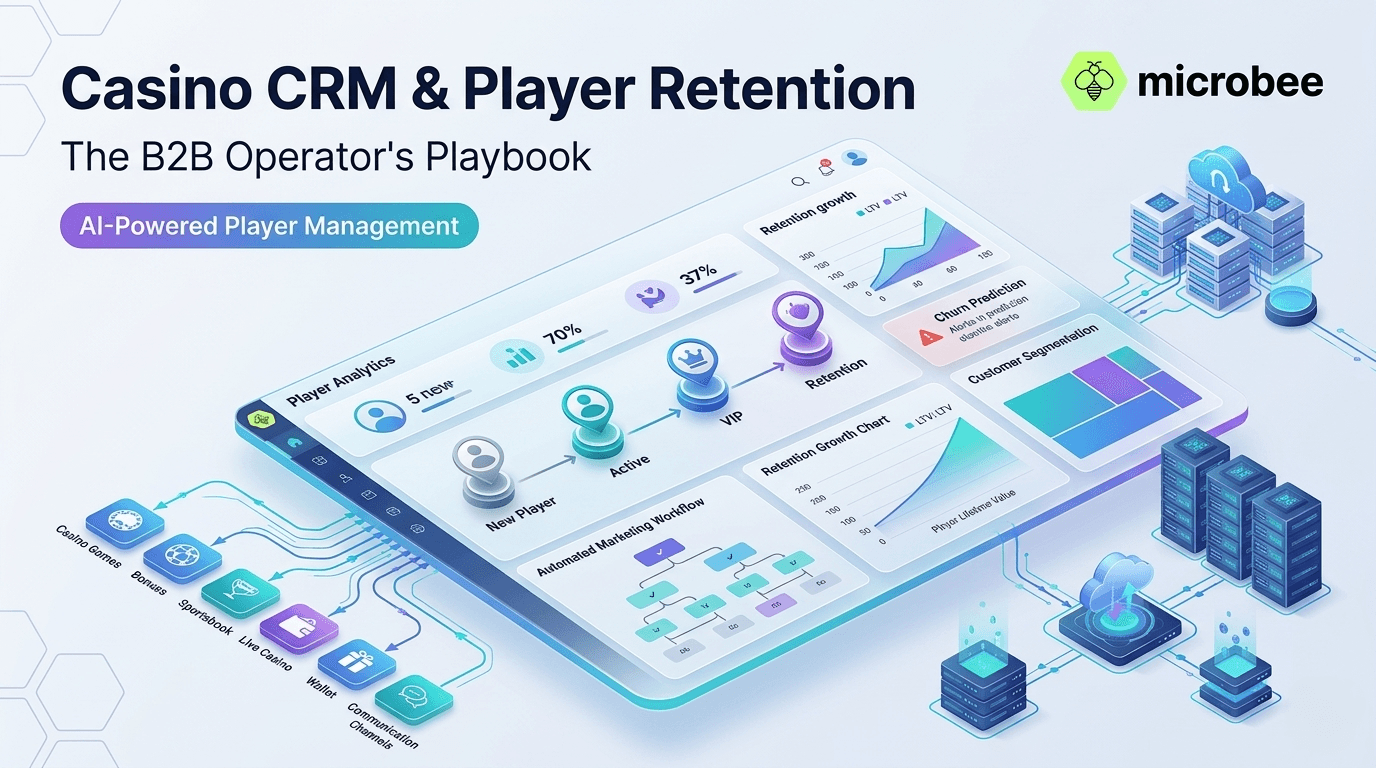
Effective casino segmentation operates on multiple dimensions simultaneously. Value segmentation groups players by GGR contribution (VIP, mid-value, recreational). Behavioural segmentation groups by activity patterns (daily players, weekend warriors, event-driven bettors). Lifecycle segmentation groups by journey stage (new registrant, first depositor, active regular, at-risk, churned, reactivated). Preference segmentation groups by game type (slots-only, table game players, live casino enthusiasts, mixed).
The most effective CRM systems allow dynamic multi-dimensional segments that update in real time. A player who was classified as "mid-value slots player" might shift to "high-value live casino VIP" over the course of a month — the segmentation engine should reflect this change automatically rather than waiting for manual reclassification.
Automation Engine
The automation engine executes pre-configured actions when players meet specified trigger conditions. This is where CRM translates data and segmentation into actual player communications and bonus distributions.
A well-configured casino CRM runs dozens of automated workflows simultaneously. The most impactful workflows target specific lifecycle moments.
Post-registration, pre-deposit. A player who registers but does not deposit within 24 hours receives a series of onboarding communications — platform walkthrough, game recommendations, and a time-limited deposit incentive. The automation must be sensitive to jurisdiction-specific bonus rules (for example, Swedish operators cannot offer deposit match bonuses).
First-deposit follow-up. Within 2 hours of a player's first deposit, the CRM triggers a personalised game recommendation based on registration data (stated preferences) or first-session behaviour (which game categories the player browsed). This is the highest-leverage retention moment — the player has committed money and is forming their initial impression of the platform.
Churn risk detection. When an active player's session frequency drops below their established baseline — for example, a daily player who has not logged in for 3 days — the CRM triggers a re-engagement sequence. The timing, channel, and offer should be calibrated to the player's value segment.
Reactivation. Players who have been inactive for 30+ days receive a reactivation campaign with an escalating incentive structure. The first touchpoint is typically a "we miss you" communication with no bonus. If the player does not respond within 7 days, a small bonus offer is sent. If still inactive after 14 days, a larger offer is triggered. This staged approach prevents over-discounting on players who would have returned without incentive.
Retention Mechanics That Actually Work
Not all retention tactics are equal. The following mechanics have the strongest documented impact on Day-30 and Day-90 retention rates based on operator performance data across the industry.
Personalised Game Recommendations
Players who receive game recommendations based on their demonstrated preferences — not generic "popular games" lists — show 25–35% higher session frequency in the first 30 days compared to players who receive no recommendations. The CRM must connect to the game aggregation layer to understand which games the player has tried, which they returned to, and which they abandoned.
The recommendation algorithm should account for game variance preference (does the player favour high-volatility or low-volatility slots), session duration patterns (short-session players should not be recommended slow-paced table games), and provider affinity (if a player consistently engages with one studio's games, recommend other titles from the same studio before suggesting competitors).
Deposit Milestone Recognition
Acknowledging player milestones — 10th deposit, first month anniversary, reaching a new loyalty tier — creates a sense of progression that generic bonus offers do not. Recognition communications should be congratulatory rather than transactional. The bonus attached to a milestone should feel like a reward for loyalty rather than a bribe to continue playing.
Responsible Gambling Integration
This is counterintuitive to many operators, but responsible gambling tools are a retention mechanism. Players who set deposit limits, loss limits, or session time reminders churn at lower rates than unrestricted players. The reason is straightforward: players who feel in control of their gambling activity maintain a positive relationship with the platform. Players who experience uncontrolled losses develop negative associations and either self-exclude or simply stop returning.
A CRM that integrates responsible gambling data can identify players at risk of harmful gambling behaviour and intervene with cooling-off suggestions before the player reaches a crisis point. This is both ethically correct and commercially smart — the alternative is losing the player entirely to self-exclusion or regulatory intervention.
Cross-Product Engagement
Players who engage with multiple product verticals — casino and sportsbook, or slots and live casino — have significantly higher retention rates than single-product players. The CRM should identify players who have only engaged with one product and introduce them to adjacent products through targeted communications.
For example, a slots-only player might receive a communication highlighting a live casino welcome offer, positioned as an extension of their existing gaming experience rather than a separate product. MicroBee's unified platform architecture, which combines sportsbook, casino, live casino, and esports in a single system, makes cross-product campaigns operationally simple because all player activity is visible in one CRM view.
Churn Prediction and Prevention
Advanced casino CRM systems employ predictive analytics to identify players likely to churn before they actually stop playing. Churn prediction models analyse patterns across the player base to identify behavioural signals that precede inactivity.
Leading Indicators of Churn
The strongest churn predictors in casino operations are declining session frequency (a player's visits-per-week dropping from their established baseline), decreasing average deposit amount (smaller deposits suggest decreasing engagement), narrowing game variety (a player who used to try new games but now only plays one or two titles), increasing withdrawal-to-deposit ratio (the player is withdrawing more frequently relative to deposits, signalling they are extracting rather than enjoying their balance), and declining session duration (shorter sessions suggest the player is checking in out of habit rather than genuine engagement).
A CRM that monitors these indicators in real time can trigger intervention campaigns before the player becomes fully inactive. The intervention might be a personalised bonus offer, a new game recommendation, or simply a communication acknowledging the player's loyalty.
Measuring CRM Effectiveness
The core metrics for casino CRM performance are Day-1 retention (percentage of first-time depositors who return within 24 hours), Day-7 retention (percentage returning within a week), Day-30 retention (the industry benchmark for short-term retention), player lifetime value (total GGR per player over their active lifetime), and bonus cost ratio (total bonus costs as a percentage of total GGR). Industry benchmarks vary by market and player segment, but broadly, a well-optimised casino CRM should achieve Day-30 retention rates of 30–40% for deposit-match acquired players and 15–25% for organic registrants.
Evaluating CRM Capabilities in B2B Platforms
When comparing B2B casino platform providers, CRM evaluation should cover integration depth, automation sophistication, and regulatory awareness.
Unified data model. Does the CRM have access to all player data (transactions, game activity, bonuses, support, compliance) in a single view? Or does it rely on periodic data imports from separate systems?
Real-time event processing. Can the CRM trigger actions based on real-time player behaviour (depositing right now, playing a specific game right now)? Or does it only process data in batch cycles?
Multi-channel communication. Does the CRM support email, SMS, push notification, in-app messaging, and on-site banners from a single campaign builder? Or does each channel require separate tooling?
Regulatory compliance. Does the CRM enforce opt-in/opt-out preferences per channel and per jurisdiction? Does it prevent marketing communications to self-excluded players? Does it integrate with responsible gambling triggers?
Reporting and attribution. Can the operator measure the direct impact of a specific CRM campaign on player retention, GGR, and bonus cost? Or does reporting stop at open rates and click rates?
MicroBee's player management and CRM module is built directly into the platform — not bolted on as a third-party integration. This means player data from the wallet, game aggregation, bonus engine, payment gateway, and compliance module feeds into one CRM view in real time. Operators configure segmentation, automation, and communications from the same back office that manages every other aspect of their casino and sportsbook operation.
With 300+ operators across 50+ jurisdictions relying on MicroBee's platform, the CRM system has been refined against the retention challenges of diverse markets, player behaviours, and regulatory requirements over 12 years of continuous operation.
Related Reading
• Casino Bonus Engine: Architecture, Types, and Provider Comparison
• Casino Back Office System: From Data Dump to Decision Engine
• Casino Game Provider Integration: How Aggregators Connect 100+ Studios
• B2B Casino Platform Provider: Complete Selection and Comparison Guide
Ready to see how MicroBee's CRM drives retention? Contact us for a player management demo. |