
Microbee FinTech Team
Reading Time :
12 Minute
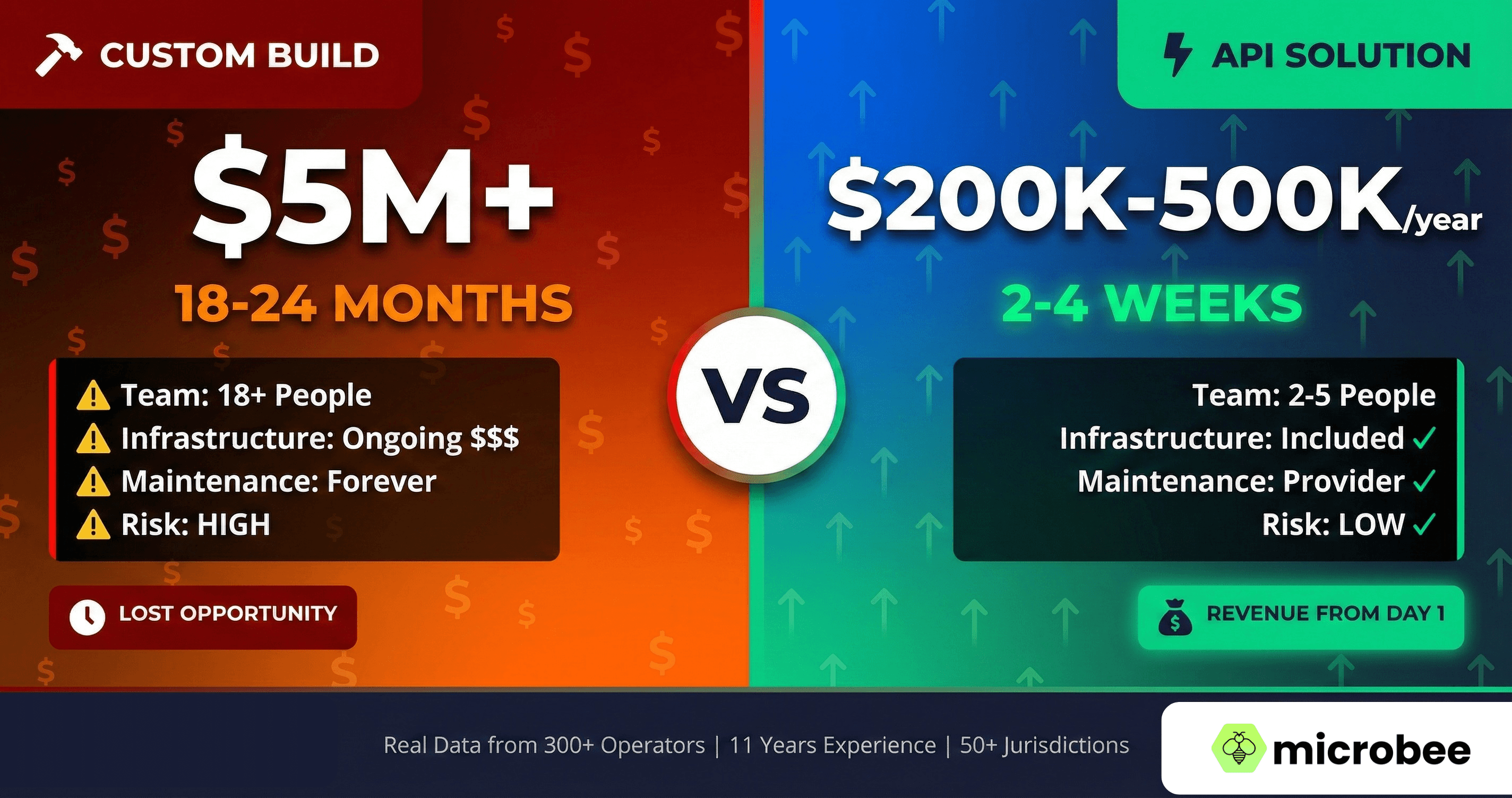
Introduction: The $5 Million Question Every Operator Asks
"Should we build our own sportsbook or use an API provider?"
In my 11 years working with over 300 sports betting operators at MicroBee, I've seen this question asked countless times. And I've watched both paths play out—some spectacularly successful, others ending in costly failures.
The answer isn't simple, but it's become increasingly clear: in 2026, building from scratch is rarely the right choice. Not because it's impossible, but because the true costs are far higher than most operators realize.
This article reveals what we've learned from helping operators navigate this decision, backed by real data from platforms that chose different paths.
The Visible Costs: What Everyone Calculates
Most operators start by calculating the obvious expenses. Let's be honest about what building a competitive sportsbook actually requires:
Development Team Requirements
You can't build a modern sportsbook with a few developers working part-time. Here's the minimum viable team:
Backend Engineers (5-7 people)
Real-time data processing specialists
Database architecture experts
API integration engineers
Security and compliance developers
Each requiring 3-5 years of experience in high-frequency systems
Frontend Engineers (3-4 people)
Mobile app developers (iOS and Android native)
Web application specialists
UI/UX designers who understand betting interfaces
Performance optimization experts
Data Scientists (2-3 people)
Odds compilation algorithm developers
Statistical modeling experts
Machine learning specialists for risk management
Real-time analytics engineers
Sports Trading Team (3-5 people)
Experienced sports traders for each major market
Risk management specialists
Market makers who understand player behavior
24/7 coverage requires multiple shifts
Compliance and Legal (2-3 people)
Licensing specialists familiar with multiple jurisdictions
Regulatory compliance officers
Legal counsel for terms, conditions, and disputes
AML/KYC implementation experts
Operations and Support
24/7 customer support team (minimum 8-12 people for round-the-clock coverage)
System administrators and DevOps engineers
Quality assurance and testing team
This isn't a startup team—this is an experienced, specialized workforce that takes months to assemble and train.
Technology Infrastructure
Modern sports betting demands infrastructure that can handle:
Data Processing
50+ sports with thousands of daily events
Millions of odds updates per day
Sub-50 millisecond response times
99.99% uptime requirements
Server Architecture
Cloud infrastructure across multiple geographic regions
Auto-scaling to handle traffic spikes (major matches can see 50x normal traffic)
Content delivery networks for global performance
Redundant systems for disaster recovery
Security Requirements
DDoS protection (betting platforms are prime targets)
Web application firewalls
Encryption for all data in transit and at rest
Regular penetration testing and security audits
Fraud detection systems
Third-Party Services
Sports data feeds from providers like Sportradar or Genius Sports
Payment gateway integrations for multiple methods
KYC/AML verification services
Geolocation and age verification systems
The Hidden Costs: What Destroys Budgets and Timelines
The visible costs are substantial, but experienced operators know the real killers are the hidden expenses that only reveal themselves mid-project.
The Time Cost: 18-24 Months of Lost Opportunity
Let's talk about what 18 months means in the sports betting industry:
Market Evolution
Player expectations change rapidly
Competitors launch new features
Regulatory requirements shift
Technology standards advance
A platform designed in early 2024 looks outdated by late 2025. By the time you launch, you're already behind.
Competitive Positioning While you're building, competitors using API solutions are:
Acquiring customers
Building brand loyalty
Collecting valuable player data
Optimizing their operations
Generating revenue
One operator we worked with calculated they lost approximately $8 million in potential revenue during their 20-month build process—revenue that competitors captured.
The Expertise Gap: Skills Money Can't Easily Buy
Sports betting technology requires highly specialized knowledge that's rare in the market:
Odds Compilation Science This isn't simple probability calculation. Professional odds compilers need to understand:
Statistical modeling across dozens of sports
Market psychology and player behavior
Risk balancing across thousands of simultaneous events
Cultural factors in different markets
How to adjust for incomplete information
Finding people with this expertise is extremely difficult. Most work for established operators or data providers and aren't looking to join startups.
Real-Time Systems Engineering Your platform must process:
Thousands of odds updates per second during major events
Bet placements that must validate in milliseconds
Market suspensions that trigger in microseconds when goals are scored
Risk calculations across hundreds of thousands of active bets
This requires engineers who've built high-frequency trading systems, real-time gaming platforms, or similar applications. They're expensive and in high demand.
Regulatory Compliance Expertise Gambling regulation is complex and varies dramatically by jurisdiction:
Malta has different requirements than Curaçao
UK regulations are exceptionally strict
Each US state has unique rules
Asian markets have specific cultural considerations
Compliance mistakes can result in:
License denial or revocation
Substantial fines
Criminal liability in some jurisdictions
Permanent reputation damage
One compliance error can cost more than an entire API subscription.
The Maintenance Burden: Forever Costs
Building the platform is just the beginning. Ongoing maintenance includes:
Continuous Development
New sports and leagues added regularly
New bet types as player preferences evolve
Mobile app updates for new iOS and Android versions
Integration with new payment methods
Security patches and vulnerability fixes
Data Feed Management
Maintaining relationships with multiple data providers
Handling feed failures and switching to backups
Resolving data discrepancies
Negotiating renewals and managing costs
Regulatory Updates
Adapting to new compliance requirements
Implementing new responsible gambling tools
Updating terms and conditions
Maintaining audit trails and reporting
Technical Debt Every development decision creates technical debt. Rushed features to meet deadlines result in code that eventually needs refactoring. One operator told me they spent their entire second year just refactoring and fixing issues from their rushed first-year build.
The API Alternative: What Modern Platforms Actually Get
When operators choose a proven API provider instead, they're not just avoiding costs—they're gaining immediate access to capabilities that took years to build.
Instant Access to Proven Technology
A quality API provider offers:
Comprehensive Sports Coverage
50+ sports already integrated
50,000+ events per month
Every major league globally
Consistent data quality across all sports
This represents years of work building relationships with data providers, developing integrations, and ensuring quality.
Battle-Tested Infrastructure
Systems proven during the highest-traffic events
Automatic scaling that actually works under pressure
Redundancy that prevents outages
Performance optimized through millions of real bets
When the Champions League Final happens, you're not hoping your infrastructure holds—you know it will, because it's been tested with hundreds of thousands of concurrent users.
Advanced Risk Management
Sophisticated algorithms developed over years
Automated trader tools built from real-world experience
Liability management across thousands of events
Fraud detection trained on millions of betting patterns
Building risk management this sophisticated from scratch would take a dedicated team 2-3 years minimum.
Speed to Market: The Competitive Advantage
Modern API integration typically takes 2-4 weeks:
Week 1: Foundation
Authentication and basic connectivity
Understanding data structures
Setting up development environment
Initial odds display
Week 2: Core Functionality
Bet placement and validation
Pre-match betting fully functional
Payment integration begun
Basic testing completed
Week 3: Advanced Features
Live betting implemented
WebSocket connections established
Mobile optimization
Compliance tools integrated
Week 4: Launch Preparation
Comprehensive testing
Security audit
Performance optimization
Soft launch
Compare this to 18-24 months of development. That time advantage translates directly to revenue.
Continuous Innovation You Don't Have to Build
API providers invest heavily in R&D because they serve hundreds of operators. This means you automatically benefit from:
New Features
Bet builder functionality
Cash-out capabilities
New bet types and markets
Enhanced mobile experiences
Technology Upgrades
Performance improvements
Security enhancements
New data sources
Infrastructure scaling
Regulatory Compliance
Updates for new jurisdictions
Enhanced responsible gambling tools
Improved reporting and audit capabilities
New compliance certifications
One operator calculated that their API provider delivered over 50 significant platform improvements in a single year—improvements they would have needed to build themselves.
Real-World Case Studies: Two Paths Compared
Let me share two operators who launched within months of each other, one choosing to build, the other using our API.
Operator A: The Build-It-Ourselves Approach
Timeline:
Month 0: Decision to build, begin hiring
Month 3: Core team assembled, architecture planning
Month 8: First working prototype
Month 14: MVP ready for internal testing
Month 18: Beta launch with limited features
Month 22: Full launch
Resources Invested:
18-person development team
Substantial infrastructure costs
Multiple consultant fees
Licensing and compliance expenses
Outcome:
Launched 22 months after decision
Limited sports coverage initially (focused on soccer only)
Performance issues during first major event (Champions League)
Spent next 6 months fixing critical bugs
Started achieving stability around month 30
Learning: The operator's CTO later told me, "If I could do it again, I'd use an API for at least the first 2 years while building a customer base, then consider custom development if we needed very specific features."
Operator B: The API-First Approach
Timeline:
Month 0: Decision to use API, provider selection
Month 0.5: Contract signed, integration begins
Month 1: Soft launch with full sports coverage
Month 1.5: Full public launch
Resources Invested:
2-person development team for integration
5-person team for marketing and operations
Payment processing setup
Brand and customer acquisition focus
Outcome:
Launched in under 2 months
Comprehensive sports coverage from day one
Zero performance issues during major events
Focused resources on customer acquisition
Profitable within first quarter
Growth Trajectory:
Month 3: 5,000 active users
Month 6: 15,000 active users
Month 12: 40,000 active users
Year 2: Expanded to 3 additional markets
Key Difference: While Operator A was still debugging their platform, Operator B was acquiring customers and generating revenue. The revenue from months 1-22 funded their entire growth strategy.
Making the Right Decision for Your Business
Building vs using an API isn't actually about capability—it's about strategy and resource allocation.
When Building Might Make Sense
There are legitimate reasons to build custom technology:
Unique Market Requirements
You're serving a market with truly unique needs
No existing API supports your specific regulatory environment
Cultural or language requirements are highly specialized
Proprietary Advantage
You have a genuinely innovative betting concept
Your competitive advantage depends on unique technology
You're creating new market categories
Massive Scale and Resources
You have multi-million dollar funding committed
You can attract top-tier technical talent
You can wait 2+ years for ROI
You're planning 10+ year market dominance
Strategic Control
Technology ownership is central to your business model
You plan to license your platform to others
You need to customize every aspect of user experience
When API Makes Sense (Most Cases)
For the majority of operators, API solutions are superior because:
Speed to Revenue
Launch in weeks, not years
Start generating revenue immediately
Test markets quickly and pivot if needed
Capture market opportunity while it exists
Resource Optimization
Deploy capital to customer acquisition, not development
Build marketing and operations teams instead
Invest in brand differentiation
Focus on what makes your platform unique (not the betting engine)
Risk Mitigation
Proven technology with track record
Known costs and timeline
Regulatory compliance already built-in
No technical failure risk
Scalability
Infrastructure proven at scale
Automatic capacity for growth
No need to rebuild as you expand
Geographic expansion simplified
The Strategic Questions to Ask
Before deciding, answer these honestly:
1. What's Your Core Competitive Advantage?
If your answer is "superior technology," building might make sense. If your answer is "better customer experience," "superior marketing," "specific market expertise," or "unique positioning," use an API and invest in those differentiators.
2. What's Your Time to Market Sensitivity?
In rapidly evolving markets, speed matters more than perfection. An API-powered platform live in 4 weeks beats a perfect custom platform launching in 20 months—because the market will have changed by then.
3. How Deep Are Your Technical Resources?
Do you have access to:
Experienced sports betting engineers?
Real-time systems architects?
Compliance and regulatory experts?
24/7 operations capabilities?
If no to any of these, the learning curve will be expensive and painful.
4. What's Your Capital Strategy?
Would you rather:
Spend heavily upfront with long payback periods?
Deploy capital gradually with faster ROI?
Invest in growth rather than infrastructure?
Your capital strategy should drive your technology approach.
5. What's Your Growth Plan?
Launching in one market or multiple?
Planning geographic expansion?
Need to pivot quickly based on market response?
Want to test different approaches?
APIs provide flexibility that custom-built platforms don't.
Conclusion: The 2026 Reality
The sports betting technology landscape has matured significantly. In 2015, building your own platform was often necessary because API options were limited and inflexible. In 2026, the calculus has completely changed.
Modern API providers offer:
Enterprise-grade infrastructure
Comprehensive sports coverage
Advanced features that took years to develop
Proven scalability and reliability
Continuous innovation and updates
The real question isn't "Can we build this ourselves?" Of course you can—given enough time and resources. The question is "Should we build this ourselves, or should we deploy those resources to grow our business faster?"
For most operators, the answer is clear: use proven technology to launch quickly, focus resources on customer acquisition and retention, and build your competitive advantage in areas that truly differentiate you in the market.
The operators winning in 2026 aren't those with the most sophisticated custom technology—they're those who reached market first, built loyal customer bases, and continuously optimized their operations.
Technology should enable your business, not consume it.
About MicroBee
For 11 years, MicroBee has powered sports betting operators across 50+ jurisdictions. Our platform processes millions of bets daily, covering 50+ sports and 50,000+ monthly events with industry-leading sub-50ms response times and 99.99% uptime.
We've helped operators launch in as little as 2 weeks, allowing them to focus resources on growth rather than infrastructure. Our clients range from startups to established operators serving global markets.
Ready to explore your options? Contact our team to discuss your specific requirements and see our platform in action.